School of Mechanical Engineering Aviad Sasson

05 בדצמבר 2018, 14:00 - 15:00 
בניין וולפסון חדר 206  
0
School of Mechanical Engineering Aviad Sasson


School of Mechanical Engineering Seminar
Wednesday, December 05, 2018 at 14.00
Wolfson Building of Mechanical Engineering, Room 206


The Parametric HFGMC Micromechanics for Nonlinear and Damage Modeling of Multiphase Materials

Aviad Levi Sasson

 Ph.D. student of Prof. Rami Haj-Ali and Prof. Jacob Aboudi

This study expands the parametric HFGMC capabilities to model and solve engineering problems. New condensed formulation is proposed and proved to yield good results for the effective thermo-mechanical properties and the spatial elastic fields in terms of computing time. For the first time, the parametric HFGMC is extended to predict the effective thermal properties of composite material: coefficients of thermal expansion, effective thermal conductivity and heat capacity at constant pressure and constant volume.

A continuum damage model has been integrated with the parametric HFGMC. This damage model was originated from the principal of energy dissipation proposed by Marigo (1981) model and was coupled with Ledeveze-Lemaitre (1984) model. The Marigo damage model was revised in the current work to eliminate nonphysical behavior under shear loading conditions. The corrected damage model is implemented at the subcell level so each subcell can detect failure due to its local stress state. Material softening behavior due to damage is implemented as well. The isotropic damage law and its evolution generates both an effective anisotropic damage behavior in the global (composite) level and global nonlinear stress-strain response. Several material systems were used to demonstrate the new damage and failure prediction capabilities of the parametric HFGMC. The obtained failure envelops from the parametric HFGMC were compared with experimental results and showed very good agreement. For the first time, micromechanical based failure envelops are matched with new analytical-mathematical expressions for future design and analysis and to reduced computational effort during analyses.

Multiscale analysis of laminated composite structures is proposed by integrating the parametric HFGMC with the classical FE. The multiscale analysis is compared with the experimental results for the cases of notched laminated composite coupons that are subjected to tension and compression loading. In additions, the parametric HFGMC is used to model the mechanical behavior of a Dyneema based soft composite. The new capacities of the parametric HFGMC are shown again to succeed with the prediction of stress-strain curves of soft composite. New experimental tests for the soft composite are designed and proposed in the framework of this study in order to compare the periodic HFGMC prediction with some measurements. The parametric HFGMC shows good agreement with the measured elastic properties.  This talk will conclude by discussing potential future extensions of the proposed micromechanical framework.

School of Mechanical Engineering Denis Voskov

31 בדצמבר 2018, 15:00 
בניין וולפסון חדר 206  
0
School of Mechanical Engineering Denis Voskov


School of Mechanical Engineering Seminar
Monday, December 31, 2018 at 14:00
Wolfson Building of Mechanical Engineering, Room 206


Efficient and robust forward simulation of complex geothermal processes


Denis Voskov

Department of Geoscience and Engineering, TU Delft

Department of Energy Resources Engineering, Stanford University


In the recent years, geothermal technology has received substantial attention as an alternative source of energy. However, the lack of detailed information about subsurface formations of interest often introduces significant uncertainties to the technological and economic planning of geothermal projects. That makes the robustness and efficiency of forward simulation extremely important. Geothermal modeling implies the solution of governing laws describing mass and energy transfer in the subsurface, which in turn requires the linearization of strongly nonlinear systems of equations. In my talk, I will describe a novel linearization strategy – Operator-Based Linearization (OBL) - capable to deal with complex nonlinear problems. The key idea of the approach is a transformation of discretised mass- and energy-conservation equations to an operator form with separate space-dependent and state-dependent operators. This transformation provides an opportunity for an approximate representation of the exact physics which is conceptually similar to an approximate representation of space and time discretization performed in conventional simulation. The current version of our simulation framework for geothermal applications includes OBL approximation for thermal-compositional physics of convection, conduction and buoyancy forces with multi-segmented wells and advanced nonlinear solvers.

The OBL approach enhances the computational performance of simulation and provides an opportunity for a simplified porting of simulation engine to heterogeneous computing architectures (such as GPU) which improves the performance even farther. I will show a few examples when the OBL framework is complemented with unique advanced simulation technologies such as compositional multiscale transport or species-based formulation for reactive transport. The advanced nonlinear solvers in OBL formulation is implemented based on the direct analysis of conventional operators in parameter space of nonlinear problem. In addition, the OBL approach can be used in creating physics-based data-driven models for complex subsurface processes. I will discuss several practical applications, ongoing developments and possible extensions of the proposed methodology.


Bio: Dr. Voskov is an Associate Professor at TU Delft. He received his PhD degree in Applied Mathematics from Gubkin’s Russian University of Oil and Gas in 2002. Dr. Voskov former positions include: senior researcher at Stanford University, founder and chief technology officer of Rock Flow Dynamics company, chief engineer at YUKOS EP company, and leading engineer-mathematician at the Institute for Problems in Mechanics within the Russian Academy of Sciences.


EE Seminar: TOP-GAN: Label-Free Cancer Cell Classification Using Deep Learning with a Small Training Set

28 בנובמבר 2018, 15:30 
חדר 011, בניין כיתות-חשמל  

Speaker: Moran Rubin

M.Sc. student under the supervision of Prof. Natan T. Shaked


Wednesday, November 28th 2018 at 15:30

Room 011, Kitot Bldg., Faculty of Engineering


TOP-GAN: Label-Free Cancer Cell Classification Using Deep Learning with a Small Training Set


Abstract


We propose a deep learning approach for medical imaging that copes with the problem of a small labeled training set, the main bottleneck of deep learning, and apply it for classification of healthy and cancer cells acquired by quantitative phase imaging. The proposed method is hybridization between transfer learning and generative adversarial networks (GANs). Healthy cells and cancer cells of different metastatic potential have been imaged by low-coherence off-axis holography. After the acquisition, the optical path delay maps of the cells have been extracted and directly used as an input to the deep networks. In order to cope with the small number of classified images, we have used the GAN setup to train a large number of unclassified images from another cell type (sperm cells). After this preliminary training, and after transforming the last layers of the network with new ones, we have designed an automatic classifier that copes with a small training set and classified the correct cell type (healthy/primary cancer/metastatic cancer) with 90-99% accuracy. We believe that our approach makes the combination of holographic microscopy and deep learning networks more accessible to the medical field by enabling a rapid, automatic and accurate classification in stain-free imaging flow cytometry.

EE Seminar: Prosodic Feature Criterion

28 בנובמבר 2018, 15:00 
חדר 011, בניין כיתות-חשמל  

Speaker: Ben Fishman

M.Sc. student under the supervision of Prof. Hagit Messer-Yaron and Dr. Irit Opher


Wednesday, November 28th, 2018 at 15:00

Room 011, Kitot Bldg., Faculty of Engineering


Prosodic Feature Criterion


Abstract

Prosody can be defined as the non-contextual information conveyed in speech utterances. Prosodic cues provide valuable information for human communication as prosody is used to express emotional states, attitudes and intentions. It carries clues regarding dialogue turns, phrase emphasis and even the physiological state of the speaker. Prosody has been researched extensively by linguists and speech scientists; However, little attention has been given to formulating and ranking the acoustic features that represent prosodic information.


In this work we present the Prosodic Feature Criterion (PFC) for evaluating the prosodic nature of a feature that was extracted from a speech signal. Using the PFC score we can rank the features, compare them and determine whether an acoustic or spectral feature carries prosodic information.


We explore the PFC using many kinds of features including ~4,300 features out of the OpenSMILE toolkit, which is a standard set of features widely used for acoustic analysis and prosody research. We use a few datasets in different languages; the main dataset is in Hebrew and was especially designed for research prosodic features. We apply our methodology successfully and find that prosodic features indeed are independent of the content of the utterance, while depend on prosodic manifestations.


We validate our methodology using several methods: showing that our ranking of prosodic features yields similar results to classification-based feature selection, showing visualization of the PFC idea using dimension reduction of multiple features representation, and comparing the PFC results to standard features, some of them are considered to be prosodic and some are not.

EE Seminar: Analog Coding Frame-work

05 בדצמבר 2018, 15:00 
חדר 011, בניין כיתות-חשמל  


Speaker:  Marina Haikin

M.Sc. student under the supervision of Prof. Ram Zamir and Dr. Matan Gavish


Wednesday, December 5th, 2018 at 15:00

Room 011, Kitot Bldg., Faculty of Engineering


Analog Coding Frame-work
 

Abstract


            Analog coding is a low-complexity method to combat erasures, based on linear redundancy in the signal space domain. Previous work examined "band-limited discrete Fourier transform (DFT)" codes for Gaussian channels with erasures or impulses. We extend this concept to source coding with "erasure side-information" at the encoder and show that the performance of band-limited DFT can be significantly improved using irregular spectrum, and more generally, using equiangular tight frames (ETF).


            Frames are overcomplete bases and are widely used in mathematics, computer science, engineering, and statistics since they provide a stable and robust decomposition. Design of frames with favorable properties of random subframes is motivated in variety of applications, including code-division multiple access (CDMA), compressed sensing and analog coding.     

            We present a novel relation between deterministic frames and random matrix theory. We show empirically that the MANOVA ensemble offers a universal description of the spectra of randomly selected subframes with constant aspect ratios, taken from deterministic near-ETFs. Moreover, we derive an analytic framework and bring a formal validation for some of the empirical results, specifically that the asymptotic form for the moments of high orders of subsets of ETF agree with that of MANOVA.


            Finally, when exploring over-complete bases, the Welch bound is a lower bound on the root mean square cross correlation between vectors. We extend the Welch bound to an erasure setting, in which a reduced frame, composed of a random subset of Bernoulli selected vectors, is of interest. The lower bound involves moment of the reduced frame, and it is tight for ETFs and asymptotically coincides with the MANOVA moments. This result offers a novel perspective on the superiority of ETFs over other frames.

EE Seminar: Towards Interpretable Deep Learning for Natural Language Processing

10 בדצמבר 2018, 15:00 
חדר 011, בניין כיתות-חשמל  

(The talk will be given in English)


Speaker:     Dr. Roy Schwartz
                   University of Washington and the Allen Institute for AI.


Monday, December 10th, 2018
15:00 - 16:00

Room 011, Kitot Bldg., Faculty of Engineering


Towards Interpretable Deep Learning for Natural Language Processing


Abstract

Despite their superb empirical performance, deep learning models for natural language processing (NLP) are often considered black boxes, as relatively little is known as to what accounts for their success. This lack of understanding turns model development into a slow and expensive trial-and-error process, which limits many researchers from developing state-of-the-art models. Customers of deep learning also suffer from this lack of understanding, because they are using tools that they cannot interpret. In this talk I will show that many deep learning models are much more understandable than originally thought.


I will present links between several deep learning models and classical NLP models: weighted finite-state automata. As the theory behind the latter is well studied, these findings allow for the development of more interpretable and better-performing NLP models. As a case study, I will focus on convolutional neural networks (ConvNets), one of the most widely used deep models in NLP. I will show that ConvNets are mathematically equivalent to a simple, linear chain weighted finite-state automaton. By uncovering this link, I will present an extension of ConvNets that is both more robust and more interpretable than the original model. I will then present similar observations regarding six recently introduced recurrent neural network (RNN) models, demonstrating the empirical benefits of these findings to the performance of NLP systems.


This is joint work with Hao Peng, Sam Thomson and Noah A. Smith
 

Short Bio

Roy Schwartz is a postdoctoral researcher at the University of Washington and the Allen institute for AI. Roy's research focuses on improving deep learning models for natural language processing by gaining mathematical and linguistic understanding of these models. He received his Ph.D. and M.Sc. in Computer Science and his B.Sc. in Computer Science and Cognitive Science from the Hebrew University. Roy has won a best paper award at RepL4NLP 2018, as well as a Hoffman leadership and responsibility fellowship.

יום זרקור של חברת אינטל

20 בנובמבר 2018, 12:00 
פקולטה להנדסה  
אינטל

ביום שלישי ה- 20.11 מרכז הייצור של אינטל מגיע לפגוש אותך בפקולטה להנדסה של אוניברסיטת תל אביב!

בוא/י למתחם של אינטל לדבר עם המהנדסים/ות שלנו, לשאול את השאלות המעניינות אותך ולשמוע על הזדמנויות הקריירה שיש לנו בשבילך.

12:00-17:00 בבניין וולפסון


מחכים לכם  >>> http://career.intel.com/tp/rj6_RAIwg_e-K

Intelligence 2025 - הכנס הבינלאומי המשותף לאוניברסיטת קליפורניה אירווין ואוניברסיטת תל אביב

18 נובמבר 2018
UCI

כמדי שנתיים, הפקולטה להנדסה של אוניברסיטת תל-אביב מארחת את מיטב המוחות מאוניברסיטת אירווין שבקליפורניה ומאוניברסיטת תל-אביב במטרה להציג ולדון במחקרים פורצי דרך שיהוו את הבסיס להתפתחות ההנדסה בעשור הבא.


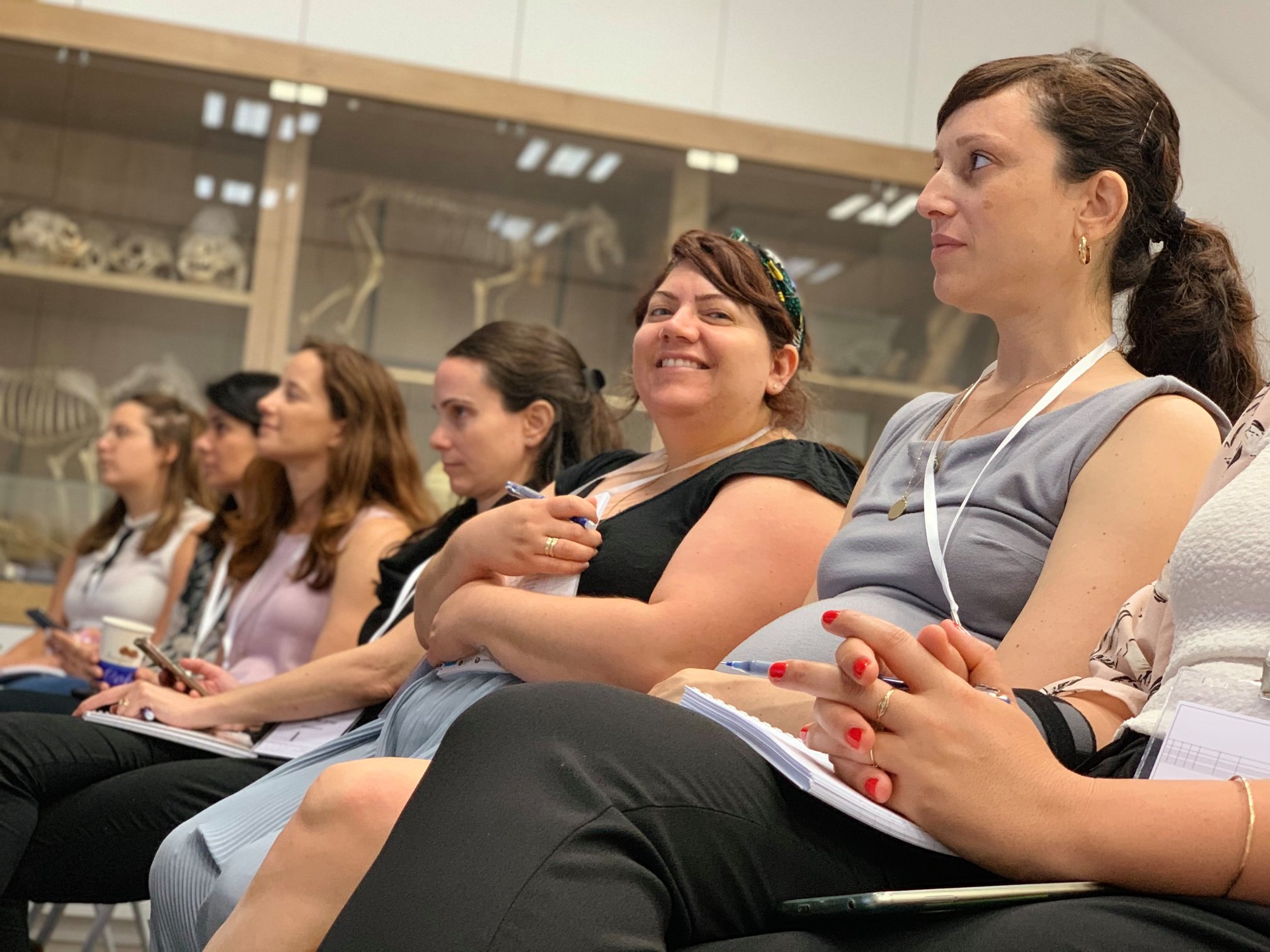
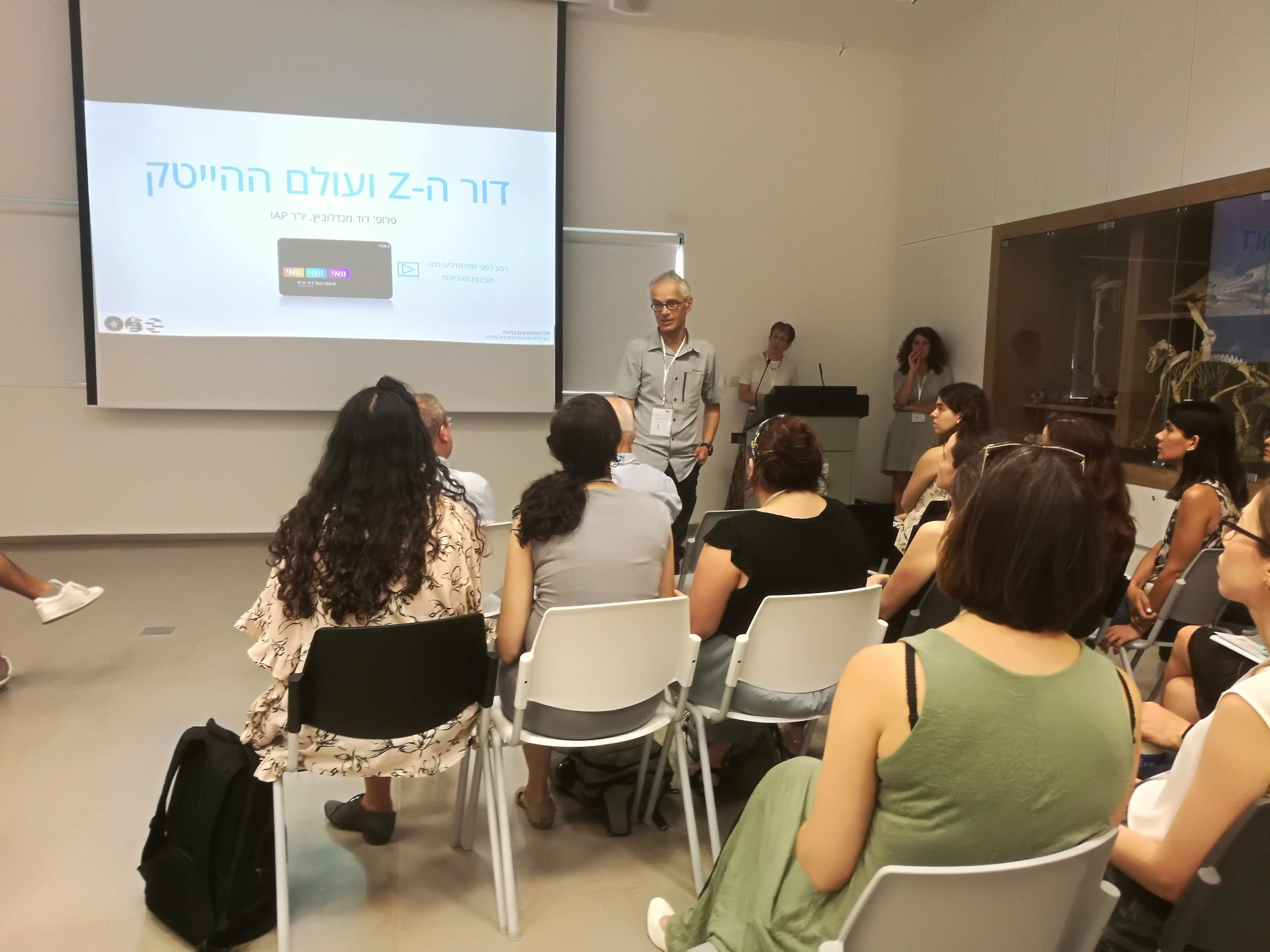
השנה כנס Intelligence 2025 התקיים במוזיאון הטבע ע"ש שטיינהרדט. בכנס נכחו חברי סגל בכירים מאוניברסיטת קליפורניה אירווין בראשותו של דקאן הנדסה באוניברסיטת קליפורניה אירווין - פרופ׳ גרגורי וושינגטון. הכנס אורגן ע"י ארגון עמיתי התעשיה (IAPׂ) של הפקולטה להנדסה והוועדה האקדמית של הכנס הכללה את פרופ׳ שחם ופרופ׳ מנדלוביץ מהפקולטה להנדסה באוניברסיטת תל אביב ופרופ' גרגורי וושינגטון מאוניברסיטת קליפורניה אירווין.

בין אורחי הכבוד - פרופ׳ הנרי סמואלי, מייסד חברת ברודקום, יו״ר לשעבר וכעת מנהל הטכנולוגיות של החברה. פרופ׳ סמואלי הציג את רעיונותיו בדיון מיוחד שנערך בהנחייתו של ד״ר שלמה מרקל, יו״ר רמות, חברת היישום של אוניברסיטת תל אביב וסגן נשיא ברודקום


הכנס השנה יוחד לנושאים הקשורים למערכות חכמות ואוטונומיות ללימוד מכונה ונושאים הקשורים לניתוח בסיס נתונים גדולים (״ביג דאטה״). הדיון נבע מהעובדה שבשנת 2025 יהיה שימוש רב במכונות אוטונומיות ומערכות חכמות. ההתקדמות הרבה בתחום התוכנה, החומרה ושילובם יחד עם לימוד מכונה ובנוסף ההתקדמויות בתחומי התקשורת וההדמיה סוללים כולם ביחד את הדרך למערכות חכמות ו/או אוטונומיות. התקדמות דומה יש בשיטות לניתוח בסיס נתונים גדולים המשפרים את הטיפול במערכות לוגיסטיות מורכבות ועושות את השימוש במערכות אוטונומיות יעיל יותר. שיטות אלו משנות את ההתייחסות של הנדסה בטיפול בבסיסי נתונים גדולים. הכנס טיפל בנושאים בשימושם שונים כגון תחבורה, אנרגיה ורפואה.


בפתיחת הכנס נשאו דברים נשיא אוניברסיטת תל-אביב פרופ׳ קלפטר, דקאן הפקולטה להנדסה באוניברסיטת תל אביב פרופ׳ רוזנוקס, הדקאן האורח פרופ' וושינגטון ופרופ׳ סמואלי. האורחים – חברי סגל, סטודנטים לתארים מתקדמים ואנשי תעשייה, נהנו מ-16 הרצאות מרתקות בתחומים השונים, בהן הרצאות של החוקרים מתל אביב: פרופ׳ שי אבידן (רכב אוטונומי), ד"ר גורן גורדון (מעבדת הסקרנות), ד"ר ארז שמואלי (אבטחת מידע), פרופ׳ עירד בן גל (ביג דאטה), פרופ׳ חיית גרינשפן (ביג דאטה והדמיה רפואית), ד"ר רג׳א ג׳ריס (מערכות אופטיות לומדות), פרופ׳ דוד מנדלוביץ והדוקטורנט מר עידו יובל (תמונת תלת מימד, ממצלמה אחת בלבד).


סיימנו את הכנס בדיון במסגרת פאנל הדן בקשרים עם התעשייה בנוכחות ד״ר שלמה מרקל (סגן נשיא ברודקום ויו"ר רמות), פרופ׳ עירד בן גל (מנכ"ל חברת הסייבר CB4), פרופ׳ אמיר אורבוך (מנכ"ל חברת ThetaRay), מר קובי סלע (מנכ"ל יוניספקטרל) ומר בני קורן (סגן נשיא מלנוקס).


הכנס מהווה עוד נדבך חשוב בבניית הקשרים עם אוניברסיטת קליפורניה אירווין שהנה השותפה הצעירה במערך אוניברסיטאות העילית של קליפורניה והדינמית מכולן.

לינק לתמונות מהכנס

אלה שמתאהבים בבעיה הם אלה שממציאים לה הפתרון

תחרות הפרוייקטים השנתית של חברת Xilinx

15 נובמבר 2018
חברת Xilinx

חברת XILINX היא אחת החברות הגדולות בעולם בתחום של רכיבים מתוכנתים. לחברה יש תכנית לתמיכה באוניברסיטאות, במסגרתה היא עוזרת ומעודדת את השימוש ברכיבים שלה למטרות הוראה. בבית-ספר להנדסת חשמל של הפקולטה להנדסה ישנן 3 מעבדות לימודיות שמבוססות על רכיבי  Xilinx. 


תחרות פתוח עיצוב החומרה של חברת Xilinx נותן לסטודנטים את ההזדמנות כדי להציג את היכולות הטכניות והיצירתיות שלהם. זאת השנה השנייה ברציפות, בה פרויקט של הפקולטה להנדסה זוכה בתחרות, מה שמחזק עוד יותר את שיתוף הפעולה.


על הזוכים והפיתוח

דוד צ'רניאק וליאון בן נדבה, סטודנטים לתואר ראשון,  ביצעו את הפרויקט  " "Automotive Main Control Unitבהנחיתם של יעקב פיינגלרנט וד"ר גבי דוידוב. הפרויקט זכה במקום הראשון בתחרות של חברת Xilinx בקטגוריית הסטודנטים "פתוח עיצוב חומרה" ואף הוזמנו לדאבלין בסוף חודש אוגוסט לטקס הענקת פרס כספי בסך 1500 אירו. בתחרות עצמה השתתפו פרוייקטים מאוניברסיטאות מכובדות באירופה.


דוד וליאון חברים בצוות פרויקט הפורמולה של הפקולטה להנדסה. הם ביקשו לשלב את פרויקט הגמר שלהם עם פעילות רכב הפורמולה והציעו לפתח את כרטיס הבקרה הראשי של הרכב. כרטיס הבקרה הראשי של הרכב, נועד לשלוט על המצערת החשמלית והכנפיים הדינמיות, לאסוף ולעבד נתונים מחיישנים שונים ברכב, ולהעביר את המידע למחשב מרוחק באמצעות Wi-Fi. הפרויקט מהווה בסיס לדגמים עתידיים של רכב הפורמולה.

לתמונות מהתחרות

סמינר מחלקתי אלקטרוניקה פיזיקאלית : Shurik Yatom

22 בנובמבר 2018, 15:00 
פקולטה להנדסה, ביניין כיתות, חדר 011  
סמינר מחלקתי אלקטרוניקה פיזיקאלית : Shurik Yatom

שוריק יתום סמינר


You are invited to attend a lecture


(Selected) Frontiers in plasma science

:By

Shurik Yatom

Princeton University, Princeton Plasma Physics Laboratory

Abstract


Plasma is a partially of fully ionized gas, comprising the 99 % of the visible matter in the universe. The physical plasma is scarce in nature on Earth, however is continuingly gains popularity in the science and technology fields, since being described by Langmuir in 1920s. Currently, multiple directions of plasma related research are prominent in a variety of scientific and technological fields: from the quest for fusion energy, through plasma propulsion for space-travel, to plasma medicine, agriculture and material fabrication and functionalization.  The potential for applications is indeed vast, however so are the scientific challenges that emerge in the context of the above applications. In this talk I will concentrate on two exciting areas: plasma-assisted synthesis of nanomaterials and the plasma interactions with liquids, biological tissues and cells. Both of these research areas are incredibly complex, owing to multiple different interacting species with a wide variety of energies, sizes and chemical potentials, interacting across all the possible phases of matter, from gas to liquid, solid and crystal phases, presenting many exciting physical challenges. Notably, both these areas consider multiphase environment, posing many scientific challenges, such as: large density and temperature, unknown plasma characteristics, the control of the reactivity transfer at the plasma–liquid/solid interface, interfacial charging, droplet transport and self-organization of plasmas in contact with liquid/solid. Similar challenges occur in the interface of plasma with biological tissues and cells. The phenomenon of plasma self-organization into coherent structures and patterns is particularly interesting, because it modulates the characteristics of the plasma, influencing the density and the energy of the charged particles, chemical composition, species transport along and across the plasma-tissue/liquid interface, radiation and electric fields. The aim of this seminar is to introduce these selected frontiers of plasma science, discuss their promise, challenges and the experimental approach to their investigation.

On Thursday, Nov 22, 2018, 15:00

Room 011, Kitot building

עמודים

אוניברסיטת תל אביב עושה כל מאמץ לכבד זכויות יוצרים. אם בבעלותך זכויות יוצרים בתכנים שנמצאים פה ו/או השימוש שנעשה בתכנים אלה לדעתך מפר זכויות
שנעשה בתכנים אלה לדעתך מפר זכויות נא לפנות בהקדם לכתובת שכאן >>