סמינר מחלקה עם המסטרנט ניצן בריסקין

29 בדצמבר 2021, 14:00 - 15:00 
פקולטה להנדסה  
0
סמינר מחלקה של מסטרנט ניצן בריסקין - מודלי נזק התעייפות מבוססי-מיקרומכניקה עבור חומרים מרוכבים שכבתיים.

בנושא: מודלי נזק התעייפות מבוססי-מיקרומכניקה עבור חומרים מרוכבים שכבתיים.


School of Mechanical Engineering Seminar
Wednesday, December 29, 2021, at 14.00

Wolfson Building of Mechanical Engineering, Room 206

Micromechanics-based Fatigue Damage Modeling of Laminated Composite Structures

Nitsan Briskin

M.Sc. student of Prof. Rami Haj-Ali


The increased demand for new advanced composites in aerospace, automotive, civil, and military applications necessitate a predictive fatigue failure framework of composite materials and structures for wide range of multi-axial loadings. While fatigue theories are relatively well-established for homogenous-isotropic materials, most are unsuited for composites. Furthermore, fatigue failure in composites is often associated with several interacting damage modes.

Fatigue experiments can get highly resource-demanding, as a single specimen may need to be tested for up to several weeks. Moreover, a wide experimental effort is needed to enclose the possible different material systems and their constituents, such as fibers, matrices, and lamination stacking sequences. A robust fatigue model is needed in order to deal with these challenges.

This study is aimed to develop a predictive model for fatigue-life, residual stiffness, and residual strength of composite materials and structures, such as plates and shells for aircraft components and other applications. In this research, a homogenized model of the composite material is generated using the Generalized Method of Cells (GMC) for computationally efficient micromechanics-based calculations. A new fatigue model is integrated with GMC by utilizing the Kinetic Theory of Fracture (KTF). The GMC-KTF developed code is integrated within the Abaqus commercial-based FEA. The fatigue cyclic damage modeling is achieved by using a loading history as an input to the FEA-GMC-KTF framework in order to estimate the service-life, residual stiffness, and strength of composite structural components.

The second part of this study is to apply the FEA-GMC-KTF framwork for the post-impact fatigue damage of composites.  Towards that goal, low-velocity impact (LVI) analysis was performed for composite plates.  The proposed fatigue framework predictions agree with the degradation in stiffness with cycles for notched multidirectional laminates. Progressive damage contours can capture the general characteristics of the experimentally observed damage patterns. Finally, preliminary simulations for post-fatigue strength are in good agreement with the limited avilable experimental data.


Join Zoom Meetin https://us02web.zoom.us/j/82108132163?pwd=Z2h4UzNzUS9mbXplT0lMU1pZenFEQT09


סמינר מחלקה של המסטרנטית הדס הוסטר

29 בדצמבר 2021, 14:00 - 15:00 
פקולטה להנדסה  
0
סמינר מחלקה של המסטרנטית הדס הוסטר - רשתות נוירונים מלאכותיות מוטמעות במודל התאים המוכללים המיקרו-מכניים להתנהגות לא לינארית וכשל של חומרים מרוכבים

נושא: רשתות נוירונים מלאכותיות מוטמעות במודל התאים המוכללים המיקרו-מכניים להתנהגות לא לינארית וכשל של חומרים מרוכבים


School of Mechanical Engineering Seminar
Wednesday, December 29, 2021 at 14:00   
Wolfson Building of Mechanical Engineering, Room 206

Hadas Hochster

Msc student of Prof. Rami Haj-Ali


Artificial Neural Networks as Surrogate Models for the PHFGMC Nonlinear Micromechanical and Failure Analysis


Multilayered composites are widely used in the aircraft industry due to their lightweight and high strength.  However, a major disadvantage of these composites is their complex multi‐mode interactive process of failure. In this study, discrete multi-axial failure points of IM7/977-3 unidirectional laminate are generated using the cohesive parametric high-fidelity-generalized-method-of-cells (Cohesive-PHFGMC) micromechanical model. In general, cohesive elements or surfaces are used to model their adhesion and separation according to mixed-mode traction-separation law.  Therefore, the progressive local-global failure initiation and propagation are fully captured.  In the Cohesive-PHFGMC model, cohesive elements are discretely embedded in the matrix phase allowing the damage growth in arbitrary un-specified paths.  The model calibration is based on test data performed for unidirectional coupons. The calibrated Cohesive-PHFGMC model is used to simulate failure under bi-axial loads using refined unit-cells.  The simulated failure points are used to generate continuous failure envelopes for the composite under general multi-axial loading. Predicted failure envelopes are compared to bi-axial experimental results from the literature.  Good results are shown for the new simulated failure envelopes that can be used as an alternative to current composite failure theories and can capture additional modes of failure.


The second part of this study includes using Artificial Neural Networks (ANNs) to capture the multi-axial effective stress-strain responses for the composite based on pre-simulations of finite strain paths by the PHFGMC micromechanical model. The new ANN are examined in their ability to predict the PHFGMC response for stress-strain paths that were not used in the training process. The trained surrogate ANN models are later integrated as material models in the Abaqus commercial FE explicit code.  Low-Velocity Impact (LVI) analyses were conducted using the integrated ANN with 3D-shell layer-by-layer elements. The results are compared to those using standard nonlinear material models.  It is demonstrated that the newly proposed ANN surrogate modeling can be an efficient computational tool for future multi-scale analysis with highly refined models at both the micro and macro scales.


Join Zoom Meetin https://us02web.zoom.us/j/82108132163?pwd=Z2h4UzNzUS9mbXplT0lMU1pZenFEQT09


סמינר מחלקה של המסטרנט דן דוידה - דחיסה קוטרלית של דיסק אניסוטרופי: מחקר אנליטי וניסיוני לאפיון מכני של חומרים מרוכבים של מטריקס קרמי

05 בינואר 2022, 14:00 - 15:00 
פקולטה להנדסה  
0
סמינר מחלקה של  המסטרנט דן דוידה - דחיסה קוטרלית של דיסק אניסוטרופי: מחקר אנליטי וניסיוני לאפיון מכני של חומרים מרוכבים של מטריקס קרמי


School of Mechanical Engineering Seminar
Wednesday, January 5th, 2021, at 14:00

Wolfson Building of Mechanical Engineering, Room 206

Dan Davida
Advisor:  Prof. Rami Haj-Ali


Anisotropic Disk Diametral Compression: Analytical and Experimental Study for Mechanical Characterization of Ceramic Matrix Composites


Composite materials are an integral part of many industries, such as aerospace, rocketry, automotive, sports, etc. One particular class of composites is the Ceramic Matrix Composites (CMC) which excel with their ability to withstand high-temperature conditions without mechanical properties degradation due to their specific strength-temperature ratio.

 The CMC system investigated in this research was made from pyrolyzed 8-harness phenolic carbon-matrix composite followed by Liquid Silicon Infiltration (LSI) manufacturing process.

The main objective of the current study is to analytically and experimentally characterize the mechanical properties of an arbitrary CMC system. Analytical-computational models were proposed and examined using the Parametric High Fidelity Generalized Method of Cells (PHFGMC); a highly accurate and efficient nonlinear micromechanical model.

 The first part of this study deals with the characterization of the mechanical properties of the materials through CT scans and the construction of a PHFGMC model in order to create a Repeating unit cell (RUC) that allows for micromechanical analysis, as well as developing a model reduction algorithm using two different methods.

Next, a fully analytical solution of an anisotropic diametrically compressed disk has been developed based on an adaptation of Lekhnitskii's anisotropic elasticity solution. The solution was verified and compared to finite element analysis. In addition, the analytical solution was used in inverse-type mechanics to extract elastic properties from experimental tests conducted on the CMC using the digital image correlation (DIC) method. 

A dedicated setup for the diametrical compression disks setup was manufactured and used along with DIC, which provided the full-field strains needed to compare with the analytic solution and iterate to find the CMC's effective properties. The PHFGMC and the analytical and experimental methods are shown to be effective tools to simulate and characterize the linear elastic properties of CMCs. They can be extended to nonlinear and failure of CMCs.

Zoom Meetin https://us02web.zoom.us/j/82108132163?pwd=Z2h4UzNzUS9mbXplT0lMU1pZenFEQT09 Join

סמינר מחלקה של יגאל גלוזמן - קוויטציה ודינאמיקה של בועות בדלק תעופה

29 בנובמבר 2021, 14:00 - 15:00 
פקולטה להנדסה  
0
סמינר מחלקה של יגאל גלוזמן - קוויטציה ודינאמיקה של בועות בדלק תעופה


SCHOOL OF MECHANICAL ENGINEERING SEMINAR
Monday November 29, 2021 at 14:00
Wolfson Building of Mechanical Engineering, Room 206


Cavitation and bubble dynamics in aviation fuels

Dr. Igal Gluzman

 Department of Aerospace and Mechanical Engineering, University of Notre Dame, Indiana, USA.


Cavitation in the aircraft fuel systems can lead to unexpected material degradation and damage to fuel-system components. Thus, it is important to be able to accurately model fuel cavitation inception, bubble growth, and collapse. This is challenging due, in part, to the fact that fuels are a complex mixture of hundreds of hydrocarbons and additives. Furthermore, the dissolved gas content in fuels is affected by their storage history, and gaseous cavitation often occurs. This study is focused on the fundamental understanding of cavitation inception, shock wave generation mechanisms, and nonspherical bubble dynamics interactions in aviation fuels via rigorous experimental studies and modeling efforts.

First, the shock wave generation and propagation mechanisms in aviation fuel cavitation are characterized in a generic converging-diverging nozzle geometry. We provide unprecedented quantitative data on shock wave emission and propagation characteristics via a novel high-speed image processing technique we term "enhanced gradient shadowgraphy." It is shown that two sustained independent mechanisms are responsible for shock wave generation in the choked flow regime. We obtain nonlinear solutions of the governing equations for nonbarotropic homogeneous flow to predict shock speeds. Good agreement is obtained with the newly acquired experimental data.

Second, a novel approach is presented for extracting quantitative data via computer vision algorithms from non-intrusive high-speed imaging techniques applied to the quantification of the bubble spatial-temporal evolution, breakup kinematics, and cavitation inception mechanisms in aviation fuels. It is shown that the initial bubble size plays an essential role in the resulting void fraction variation after the breakup, but not in the breakup kinematics. We also define a unique dimensionless parameter that allows the prediction of the bubble breakup event for different fuels and flow regimes.

Lastly, we present a new model to predict cavitation collapse in radial flow between two parallel disks with a thin gap which represents a geometry highly relevant to aviation fuel pumps and their operating conditions. A spatial Rayleigh-Plesset equation was derived and adapted to model the bubble collapse in the disk geometry. Our model prediction shows remarkable agreement with our experimental data. Results from our study shed light on the complex physics of fuel cavitation and the dynamics of a group of nonspherical cavities


Bio:
Dr. Igal Gluzman is a Postdoctoral Research Associate in the Department of Aerospace and Mechanical Engineering at the University of Notre Dame (2020-present). Prior to that, he was a Postdoctoral Fellow in the Department of Mechanical Engineering at Johns Hopkins University (2018–2020). He received his Ph.D. (2017) from the Faculty of Aerospace Engineering at the Technion – Israel Institute of Technology and both M.Sc. (2013) and B.Sc. (2011) from the Department of Mechanical Engineering at Ben-Gurion University. His research interests include cavitation and bubble dynamics (in aviation fuels), transitional and turbulent boundary layers, flow control (low-order system modeling), smooth body flow separation, and non-isothermal multi-phase turbulence. In his research, he employs interdisciplinary approaches from dynamical systems, signal processing, computer vision tools, and estimation theory.

Join Zoom Meeting https://us02web.zoom.us/j/82108132163?pwd=Z2h4UzNzUS9mbXplT0lMU1pZenFEQT09

ד"ר אינס צוקר

השפעת מיקרופלסטיק על תאי הגוף

Communication Algorithm Engineer


לאתר החברה של אלביט בנתניה דרוש.ה מהנדס.ת פיתוח אלגוריתמיקה - משרת סטודנט.ית​


דרישות:

  • דוקטורנטים/ בוגר תואר שלישי במדעים מדויקים ( הנדסת חשמל / מדעי המחשב / פיזיקה / כימיה / מתמטיקה )
  • ניסיון בסימולציה בסביבת MATLAB / C
  • ניסיון בפיתוח אלגוריתמי תקשורת - חובה
  • רצון ויכולת להתפתח ולהתמחות בתקשורת ספרתית ועיבוד אותות
  • יכולת עבודה עצמאית ובצוות


מהנדס.ת פיתוח אלגוריתמיקה - משרת סטודנט.ית


לאתר החברה של אלביט בנתניה דרוש.ה מהנדס.ת פיתוח אלגוריתמיקה - משרת סטודנט.ית​


דרישות:

  • בשלבים מתקדמים של תואר שני / שלישי במדעים מדויקים ( הנדסת חשמל / הנדסת מחשבים / מדעי המחשב / מתמטיקה )
  • ניסיון מעשי בסימולציה בסביבת MATLAB
  • רצון ויכולת להתפתח ולהתמחות בתקשורת ספרתית ועיבוד אותות
  • יכולת עבודה עצמאית ובצוות
  • יתרון לבעלי ניסיון קודם בפיתוח אלגוריתמי תקשורת


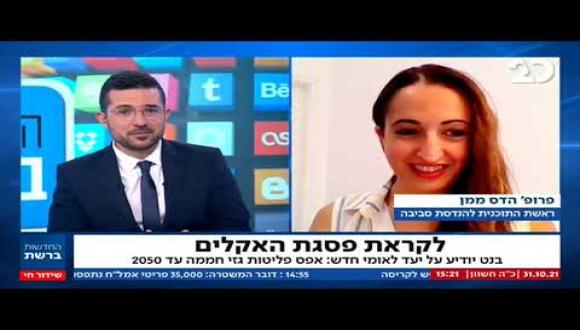
פרופ' הדס ממן

לקראת פסגת האקלים 2021

חוקר.ת מוביל.ה לקבוצת מחקר בתחום תקשורת ו-ML


דרישות

  • בעל.ת תואר שני עם תיזה בנושא רלוונטי
  • תקשרות מחשבים (TCP, Routing), ML, 5G.
  • שפות תכנות רלוונטיות: C++, Python, Matlab.


סמינר מחלקה של רז אגרון - "אפיון קרעים חלקיים ברצועה הצולבת בברך באמצעות אנליזות אלמנטים סופיים"

15 בדצמבר 2021, 14:00 - 15:00 
פקולטה להנדסה  
0
סמינר מחלקה של רז אגרון -  "אפיון קרעים חלקיים ברצועה הצולבת בברך באמצעות אנליזות אלמנטים סופיים"


School of Mechanical Engineering Seminar
Wednesday, December 15, 2020 at 14:00   
Wolfson Building of Mechanical Engineering, Room 206


Characterization of partial knee ACL tears using finite element analysis


Raz Agron
M.Sc. student of Dr. Mirit Sharabi, Prof. Rami Haj-Ali and Dr. Mustafa Yasin

The Anterior Cruciate Ligament (ACL) is one of the four knee ligaments responsible for stabilizing the joint's Anterior-Tibial Translation (ATT). ACL tear is one of the most common sports injuries, with approximately 37 ACL-related surgeries for every 100,000 people annually due to ACL tears. Many partial tears to the ligament can go undetected as long as their effect on knee laxity is minor.  Preliminary detection of ACL tears and Anterior-Tibial laxity (ATL) is commonly done by hand using the Lachman test (an anterior knee laxity examination). Advanced diagnostics involve MRI, CT, arthroscopy, among others.  The ACL tears are treated by using an autograft solution, e.g., Patellar tendon, Hamstring tendon. These “Gold Standard” ACL replacements and repairs yield good but not ideal results.  

This biomechanical study deals with partial ACL tears.  Characterization and classification of tear types and sizes are performed based on tear locations in the longitudinal and transverse ligament directions.  This is performed computationally by modeling the Lachman test using a specialized finite element model (FEM) to predict the effect of ACL tears on ATT.  The FEM model was built by modifying and extending the knee-joint three-dimensional (3D) open-source model, Open-Knee, developed by SimTK.  The current modified knee-joint model is able to include ACL tears with additional new material and mechanical features.  To that goal, joint parts were edited, and select remeshing of the tissues was conducted to accurately simulate the mechanical interactions between the parts.  Hyperelastic constitutive model was used for the soft tissue of the knee.  The Lachman test examination procedure was then simulated based on the GNRB testing system and validated by comparing the model with clinical test results. Next, different tears to the ACL were introduced in the model and varied by location and size to investigate their effect on the ATL of the joint. Results show that differences in size and tear location indeed produce different detectable levels of ATT, however not necessarily detectable by hand. Therefore, the model can help better characterize partial ACL tears and provide an incentive to implement instrument-based Lachman tests. Thus, help advance a more accurate preliminary diagnosis of partial tears to the ACL.


Join Zoom Meetin https://us02web.zoom.us/j/82108132163?pwd=Z2h4UzNzUS9mbXplT0lMU1pZenFEQT09

עמודים

אוניברסיטת תל אביב עושה כל מאמץ לכבד זכויות יוצרים. אם בבעלותך זכויות יוצרים בתכנים שנמצאים פה ו/או השימוש שנעשה בתכנים אלה לדעתך מפר זכויות
שנעשה בתכנים אלה לדעתך מפר זכויות נא לפנות בהקדם לכתובת שכאן >>