Inception and evolution of attached and shear layer intermittent cavitation : 20.5.20

20 במאי 2020, 14:00 - 15:00 
בניין וולפסון 206  
0
Inception and evolution of attached and shear layer intermittent cavitation : 20.5.20

~~
"ZOOM" SEMINAR
Wednesday May 20th , 2020
Inception and evolution of attached and shear layer intermittent cavitation
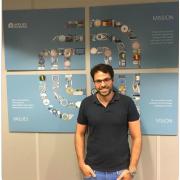
Dr. Omri Ram
Department of Mechanical Engineering, Johns Hopkins University, Baltimore, MD, USA


~~~~Cavitation adversely affects the performance and efficiency of pumps, propellers, and turbines, causing erosion, significantly increased noise levels, and, in extreme cases, complete system failure. Even so, there is limited knowledge of the mechanisms underlying the inception of cavitation and how its evolution is influenced by the surrounding flow field. Experimentally probing the flow in the inception regime is an ongoing challenge due to the extremely fast growth and collapse of bubbles, as well as complex bubble-bubble and bubble-flow interactions. Accordingly, we used a combination of high-speed imaging and highly resolved flow measurements to study the inception of attached cavitation near curved smooth surfaces and shear-layer cavitation behind a back-facing step. In both cases, cavitation was instigated when free-stream nuclei approached locations where there was minimum pressure. On curved surfaces, isolated attached cavities formed intermittently, prior to quickly collapsing into microbubbles. We found that in cases characterized by high adverse pressure gradients (downstream of the pressure minimum), some of the microbubbles randomly migrated upstream and laterally inside the low momentum zone of the thickened boundary layer. Some of these microbubbles eventually cavitated, acting as a prominent source of new cavitation. This explains how attached cavitation can become relatively insensitive to the free-stream nuclei population – a phenomenon that has been well recognized but previously unexplained. In shear layers, cavitation incepts as elongated vapor strings in the core of quasi-streamwise vortices, forming intermittently between the primary spanwise vortices. Accordingly, we conducted time-resolved volumetric flow measurements to characterize the temporal evolution of the quasi-streamwise vortices and to calculate the pressure in and around them for the first time. Statistical analysis of the data showed that quasi-streamwise vortices were more likely to be stretched axially compared to the rest of the sample volume, and pressure minima are more likely to be located and last longer there. These trends become more pronounced as the Reynolds number increases, offering an explanation for why high Reynolds number flows are more susceptible to cavitate (recorded in previous studies).                                                                                                                                                                                                                                                                                                                                                                                                                      
Bio: Omri Ram is a Postdoctoral Fellow in the Laboratory for Experimental Fluid Dynamics at the Department of Mechanical Engineering at Johns Hopkins University, since 2017. He earned his BSc (2011), MSc (2013), and PhD (2017) degrees from the Department of Mechanical Engineering at Ben-Gurion University of the Negev in Beer-Sheva. His research expertise includes: attached and shear layer cavitation, how shock and blast waves interact with porous media, shock-wave reflection phenomena, pollutant dispersion in aquatic environments, and the development of experimental methods in fluid mechanics.                                                      
 

התגייסו לסיוע לסטודנטים שנקלעו לקשיים כלכליים עקב המצב

05 מאי 2020

בוגרות ובוגרים יקרים,
 
ראשית אני מקווה ששלומכם ושלום יקירכם איתן וכולם בבריאות טובה.
 
כבוגרי הפקולטה להנדסה באוניברסיטת תל אביב, רצינו לשתף אתכם במצב המיוחד שבו נמצאים חלק לא מבוטל מתלמידינו.
 
מי כמוכם יודע שלימודים באוניברסיטה בכלל ובפקולטה להנדסה בפרט, הם תובעניים מאד, הן מצד ההשקעה המנטלית והן מצד העול הפיננסי. משבר הקורונה שהתרגש ובא עלינו יצר למספר לא מבוטל של תלמידים בפקולטה מצב לא פשוט. מחד, ערוצי ההשתכרות שלהם כתלמידים נחסמו, ומאידך ההוצאות, לרבות שכר לימוד ושכר דירה, ממשיכות כרגיל. תמיכה מההורים בהרבה מקרים הפכה למסובכת שכן רבות מהמשפחות בארץ נקלעו למשבר פיננסי משמעותי.
 
לצד התמיכה שמציעה האוניברסיטה לכלל הסטודנטים אנו בהנהלת הפקולטה ובארגון בוגרי הנדסה, החלטנו להקים קרן לתמיכה בתלמידים שהמצוקה שלהם עלולה להרחיק אותם מספסל הלימודים. במסגרת פרויקט "אמץ סטודנט", אנו שואפים לאסוף תרומות מבוגרי הפקולטה ובעזרתם להעניק מלגות גישור בסך של 2,500 ש"ח למלגה, לאותם תלמידים שוועדת המלגות תמצא אותם מתאימים.
 
בפקולטה לומדים למעלה מ-4,000 תלמידים, ובהנחה שלפחות 100 מתוכם מצויים במצב כלכלי קשה במיוחד, נזדקק לגייס 250,000 ש"ח. עוד לפני שיצאנו בהכרזה רשמית על יוזמה זו, הצלחנו לגייס כ-80,000 ש"ח, ואנו מאוד מקווים שנוכל לעמוד ביעד המצופה.
 
כל תרומה תתקבל בתודה גדולה ובידיעת התורם שבצד המקבל נמצא תלמיד, שנתון במצוקה כלכלית אמיתית ותמיכה זו יכולה לשנות את נתיב חייו. התרומה תהיה מוכרת לזיכוי במס ככל תרומה אחרת לאוניברסיטת תל אביב.
 
תודה על שיתוף הפעולה ובתקווה לבריאות שלמה ולחזרה מהירה לשגרה.


שלכם

פרופ' יוסי רוזנוקס

דקאן הפקולטה להנדסה


לינק לתרומה: https://ed2020.forms-wizard.biz/users/new


                                                לעוד חברים שלנו >>

EE ZOOM Seminar: Best Buddies Registration For Point Clouds

13 במאי 2020, 11:00 
ZOOM  

השתתפות בסמינר תיתן קרדיט שמיעה = עפ"י רישום שם מלא + מספר ת.ז.  בצ'אט

Join Zoom Meeting
https://zoom.us/j/97758431884?pwd=eDYxT1ZGdk1BSHZ4cjdhbE0xREk0UT09

Meeting ID: 977 5843 1884

Password: 843294

Speaker: Tal Dimry

M.Sc. student under the supervision of Prof. Shai Avidan and Dr. Raja Giryes


Wednesday, May 13th, 2020 at 11:00 AM

Best Buddies Registration For Point Clouds

Abstract

We propose a new loss function for the point clouds registration problem. The loss is based on the Best Buddies Similarity (BBS) measure that counts the number of mutual nearest neighbors between two point clouds. This measure has been shown to be robust to outliers and missing data in the case of template matching for images. BBS is not differentiable, because it involves a nearest neighbor search, and we overcome this by using a differentiable approximation that is based on the soft argmin operator. This allows us to perform gradient descent using existing neural network optimization tools.

We explore two variants of our loss function. One with a very large basin of convergence and one with a narrower basin but with high accuracy. Combining the two leads to an efficient and accurate registration of two point clouds without requiring any pre- or post-registration steps. We also show that our loss can use the normals of the points, if they are available, to further improve accuracy. Exper- iments on various data sets, both synthetic and real, demonstrate the effectiveness of our approach.


Mixed Mode Fracture Behavior of a Multi-Directional Plain Weave Composite - an Interface Delamination Between a 0◦/90◦ and a +45◦/-45◦ Weave

17 ביוני 2020, 14:00 - 15:00 
בניין וולפסון 06  
Mixed Mode Fracture Behavior of a Multi-Directional Plain Weave Composite - an Interface Delamination Between a 0◦/90◦ and a +45◦/-45◦ Weave

~~

PhD "ZOOM" SEMINAR
Wednesday, June 17, 2020 at 14:00
Mixed Mode Fracture Behavior of a Multi-Directional Plain Weave Composite - an Interface Delamination Between a 0◦/90◦ and a +45◦/-45◦ Weave
Orly Dolev
Ph.D. candidate under the supervision of Professor Leslie Banks-Sills

Currently, the advantages of composite materials, such as high strength and toughness to weight ratios, corrosion and fatigue resistance, make these materials very desirable to work with, especially in the aerostructure industry. However, composite structures are sensitive to the presence of damage such as delamination, which is one of the most typical failure modes in laminate composites. The main problem is that most of composite structural damage is difficult to detect or follow. The lack of accurate and reliable fracture toughness, fatigue and damage tolerance properties, which enable the evaluation of damage growth within a structure, results in an over-designed structure due to the high safety margin regulations. In order to better understand the mixed mode I/II fracture (initiation and propagation) behavior of a carbon/epoxy multi-directional (MD) woven composite containing a delamination between two plain woven plies, with tows in the 0◦/90◦ and +45◦/-45◦ directions, a comprehensive investigation has been performed, involving analytical, numerical and experimental work.
Mixed-mode fracture toughness tests were carried out on an MD laminate making use of the Brazilian disk (BD) specimen, containing a delamination, at various loading angles in order to obtain a wide range of mode mixities. Employing the experimentally and numerically obtained results at fracture, a two and three-dimensional failure criterion were generated. A statistical analysis with a 10% probability of unexpected failure and a 95% confidence was performed, in order to account for scatter in the results. These failure criteria may be used for safer design purposes for the investigated interface.
Fracture toughness tests for delamination initiation and propagation under quasi-static loading were carried out making use of three beam-type specimens: double cantilever beam (DCB), calibrated end-loaded split (C-ELS) and mixed mode end-loaded split (MMELS), with the following modes of deformation: nearly mode I, nearly mode II and one in-plane mixed mode ratio, respectively. Based upon the experimentally and numerically obtained results, a fracture toughness resistance G_iR-curve was generated, for each kind of beam-type specimen. In addition, the critical values of the interface energy release rate for initiation G_ic and steady-state propagation G_iss were determined.
Quantification of the critical energy release rate G_ic values obtained for delamination initiation in all tested specimens, as a function of the in-plane mode mixity, was presented and discussed.

Join Zoom Meeting
https://zoom.us/j/4962025174
The meeting will be recorded and made available on the School’s site.

ד״ר עלית אופנהיים מנהלת מכון שלמה שמלצר לתחבורה חכמה באוניברסיטת תל אביב

03 מאי 2020
איך תראה מהפכת התחבורה החכמה ביום שאחרי הקורונה?

מכון שלמה שמלצר לתחבורה חכמה, מעלה תהיות ויפעל לקידום מחקרים יישומיים שיעסקו בשאלות מחקר כגון האם נאמץ תרבות ארגונית של עבודה מהבית? האם נוותר על הרכב הפרטי ונשתמש בתחבורה ציבורית? מה יעלה בגורל התחבורה השיתופית? 

 כל זאת ועוד ניתן לקרוא כאן

EE ZOOM Seminar: EEG Source Localization Using Compressed Measurements and the Fabrication of an Anisotropic Phantom Head Model

06 במאי 2020, 15:00 
ZOOM  

השתתפות בסמינר תיתן קרדיט שמיעה = עפ"י רישום שם מלא + מספר ת.ז.  בצ'אט

Join Zoom Meeting
https://us04web.zoom.us/j/79530182251
Meeting ID: 795 3018 2251

Speaker: Tal Mund

M.Sc. student under the supervision of Prof. Alex Bronstein


Wednesday, May 6th, 2020 at 15:00

        ZOOM  Seminar


EEG Source Localization Using Compressed Measurements and the Fabrication of an Anisotropic Phantom Head Model

Abstract

One of the greatest challenges of modern-day science community is understanding how our brain functions. In a human head, a neural activity is usually modeled as a current dipole activation with a specific position and orientation. Brain imaging techniques such as EEG, MEG, fMRI etc. are used to evaluate the neural activities location, orientation and magnitude. One can study the spatiotemporal behavior of the head’s neural circuits using these techniques. However, for us to better understand how our brain works, we need to collect a vast amount of data. One of the main advantages of EEG is its portability, since competing imaging techniques such as fMRI and MEG are stationary. A mobile EEG device can continually collect data from research subjects as they perform their everyday tasks. By compressing the EEG measurements, the hardware requirement of a portable EEG device is reduced, which in turn makes it cheaper and lighter. Hence getting closer to a portable EEG device. In this work, the possibility of using a compressed set of EEG measurements was simulated and analyzed. In addition, a phantom mimicking the electromagnetic properties of the human head is presented. A phantom head is considered an essential validation step between computer simulations and the data processing of EEG recordings on humans. The fabrication is based on 3d-printing technology combined with an electrically conductive gel. The novel key features of the phantom are the controllable anisotropic electrical conductivity of the skull and the densely packed monopolar current sources permitting interpolation of the measured gain function to any dipolar current source position and orientation within the head.


EE Seminar: Using artificial neural networks for Echo-based object classification & reconstruction

04 במאי 2020, 15:00 
 

השתתפות בסמינר תיתן קרדיט שמיעה = עפ"י רישום שם מלא + מספר ת.ז.  בצ'אט

Join Zoom Meeting
https://zoom.us/j/95381960872?pwd=bEVvNjYxOUNNRzN3Q20vWHY4SENTdz09
Meeting ID: 953 8196 0872
Password: 012254

Speaker: Netanel Frank

M.Sc. student under the supervision of Prof. Anthony Weiss and Prof. Yossi Yovel


Monday, May 4th, 2020 at 15:00

         ZOOM


Using artificial neural networks for Echo-based object classification & reconstruction

Abstract

Our understanding of sonar-based sensing is very limited in comparison to light based imaging. In this work, we synthesize a ShapeNet variant in which echolocation replaces the role of vision. A new hypernetwork method is presented for 3D reconstruction from a single echolocation view. The success of the method demonstrates the ability to reconstruct a 3D shape from bat-like sonar, and not just obtain the relative position of the bat with respect to obstacles. In addition, it is shown that integrating information from multiple orientations around the same view point helps performance.

The sonar-based method we develop is analog to the state-of-the-art single image reconstruction method, which allows us to directly compare the two imaging modalities. Based on this analysis, we learn that while 3D can be reliably reconstructed form sonar, as far as the current technology shows, the accuracy is lower than the one obtained based on vision, that the performance in sonar and in vision are highly correlated, that both modalities favor shapes that are not round, and that while the current vision method is able to better reconstruct the 3D shape, its advantage with respect to estimating the normal's direction is much lower.


עמודים

אוניברסיטת תל אביב עושה כל מאמץ לכבד זכויות יוצרים. אם בבעלותך זכויות יוצרים בתכנים שנמצאים פה ו/או השימוש שנעשה בתכנים אלה לדעתך מפר זכויות
שנעשה בתכנים אלה לדעתך מפר זכויות נא לפנות בהקדם לכתובת שכאן >>