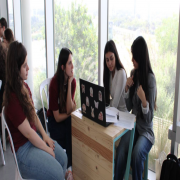
#ארגון_בוגרי_הנדסה ממשיך בפינת #הכר_את_המהנדס.ת והפעם, הכירו בוגר הפקולטה להנדסת מכונות אור מאיו!

אור מתנדב כמנטור בתכנית המנטורינג שלנו, בוגר תואר ראשון בהנדסת מכונות, ומהנדס פיתוח בחברת V-Wave!

אור מספר לנו קצת על מהלך הקריירה שלו:

את הקשר עם הנדסה התחלתי במגמת הרובוטיקה בתיכון, כסטודנט עבדתי כעוזר מחקר במעבדה למכניקת השבר ולאחר מכן השתלבתי במשרת סטודנט בחברת V-Wave, סטרט-אפ מיכשור רפואי המפתח שתלים לטיפול בחולי אי-ספיקת לב. עם סיום הלימודים, הפכתי למהנדס פיתוח בחברה.

מה ההצלחה המקצועית הגדולה ביותר שלך לטעמך?

רישום כאחד הממציאים בבקשת פטנט מסוג provisional על טכנולוגיה פורצת דרך בתחום המכשור הרפואי, לפני גיל 28.

ספר לנו על רגע מכונן שחווית בזמן הלימודים

קבלת תעודת "ציון לשבח" עבור אב טיפוס מצטיין במסגרת תערוכת פרויקטי הגמר של בית הספר להנדסה מכנית.

הפרויקט בוצע אצל ד"ר סיגל פורטנוי בשיתוף הפקולטה לרפואה.

https://engineering.tau.ac.il/Engineering-Faculty...

מה היית מייעץ למהנדס.ת צעיר.ה בתחילת דרכו.ה?

אני מאמין גדול בכך שחיפוש עבודה הוא תהליך אקטיבי, וכדי לצלוח אותו צריך לגלות יוזמה, אחריות ורצינות.

ממליץ להשתמש בפלטפורמת הלינקדאין כדי לפנות למעסיקים ולנסות לטרגת את הדמויות הנכונות בחברה שבה אתם מעוניינים לעבוד.

מה החוויה הכי מעניינת שקרתה לך במקום העבודה?

הייתה לי ההזדמנות לטוס לארה"ב על מנת להשתתף בניסויים בחיות בהם הושתלו השתלים שפיתחתי כצעד מקדים להשתלות בבני אדם.

חוויה מלמדת ומיוחדת מאוד

ספר לנו משהו עליך שרק מעטים יודעים

בזכות עצומה שהקמתי בזמן הלימודים, הצלחתי לגייס שני ראשי עיר ונציגים של משרד התחבורה להקים קו אוטובוס חדש שקיצר משמעותית את זמני ההגעה שלי לאוניברסיטה, ועד היום משרת רבים שרוצים להגיע מבקעת אונו לתחנת הרכבת.

מהי עבודת החלומות שלך?

פיתוח מיכשור רפואי שיקל על חולים ויעזור להציל חיים

לשמחתי, החברה בה אני עובד מגשימה את החלום הזה.

אם לא היית מהנדס, מה היית?

לא מסוגל לדמיין תרחיש כזה

איך תכנית המנטורינג השפיעה עליך אז כמנטי והיום כמנטור?

בזכות המנטור שלי אבי לוגאסי שידרגנו את פורמט קורות החיים, סימלצנו ראיונות עבודה וקיבלתי טיפים לחיים שאני לוקח עד היום...

לכל מי שרוצה לקבל עוד טיפים ולהתייעץ עם אור , מוזמן.ת להתחבר אליו בלינקדין:

https://www.linkedin.com/in/or-mayo/


סמינר מחלקה של פרופ' ניר גוב - הגיאומטריה של קבלת החלטות בקולקטיבים וביחידים

19 באפריל 2023, 14:00 - 15:00 
פקולטה להנדסה  
0
סמינר מחלקה של פרופ' ניר גוב - הגיאומטריה של קבלת החלטות בקולקטיבים וביחידים


School of Mechanical Engineering Seminar
Wednesday April 19.4.2023 at 14:00

Wolfson Building of Mechanical Engineering, Room 206

"The geometry of decision-making in collectives and individuals"

Prof. Nir Gov

Department of Chemical and Biological Physics

Weizmann Institute of Science

Rehovot, Israel


Choosing among spatially distributed options is a central challenge for animals, from deciding among alternative potential food sources or refuges to choosing with whom to associate. We present a spin-based model that describes the decision-making process while the animal is moving through space and assessing the different options. Using an integrated theoretical and experimental approach (employing immersive virtual reality), we test the predicted interplay between movement and vectorial integration during decision-making regarding two, or more, options in space.  The theoretical model reveals the occurrence of spontaneous and abrupt “critical” transitions, whereby organisms spontaneously switch from averaging vectorial information to suddenly excluding one among, the remaining options. Experiments with fruit flies, desert locusts, and larval zebrafish reveal that they exhibit these same bifurcations, demonstrating that across taxa there exist fundamental geometric principles that determine how, and why, animals move the way they do.


Short bio:

Phd in theoretical physics at the Technion (low-temperature quantum mechanics) 1998

Postdoc at the U of Illinois Urbana-Champaign, QM

Postdoc in Weizmann, Bio-phys.

PI in weizmann since 2004

My research team and I have been developing theoretical models for various phenomena in biology that involve many interacting units, from the collective migration of cells within a body to collective motion of animals within a group. In addition we study the dynamics of cell shapes, cell migration and general non-equilibrium physics.


Join Zoom Meeting


https://tau-ac-il.zoom.us/j/86497933118

סמינר מחלקה של בנימין דוידוביץ - איך בועות צמיגות קורסות: חור הצצה להידרודינמיקה גיאומטרית-לא ליניארית וטופולוגית-לא טריוויאלית

19 ביוני 2023, 14:00 - 15:00 
פקולטה להנדסה  
0
סמינר מחלקה של בנימין דוידוביץ - איך בועות צמיגות קורסות: חור הצצה להידרודינמיקה גיאומטרית-לא ליניארית וטופולוגית-לא טריוויאלית


School of Mechanical Engineering Seminar
Wednesday 14.06.2023 at 14:00

Wolfson Building of Mechanical Engineering, Room 206


How viscous bubbles collapse: a peephole into geometrically-nonlinear & topologically-nontrivial hydrodynamics


Dr. Benny Davidovith

Phd from the Weizmann Institute


Floating viscous bubbles whose interior gas is rapidly depressurized exhibit a fascinating instability, whereby radial wrinkles permeate the liquid film in the course of its flattening (Debregeas et al, Science 1998; DaSilviera et al., Science 2000, Oratis et al., Science 2020). We show that this instability emerges from a largely unexplored type of Stokes hydrodynamics, that is geometrically-nonlinear flow of curved films of a viscous, volumetrically-incompressible liquid. This theoretical framework highlights profound similarities and differences between the mechanics of elastic sheets and viscous films, revealing experimental observations as a universal, curvature-driven surface dynamics, imparted by viscous resistance to temporal variations of the surface's Gaussian curvature. This novel surface dynamics has close ties to the kinetics of first-order phase transitions and to  ``Jelium physics" in continuum media, where topological defects, akin to localized charges in electrostatic media, spontaneously emerge to screen stress within the film.  


Benny Davidovith received his Ph.D. in 2001 from the Weizmann Institute, where he worked on fractal growth problems. After holding a postdoc position in ExxonMobil and an applied math lectureship at Harvard, he joined in 2007 the physics department at UMass Amherst, where he's now a full professor. He received NSF CAREER award in 2011 and was a Simons fellow in 2015. His current research interests include instabilies in continuum media and the interplay between mechanics and geometry in thin bodies of solids and liquids.     


Join Zoom Meeting https://tau-ac-il.zoom.us/j/86497933118


קולוקוויום: Colloquium: Fiber-optic Distributed and Quasi-Distributed Acoustic Sensing (DAS and Q-DAS) by Avishay Eyal

16 באפריל 2023, 15:00 
206 בנין וולפסון - מכנית  
קולוקוויום: Colloquium: Fiber-optic Distributed and Quasi-Distributed Acoustic Sensing (DAS and Q-DAS) by Avishay Eyal


Electrical Engineering Colloquium 


Speaker: Prof. Avishay Eyal

Title: Fiber-optic Distributed and Quasi-Distributed Acoustic Sensing (DAS and Q-DAS)


Abstract 

An optical fiber can be described as a glass pipeline which can guide light over great distances with very little loss. In addition to being the central communication channel of the information era, it has another very interesting application. This application is called distributed sensing. By launching into the fiber specially designed pulse sequences of light and analyzing their reflections from different positions along the fiber, it is possible to measure various physical parameters such as temperature, strain and acoustic signals at these positions. During recent years the use of fiber-optic Distributed Acoustic Sensing (DAS) or Quasi Distributed Acoustic Sensing (Q-DAS) systems has become ubiquitous for a variety of applications. Distributed optical fiber sensors are particularly attractive for marine applications. Facilitating long haul sensing or communications systems in the underwater arena is challenging not only due to the need for underwater compatible sensors but also since conventional wireless communication techniques cannot be used to transmit the measured signals. Distributed fiber-optic sensors perform both tasks with the same medium. In the colloquium I will describe techniques that we have developed in our lab for increasing the bandwidth and sensitivity of DAS and Q-DAS systems and will present results of underwater sensing and underwater acoustic communications.


Light refreshments will be served before the lecture

This colloquium is not counted toward seminar credit.

ההרצאה לא מזכה בקרדיט שמיעת סמינרים.

Special Colloquium: "FAST AND FLEXIBLE MULTIAGENT DECISION-MAKING" - Professor Naomi E. Leonard

30 באפריל 2023, 15:00 
011 Electrical Engineering-Classrooms  
Special Colloquium:  "FAST AND FLEXIBLE MULTIAGENT DECISION-MAKING" -  Professor Naomi E. Leonard


Electrical Engineering Colloquium 


Speaker: Professor Naomi E. Leonard, Department of Mechanical and Aerospace Engineering, Director, Council on Science and Technology, Princeton University


Prof. Leonard is a MacArthur Fellow, an elected member of the American Academy of Arts and Sciences, and winner of the 2023 IEEE Control Systems Award.
 

Title: FAST AND FLEXIBLE MULTIAGENT DECISION-MAKING


Abstract: I will present new theory and methodology for understanding and designing fast and flexible decision-making behavior for a group of agents that observe or communicate over a network. Our model-free theory shows how agreement and disagreement behaviors that capture real-world multiagent decision-making emerge through a bifurcation in which indecision is destabilized. To realize and study these behaviors, we define analytically tractable dynamics that are equivalent to classic linear opinion dynamics with a saturation applied to the exchanges of opinion states. We prove the role of network structure in the bifurcation point, the post-bifurcation opinion patterns, and the sensitivity of the bifurcation to the distribution of inputs over the network. With the additional coupling of state-feedback dynamics for the attention agents pay to their observations, the model admits tunably fast and flexible network behavior in the face of changing environmental conditions. I will demonstrate with applications to multi-robot teams.


This is joint work with Anastasia Bizyaeva and Alessio Franci and based on the papers:

https://ieeexplore.ieee.org/document/9736598   

https://arxiv.org/abs/2206.14893

https://arxiv.org/abs/2210.01642


Short bio: Naomi Ehrich Leonard is Edwin S. Wilsey Professor of Mechanical and Aerospace Engineering and associated faculty in Applied and Computational Mathematics at Princeton University.  She is also Director of Princeton’s Council on Science and Technology and Founding Editor of the Annual Review of Control, Robotics, and Autonomous Systems. She received her BSE in Mechanical Engineering from Princeton University and her PhD in Electrical Engineering from the University of Maryland.  She is a MacArthur Fellow, elected member of the American Academy of Arts and Sciences, and winner of the 2023 IEEE Control Systems Award. Leonard is Fellow of SIAM, IEEE, IFAC, and ASME.  Her current research focuses on dynamics, control, and learning for multi-agent systems on networks with application to multi-robot teams, collective animal behavior, and other networked systems in nature, technology, and the arts. 


Light refreshments will be served before the lecture

This colloquium is not counted toward seminar credit.

ההרצאה לא מזכה בקרדיט שמיעת סמינרים.

סמינר LMI -מרכז אור וחומר מארח את Prof. Prineha Narang

04 באפריל 2023, 13:00 
הפקולטה להנדסה אוניברסיטת תל אביב, בנין כיתות ,אולם 011  
 סמינר  LMI -מרכז אור וחומר מארח את Prof. Prineha Narang


LMI Seminar:

"Ab initio approaches to correlated light-matter interactions“

Prof. Prineha Narang

University of California, Los Angeles

Tuesday  April  4th,  2022

13:00-14:00

Light refreshments and drinks will be served at 12:30

Auditorium 011, Engineering Classroom Building,  Faculty of Engineering, Tel-Aviv University


Abstract: In this talk, I will present a pedagogical introduction of theoretical and computational approaches to describe excited-states in quantum matter, and predicting emergent states created by external drives. Understanding the role of such light-matter interactions in the regime of correlated electronic systems is of paramount importance to fields of study across condensed matter physics and ultrafast dynamics1. The simultaneous contribution of processes that occur on many time and length-scales have remained elusive for state-of-the-art calculations and model Hamiltonian approaches alike, necessitating the development of new methods in computational physics. I will discuss our latest results at the intersection of ab initio cavity quantum-electrodynamics and electronic structure methods to treat electrons, photons and phonons on the same quantized footing, accessing new observables in strong light-matter coupling. Current approximations in the field almost exclusively focus on electronic excitations, neglecting electron-photon effects, for example, thereby limiting the applicability of conventional methods in the study of polaritonic systems, which requires understanding the coupled dynamics of electronic spins, nuclei, phonons and photons. With our approach we can access correlated electron-photon and photon-phonon dynamics2–7, essential to our latest work on driving quantum systems far out-of-equilibrium to control the coupled electronic and vibrational degrees-of-freedom 8–20. In the second part of my talk, I will demonstrate how the same approach can be generalized in the context of control of molecular quantum matter and quantum transduction. As a first example, I will discuss a cavity-mediated approach to break the inversion symmetry allowing for highly tunable even-order harmonic generation (e.g. second- and fourth-harmonic generation) naturally forbidden in such systems. This relies on a quantized treatment of the coupled light-matter system, similar to the driven case, where the molecular matter is confined within an electromagnetic environment and the incident (pump) field is treated as a quantized field in a coherent state. When the light-molecule system is strongly coupled, it leads to two important features: (i) a controllable strong-coupling-induced symmetry breaking, and (ii) a tunable and highly efficient nonlinear conversion efficiency of the harmonic generation processes 21–23. Both of these have implications for molecular quantum architectures. Being able to control molecules at a quantum level gives us access to degrees of freedom such as the vibrational or rotational degrees to the internal state structure. Finally, I will give an outlook on connecting ideas in cavity control of molecules with quantum information science.


עמודים

אוניברסיטת תל אביב עושה כל מאמץ לכבד זכויות יוצרים. אם בבעלותך זכויות יוצרים בתכנים שנמצאים פה ו/או השימוש שנעשה בתכנים אלה לדעתך מפר זכויות
שנעשה בתכנים אלה לדעתך מפר זכויות נא לפנות בהקדם לכתובת שכאן >>