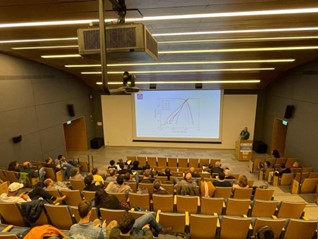
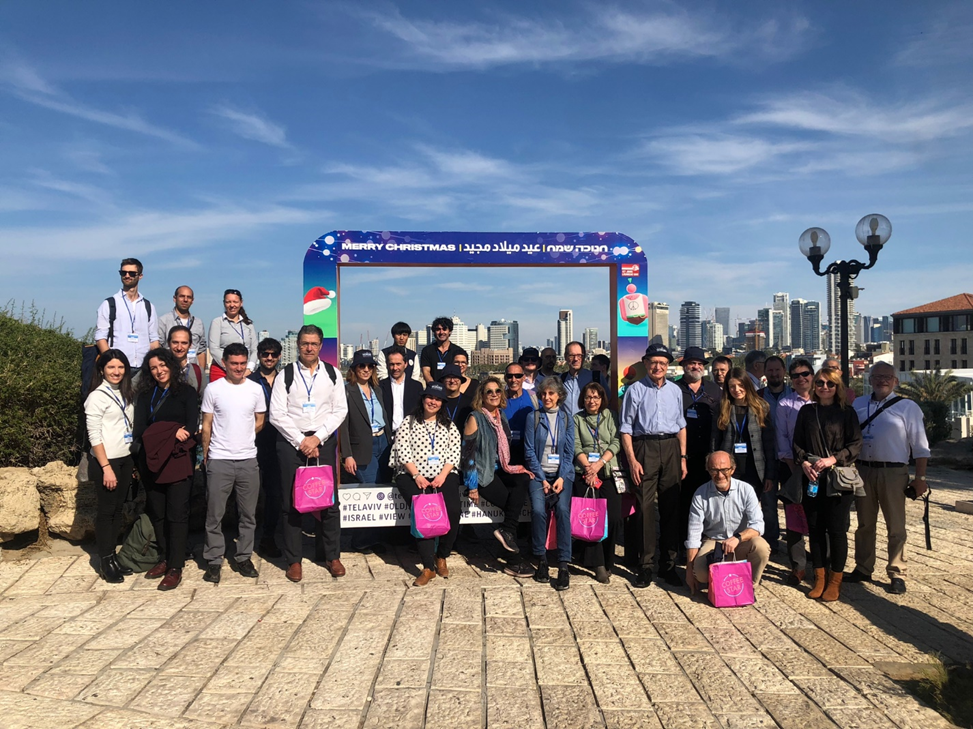
יום פרויקטים המחלקה להנדסת תעשייה

06 ביוני 2022, 11:00 
בניין ברודקום  
יום פרויקטים המחלקה להנדסת תעשייה

11:00-14:00 הצגת פרויקטים: 
בניין תוכנה: 008, 010    
בניין דן-דוד: 101, 106
 
14:00-15:00 הפסקת צהריים
פטיו ומבואה בניין ברודקום


15:00-16:00 סיכום וברכות ראש מחלקה פרופ' טל רביב, פרופ' ערן טוך ופאנל אורחים 
אולם 001 בניין ברודקום 


SW Project Delivery Manager

What’s in it for you?
You will work in a multi-disciplinary organization with many challenges related to integration between SW and other areas (e.g. Computing, System , HW, Application)
You will work in an organization who is open and embrace new initiatives and ideas. 
You will work in a super pleasant organization , who puts the employee first

QA strategy leader

What’s in it for you?
•    Working in a challenging and interesting environment.
•    Working with the latest technologies and hardware.
•    Working in a learning and supportive environment.
•    The ability to understand and learn low-level of technologically.
•    The ability to learn and evolve on a personal level.
•    The ability to challenge and find weaknesses based on our developments and hardware we work with.

סמינר מחלקה של שניר אייזיק - התקדמות דלמינציה בהתעייפות באריג מחומר מרוכב רב כיווני – מוד מעורב

02 בנובמבר 2022, 14:00 - 15:00 
פקולטה להנדסה  
0
סמינר מחלקה של שניר אייזיק - התקדמות דלמינציה בהתעייפות באריג מחומר מרוכב רב כיווני – מוד מעורב


School of Mechanical Engineering Seminar
Wednesday, November 2, 2022 at 15:00
Wolfson Building of Mechanical Engineering, Room 206


Fatigue delamination propagation in a multi-directional woven composite–mixed mode deformation


Snir Aizen

M.S.c student of Prof. Leslie Banks-Sills

School of Mechanical Engineering


Composite materials are used in a variety of industries including automotive, medical, and aerospace. Advantages of composite include high strength to weight and high toughness to weight ratios. Thus, lighter aircraft may be produced, for example, which reduces fuel consumption. In particular, composites are used as laminates which consist of a number of plies, either unidirectional or multi-directional. One of the common types of damage which occurs in a laminate structure is the separation of two plies which is called a delamination. This investigation focuses on a delamination between two plain woven carbon fiber-epoxy plies fabricated from the prepreg G0814/913. The upper ply of the interface has yarn in the 0°/90° - directions and the lower ply has yarn in the +45°/-45° - directions.

Nearly pure mode I and mixed-mode delamination propagation tests were carried out using double cantilever beam (DCB) and mixed mode end loaded split (MMELS) specimens, respectively. Both quasi-static and fatigue delamination propagation tests were performed.  The mode mixity, taken as the energy release rate of mode II, GII, to the total energy release rate, GT, was about 0.43 for the MMELS specimens. Delamination propagation resistance curves, for both mode I and one mixed mode ratio, GiR, where i represents interface, were determined using the quasi-static test results and finite element analyses. Each ply in the finite element model was assumed to be linear elastic, anisotropic and homogenous. The mechanical properties of each ply were homogenized. The energy release rate, G, was calculated by means of the virtual crack closure technique (VCCT) using the finite element results. The fracture resistance toughness curves were compared with results from previous studies and showed good correlations.

The rate of delamination propagation in fatigue was found using the Paris equation and DCB beam specimens for nearly pure mode I with a cyclic displacement ratio Rd = 0.1. For a mode mixity of about 0.43, the rate of delamination propagation was found using MMELS beam specimens with Rd = 0.1 and 0.5. Using the fatigue data from the DCB and MMELS specimens, three master curves were obtained: a master curve for the DCB specimens, a master curve for the MMELS specimens, and a master curve for all the specimens together. It was found that for the DCB specimens, the slope of the Paris equation, as well as the delamination propagation rate, were the highest. Finally, the delamination propagation rate was back-calculated from the master curves for each specimen. Those values were then compared to the values calculated from the Paris equation for each specimen. The back-calculation was found to be more accurate when the master curve has only one mode mixity i.e. nearly pure mode I or mixed mode.


Join Zoom Meeting

https://tau-ac-il.zoom.us/j/4962025174?pwd=bVJUeElXRUUya3BERisyNllLOE9EZz09


סמינר מחלקה של ישראל סולומון - קידום סדק יציב בזכוכית סודה ליים

26 באוקטובר 2022, 14:00 - 15:00 
פקולטה להנדסה  
0
סמינר מחלקה של ישראל סולומון - קידום סדק יציב בזכוכית סודה ליים


School of Mechanical Engineering Seminar
Wednesday, October 26, 2022 at 14:00
Wolfson Building of Mechanical Engineering, Room 206


Stable crack propagation in Soda lime glass


Israel Solomon

M.Sc. student of prof. Dov Sherman


This research presents the development of a new method to cleave brittle amorphous materials. The loading in the new method is displacement controlled, resulted, presumably, with stable crack propagation under pure Mode I. The main goal of this method is to study the difference between stable crack propagation in materials possessing long-range order atomistic arrangement (typical for brittle crystals), and that in short-range order (typical for amorphous glasses) along the crack front.  The second goal was to evaluate the cleavage energy at initiation for stable cracks propagation.

Surprisingly, the cracks were propagated unstably, macroscopically, at very low speed. No initiation, propagation, and arrest cycles were observed, owing to the amorphous arrangement at the crack front. Evaluations of the energy release rate (ERR) by the J-integral of static and frictional contact boundary value problem (BVP) finite element analysis (FEA) of amorphous soda-lime glass, were performed. The new macroscopic experimental parameter representing the strain energy release rate gradient, Q, was incorporated and was used to show the lower and upper limits for the initial preload. In addition, this new parameter was used to determine whether the crack preloading conditions are leading to correct fracture related properties.


Join Zoom Meeting

https://tau-ac-il.zoom.us/j/4962025174?pwd=bVJUeElXRUUya3BERisyNllLOE9EZz09


יום פתוח מקוון לתואר שני

15 ביוני 2022, 9:00 
ZOOM  
יום פתוח לתואר שני

ב-15 וב-16 ביוני יתקיים יום פתוח מקוון לתואר שני באוניברסיטת תל אביב. 


זאת ההזדמנות להכיר את תוכניות התואר השני שלנו מקרוב, לדבר עם החוקרות והחוקרים, עם הבוגרות והבוגרים, ולשאול את כל השאלות במפגשים של תוכניות הלימוד שמעניינות אותך.


לכל המפגשים ולהרשמה מראש > 

סמינר מחלקה של דר' קרלוס פורטלה - "מכניקה של חומרים ארכיטקטוניים על פני טווחי אורך וזמן"

08 ביוני 2022, 15:00 - 16:00 
פקולטה להנדסה  
0
סמינר מחלקה של דר' קרלוס פורטלה - "מכניקה של חומרים ארכיטקטוניים על פני טווחי אורך וזמן"


School of Mechanical Engineering Seminar
wednesday, June 8, 2022, at 15:00
Wolfson Building of Mechanical Engineering, Room 206

“Mechanics of Architected Materials Across Length and Time Scales”

Dr. Carlos Portela, MIT (USA)

The lecture is supported by MIT - Israel - MIT-Lockheed Martin Seed Fund


A screenshot of a cell phone

Description automatically generatedArchitected materials have been ubiquitous in nature, enabling unique properties that are unachievable by monolithic, homogeneous materials. Inspired by natural processes, human-made three-dimensional (3D) architected materials have been reported to enable novel mechanical properties such as high stiffness-to-density ratios or extreme resilience, increasingly so when nanoscale size effects are present. However, most architected materials have relied on advanced additive manufacturing techniques that are not yet scalable and yield small sample sizes. Additionally, most of these nano- and micro-architected materials have only been studied in the static regime, leaving the dynamic parameter space unexplored.

In this talk, we discuss advances in our understanding of architected materials by: (i) proposing numerical and theoretical tools that predict the behavior of architected materials with non-ideal geometries, (ii) presenting a pathway for scalable fabrication of tunable nano-architected materials, and (iii) exploring the response of nano- and micro-architected materials under three types of dynamic loading. We first explore the mechanics of lattice architectures with features at the micro- and millimeter scales, an

discuss the effect of nodes (i.e., junctions) to obtain more accurate computational and theoretical predictive tools. Going beyond lattices, we propose alternative node-less geometries that exhibit extreme mechanical resilience, and we harness self-assembly processes to demonstrate a pathway to fabricate one type in cubic-centimeter volumes while maintaining nanoscale features. Lastly, we venture into the dynamic regime by designing, fabricating, and testing micro-architected materials that exhibit vibrational band gaps in the MHz regime as well as nano-architected materials with extreme energy absorption upon microparticle supersonic impact.


BIO


Carlos Portela is the d’Arbeloff Career Development Professor in Mechanical Engineering at MIT. Dr. Portela received his Ph.D. and M.S. in mechanical engineering from the California Institute of Technology, where he was given the Centennial Award for the best thesis in Mechanical and Civil Engineering, and he received degrees in Aerospace Engineering (B.S.) and Physics (B.A.) from the University of Southern California. His current research lies at the intersection of materials science, mechanics, and nano-to-macro fabrication with the objective of designing and testing novel materials—with features spanning from nanometers to centimeters—that yield unprecedented mechanical and acoustic properties. Dr. Portela’s recent accomplishments have provided routes for fabrication of these so-called ‘nano-architected materials’ in scalable processes as well as testing nanomaterials in real-world conditions such as supersonic impact. Present application areas in Dr. Portela’s group involve the creation of novel lightweight armor materials, ultrasonic devices for medical purposes, and new generations of highly resilient structural materials. Dr. Portela is a recipient of the 2022 NSF CAREER Award, the 2019 Gold Paper Award from the Society of Engineering Science (SES), and his work has been featured in The National Nanotechnology Initiative Supplement to the President’s 2020 Budget (National Science and Technology Council).


Join Zoom Meeting

 https://us02web.zoom.us/j/82108132163?pwd=Z2h4UzNzUS9mbXplT0lMU1pZenFEQT09

איך לייצר מודעות ארגונית יעילה עבור התמודדות מול מתקפות דיוג?

26 במאי 2022, 12:00 
בניין וולפסון, חדר 206  
איך לייצר מודעות ארגונית יעילה עבור התמודדות מול מתקפות דיוג?

הסמינר יועבר ע״י דורון הילמן, סטודנט לתואר שני במחלקה להנדסת תעשייה, אוניברסיטת תל אביב. 

​ניתן לצפות גם דרך הזום

Abstract:

AEmployees frequently fall victim to Phishing attacks, putting themselves and their organizations at risk. As a response, organizations today invest time, resources, and their employees’ efforts into training and recognizing simulating Phishing attacks. However, the effectiveness of these efforts in real-world enterprise organizations is still widely unknown. To close this gap, we conducted a controlled experiment in an Israeli financial institution with about 5000 employees, including three Phishing simulation emails, and investigated how various variables affect the Phishing click-through rate (CTR).
Our results indicate that employees are more likely to click on personal-phrasing Phishing simulation emails, and organizations should promote skills that increase their employees’ capability to choose (boosting) rather than providing persuasive information (nudging). Furthermore, organizations should focus less on the timing of awareness activities and more on tailoring them to different departments. This can be used to offer guidelines to Chief Information Security Officers (CISOs) on how to build effective Phishing organizational awareness to prevent Phishing attacks.

Bio:

Doron Hillman is an MSc student at the Department of Industrial Engineering at Tel Aviv University, specializing in Data Science. Doron holds a BSc degree in Industrial Engineering, specializing in information systems, from Ben-Gurion University. In the past few years, Doron has been leading cyber-security products from a technical and analytical perspective. His research focuses on organizational cyber-security awareness to prevent Phishing attacks.
This work was conducted under the supervision of Prof. Eran Toch collaborated with Dr. Yaniv Harel.


סמינר מחלקה של נאור צדוק - אופטימיזציה של מודלים זרימה ותגובה ללכידת מאפייני פיצוץ סלולרי בשלבי גז בתערובות מעורבות מראש

01 ביוני 2022, 14:00 - 15:00 
פקולטה להנדסה  
0
סמינר מחלקה של נאור צדוק - אופטימיזציה של מודלים זרימה ותגובה ללכידת מאפייני פיצוץ סלולרי בשלבי גז בתערובות מעורבות מראש

SCHOOL OF MECHANICAL ENGINEERING SEMINAR

Wednesday, June 1, 2022 at 14:30

Wolfson Building of Mechanical Engineering, Room 206

Optimization of Flow and Reaction Models for Capturing Gas-Phase Cellular Detonation Properties in Premixed Mixtures

Naor Zadok

M.Sc. student of Dr. Yoram Kozak

Detonation is a type of combustion wave involving a supersonic exothermic front that drives a shock wave. This process creates very high pressure and temperature gradients, and releases vast amounts of energy in short time periods. In particular, gas-phase detonations in premixed fuel and oxidizer mixtures are characterized by unsteady and unstable behavior, which can involve complex cellular structures.

It is today well-established that detonation properties for a given gaseous mixture, such as the detonation wave speed and the typical cellular patterns, are vital for various engineering applications. For instance, development of highly efficient detonation-based engines and improved safety measures for fuel storage facilities.

The ability to predict the behavior of gas-phase detonation waves via numerical simulations can assist the development of the above-mentioned applications. However, typical detonation simulations are multidimensional and involve complex chemistry reaction mechanisms. This leads to extremely high computational costs per simulation, and significantly limits the number of possible simulations. Simplified single-step reaction models allow performing these simulations with a considerably lower computation cost, and therefore more simulations can be conducted in a given time.

In the present study, we will develop a new numerical framework that can efficiently calibrate flow and simplified single-step reaction models to mimic detonation properties derived by detailed chemical mechanisms. This framework is based on an evolutionary algorithm coupled with a set of non-linear algebraic equations for detonation properties. We will also present a new model that can predict the detonation cell length and width for single-step reaction multidimensional detonation simulations. This model will allow us tuning and optimizing the flow and reaction rate parameters based on experimental detonation cell size data for any given premixed mixture.

In the future, we intend to utilize the proposed framework for conducting multidimensional reactive flow simulations of different novel energy conversion and propulsion systems.

Join Zoom Meeting https://us02web.zoom.us/j/82108132163?pwd=Z2h4UzNzUS9mbXplT0lMU1pZenFEQT09


עמודים

אוניברסיטת תל אביב עושה כל מאמץ לכבד זכויות יוצרים. אם בבעלותך זכויות יוצרים בתכנים שנמצאים פה ו/או השימוש שנעשה בתכנים אלה לדעתך מפר זכויות
שנעשה בתכנים אלה לדעתך מפר זכויות נא לפנות בהקדם לכתובת שכאן >>