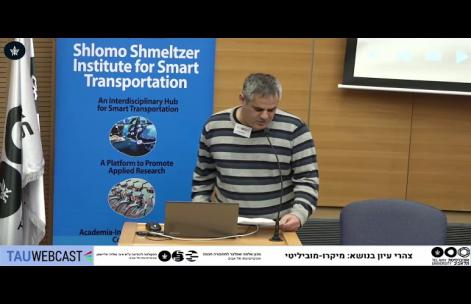
EE Seminar: Deformable Shape Completion with Graph Convolutional Autoencoders

07 במרץ 2018, 15:00 
חדר 011, בניין כיתות חשמל  


Speaker: Or Litany

Ph.D. student under the supervision of Prof. Alex Bronstein


Wednesday, March 7th, 2018 at 15:00
Room 011, Kitot Bldg., Faculty of Engineering

Deformable Shape Completion with Graph Convolutional Autoencoders


Abstract


The availability of affordable and portable depth sensors has made scanning objects and people simpler than ever. However, dealing with occlusions and missing parts is still a significant challenge. The problem of reconstructing a (possibly non-rigidly moving) 3D object from a single or multiple partial scans has received increasing attention in recent years. In this work, we propose a novel learning-based method for the completion of partial shapes. Unlike the majority of existing approaches, our method focuses on objects that can undergo non-rigid deformations. The core of our method is a variational autoencoder with graph convolutional operations that learns a latent space for complete realistic shapes. At inference, we optimize to find the representation in this latent space that best fits the generated shape to the known partial input. The completed shape exhibits a realistic appearance on the unknown part. We show promising results towards the completion of synthetic and real scans of human body and face meshes exhibiting different styles of articulation and partiality.

EE Seminar: Collaborative Time of Arrival (CToA)

30 באפריל 2018, 15:00 
חדר 011, בניין כיתות חשמל  

(The talk will be given in English)


Speaker:     Dr. Ofer Bar Shalom
                    INTEL 


Monday, April 30th, 2018
15:00 - 16:00

Room 011, Kitot Bldg., Faculty of Engineering


Collaborative Time of Arrival (CToA) 


Abstract


Collaborative time of arrival (CToA) is a time-delay based geolocation protocol, designed for taking the user capacity of IEEE802.11/Wi-Fi-based, geolocation systems to the extreme. The protocol is broadcast-based and leverages the IEEE802.11 fine timing measurements (FTM) capabilities, enabled in state-of-the-art Wi-Fi chip-sets to support two concurrent operation modes: the “client-mode” enables “GPS-like” operation indoors, and allows an unlimited number of clients to estimate their position and navigate indoors, without exposing their presence in the network. The “network-mode” is designed for large-scale asset-tracking and big-data analytics applications and enables a network positioning server to pinpoint and track the location of thousands of Wi-Fi-enabled objects, where the capacity is limited mostly by the server's processing capabilities. 


The presentation will cover the principles of the protocol and the mathematical background of the position estimation algorithms. In addition, theoretical analysis of the expected positioning accuracy and real-life system performance examples will be provided. A whitepaper describing the protocol is available on IEEE Mentor. 


Bio

Ofer Bar-Shalom received his B.Sc. in mechanical engineering and his M.Sc. and Ph.D. in electrical engineering in 1997, 2001, and 2015 (respectively), all from Tel-Aviv University. He has been involved in cellular and wireless connectivity systems development for over 20 years. Currently, he is a researcher with Intel's Location Core Division.

 

עמודים

אוניברסיטת תל אביב עושה כל מאמץ לכבד זכויות יוצרים. אם בבעלותך זכויות יוצרים בתכנים שנמצאים פה ו/או השימוש שנעשה בתכנים אלה לדעתך מפר זכויות
שנעשה בתכנים אלה לדעתך מפר זכויות נא לפנות בהקדם לכתובת שכאן >>