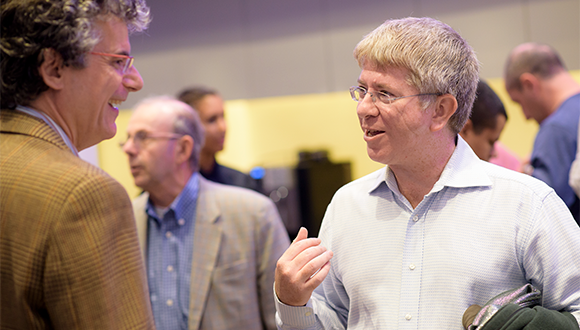
Structures and Their Analysis

14 יוני 2016

ברכות חמות למשה פוקס, על פרסום ספרו : Structures and Their Analysis

it is available on http://link.springer.com/book/10.1007%2F978-3-319-31081-7 .

Customer can order it via http://www.springer.com/in/book/9783319310794

EE Seminar: Game Theoretic Tools for Resource Allocation in Wireless Communication Networks

~~
Speaker: Ilai Bistritz,
M.Sc. student under the supervision of Prof. Amir Leshem and Prof. Hagit Messer - Yaron

Wednesday, June 29th, 2016 at 15:00
Room 011, Kitot Bldg., Faculty of Engineering

Game Theoretic Tools for Resource Allocation in Wireless Communication Networks

Abstract

We consider the problem of distributed channel allocation in large networks under the frequency-selective interference channel. Performance is measured by the weighted sum of achievable rates, when treating interference as noise. We propose two non-cooperative random game formulations for this problem, and analyze their Nash equilibria probabilistically and asymptotically in the number of players. While the first game is natural, we show that it suffers from asymptotically poor performance, when interference is sufficiently strong. The second game uses a slight modification of the utility function of the first. We show that all its Nash equilibria have asymptotically close to optimal performance, for any interference regime and for a broad class of fading distributions. In order to exploit these results algorithmically we propose a modified Fictitious Play algorithm that can be implemented distributedly without any communication between the players or any central entity.

29 ביוני 2016, 15:00 
חדר 011, בניין כיתות-חשמל  

16/6/16


Fast Antenna Diagnosis Algorithm Using

Oblate Spheroidal Non-Uniform Grids

Alexander Gergel

Ph.D. student of

Professor Amir Boag of Electrical Engineering, Physical Electronics Department

Reconstruction of the radiating fields or equivalent currents on a closed surface enclosing a radiating body, also termed source imaging, is a widely used method in antenna diagnostics for estimating inaccuracy of antenna fabrication or localizing antenna malfunction.  The Rayleigh-Sommerfeld (RS) formulation with incoming wave Green function is used in this work to enable the back-propagation from the scalar field measurement on a planar surface.  This method provides a good approximation for the field back-propagated from the measurement plane towards the source, though, due to truncation errors, it is suitable mostly for the metrology of directional arrays or large reflector antennas.  Direct evaluation of the discretized back-propagation RS integral is characterized by a computational complexity (CC) of , where  (  being the radius of the smallest sphere circumscribing the measurement domain and  - the wavenumber).  For radiating surfaces that are very large compared to the wavelength, this computational bottleneck renders this approach unattractive.  Significant reduction of the CC down to  is achieved using a modified version of the multilevel non-uniform grid (MLNG). The MLNG technique is based on a hierarchical divide-and-conquer strategy.  The partial contributions to the field integral by subdomains of the geometry are phase- and amplitude-compensated to allow for their sampling over coarse non-uniform grids.  The partial fields can be reconstructed from their samples via interpolation followed by the phase and amplitude restoration.

In order to choose the most suitable non-uniform sampling scheme, we conduct a study comparing various sampling and interpolation schemes.  As a representative example, a test case parabolic reflector with a localized surface distortion is analyzed.  The ideal reflector surface can be defined analytically in spherical and oblate-spheroidal coordinate systems, thus in both we can provide on-surface 2D grids.  The efficiency of these grids is compared to the regular volumetric MLNG scheme.  The comparison between the source distribution, reconstructed from the simulated measurements, and the desired one is used for the localization of anomalies.  The quality of the localization is measured in terms of location and contrast.  The performance of the proposed algorithm under each of the grid topologies is studied in terms of accuracy, storage requirements, and run-time.


Thursday, June 16, 2016, at 15:00

Room 011, Kitot Building


16 ביוני 2016, 15:00 
011 Kitot  
16/6/16


EE Seminar: Unified Functional Framework for Restoration of Image Sequences Degraded by Atmospheric Turbulence

~~
Speaker: Naftali Zon
M.Sc. student under the supervision of Prof. Nahum Kiryati

Wednesday, June 22nd, 2016 at 15:00
Room 011, Kitot Bldg., Faculty of Engineering

Unified Functional Framework for Restoration of Image Sequences Degraded by Atmospheric Turbulence

Atmospheric turbulence between the scene and the camera degrades image quality. Diverse algorithms estimate the latent image from an image sequence of a static scene. The flow of these algorithms reflects various concepts, but their theoretical foundations are not sufficiently clear. Recent algorithms have yielded dramatic progress, yet many aspects of the problem remain challenging and hard to understand. The goal of this thesis is to analyze recent turbulence restoration algorithms and to suggest a unified variational framework to address the turbulence restoration problem. A unified functional quantifies the association between a given image sequence and a candidate latent image restoration. Minimizing the functional using advanced numerical methods leads to a general algorithmic flow. I show that various known algorithms can be derived as special cases of the general approach. Furthermore, I show that building-blocks used in turbulence recovery algorithms, such as optical flow estimation and blind deblurring, are called for by the general model. The main contribution of this thesis is the establishment of a unified theoretical framework for the restoration of turbulence-degraded images. It leads to novel turbulence recovery algorithms as well as to better understanding of known ones. Along the way we develop a state of the art method for general-purpose blind deconvolution and a novel method for optical flow estimation.


22 ביוני 2016, 15:00 
חדר 011, בניין כיתות-חשמל  

Avimi Annie סמינר מחלקתי בית הספר להנדסה מכאנית

27 ביוני 2016, 15:00 
וולפסון 206  
0
Avimi Annie סמינר מחלקתי בית הספר להנדסה מכאנית


School of Mechanical Engineering Seminar
Monday, june 27, 2016 at 15:00
Wolfson Building of Mechanical Engineering, Room 206


Rod and shell-like structures for biomedical applications


Annie Ruimi, Ph. D.

Department of Mechanical Engineering

Texas A&M University at Qatar, Doha (Qatar)


Over the last 20 years, advances in computer techniques have penetrated the medical profession leading to an explosion of new procedures or devices to improve patient diagnosis and treatment. Large US research institutions and training hospitals (i.e. Massachusetts General Hospital, Stanford, Harvard) have taken part in these efforts and are offering simulation trainings to their residents. Still, simulations that can realistically reproduce the complexity of surgical scenarios remain a challenge.

In this talk, I will give an overview of two of my research programs funded by the Qatar Foundation with direct applications in medicine.

The first program seeks to develop physics-based tools to model the dynamic deformation of surgical filaments in the form of an interactive real-time software. That is meant to enhance-not replace the traditional methods used to train medical residents in the art of suturing and knotting, known as being particularly challenging. The filament is modeled as a one dimensional rod-like structure that coils in space in addition to bend and twist. We investigated four techniques, three based on mechanics principles and the other based on the Viterbi algorithm (VA) originally developed by the information signal community for problems related to text strings. We concluded that the discrete variational integrator (DVI) method was superior to the others in that it could capture the plectoneme formation, i.e. the looping of the thread onto itself as well as being able to simulate knot-tying using true physics principles.

             The second program uses a thin, elastic and orthotropic cylindrical shell structure to model the three layers of the aorta, the largest artery in the body that acts as conduit to drive blood away from the heart. The blood flow is pulsatile in nature and if the shear stresses resulting from the interaction between the fluid and the walls exceed a certain critical value, it causes a tear of the inner layer resulting in a weaker wall. This cardiovascular phenomenon is referred as aortic dissection and may lead to death if the patient is not quickly attended. Non-linear mechanics tools that combine analytical and finite element models are employed to investigate the large deformations and buckling of the human aorta when subjected to specific flow-pressure conditions. When the aorta is diseased, aorta replacement in the form of a Dacron prosthesis may be advised.


13/6/16

You are invited to attend a lecture


Snapshot Spectral Imaging Using a Digital Camera with an Optical Diffuser and Compressed Sensing Algorithms


By


Jonathan Hauser

M.Sc. student of

Professor Michael Golub and Professor Menachem Nathan

Physical Electronics Department, Tel Aviv University


Spectral Imaging (SI) systems are designed to capture the spatial and spectral information of an object or a scene, which is referred to generally as "data cube" or "spectral cube". There is a strong link between the spectrum, physical state and components of matter. Accordingly, SI systems are practical in various fields such as medicine, agriculture, food inspection, military and homeland security, as well as in various academic research fields related to physics, chemistry, biology, geography, engineering and more.

Many of the SI systems that exist in the industry are based on scanning techniques, are quite complicated and require long spectral cube acquisition time. Snapshot Spectral Imaging (SSI) systems aim to capture the spectral cube with a single snapshot, thus eliminating the need of scanning the spatial and/or spectral space of the scene. Known SSI systems are generally complex and expensive in terms of their electrical, optical and mechanical implementation.

The aim of this study is to realize a working prototype of a compact SSI system based on a standard monochromatic digital camera, a single thin optical diffuser and a computational unit. The diffuser is a transparent phase element, which is designed to fulfill Compressed Sensing (CS) mathematical conditions that enable the spectral cube reconstruction from a single "shot".

The achieved results show, for the first time, feasibility proof for successful restoration of a full spectral cube, from a snapshot taken with a monochromatic image sensor in a relatively simple CS-SSI system.


Monday, June 13, 2016, at 09:00

Room 011, Kitot Building

13 ביוני 2016, 9:00 
011 Kitot  
13/6/16


6/9/16


Control of thermal radiation by near-field effects

Dr. Nir Dahan

SCD – Semiconductor Devices Ltd., Israel


Abstract

In this talk, I discuss how excitation of surface waves can be utilized to modify the optical properties of materials. In particular, it is the mechanism to produce polarized and coherent thermal emission. Although the correlation length is defined by the intrinsic character of the bulk, it is enhanced by coherent coupling between resonant cavities, as in a phase antenna array. Furthermore, the interaction of surface waves with rotational symmetry structure shown to be a manifestation of geometric phase in thermal radiation. In solar applications, enhanced absorption is proposed by means of light scattering from particles close to an interface. Therein, the absorption mechanism is coupling of scattered light to surface modes. A detailed analysis is reviewed where reciprocity relation and energy conservation are satisfied on the interface. In addition, a semi-coherent model was developed to handle scattering and absorption in thin photovoltaic cells. Finally, the field of radiative energy transport in the nano-scale will be briefly presented.


Thursday, June 9, 2016, at 15:00

Room 011, Kitot Building


09 ביוני 2016, 15:00 
011 Kitot  
6/9/16


EE SEminar: Inference in Perturbation Models for Enhanced Matching

~~
Speaker: Chen Harel
M.Sc. student under the supervision of Prof. Daniel Cohen-Or and Prof. Shai Avidan

Wednesday, June 15th, 2016 at 15:30
Room 011, Kitot Bldg., Faculty of Engineering

Inference in Perturbation Models for Enhanced Matching

Matching meaningful correspondences is a challenging and important problem in computer vision. In particular, bipartite graph matching is a useful tool in many visual applications. In this work, we introduce the notion of perturbations for enhanced matching, and present the power of perturbation matching in the context of shape matching of image contours.
Perturbation models are high dimensional probability models that measure the stability of max-prediction to random shifts of the computed scores. The probability of a given matching is the volume of scores for which this matching is the highest scoring matching.
We demonstrate the effectiveness of our approach in pair of images with background clutter, showing that inference with perturbation models is more robust than finding the highest scoring matching. We also show that for perturbation matching it is favorable to use logistic perturbation models rather than Gumbel perturbation models, proving that inference using logistic perturbation models is more efficient.

15 ביוני 2016, 15:30 
 

Oz Oshri ביה"ס להנדסה מכאנית

06 ביוני 2016, 15:00 
וולפסון 206  
0
Oz Oshri ביה"ס להנדסה מכאנית


School of Mechanical Engineering Seminar
Monday, June 6, 2016 at 15:00
Wolfson Building of Mechanical Engineering, Room 206


Strain tensor selection and the elastic theory of incompatible thin sheets


Oz Oshri

School of Physics & Astronomy, Tel Aviv University


We re-examine the present theory of incompatible elastic sheets [Efrati et al., J. Mech. Phys. Solids {\bf 57}, 762 (2009)]. When applied to compatible sheets, deformed uniaxially by pure bending moments, it generates spurious in-plane stresses. We present an alternative formulation for a class of simple axisymmetric problems. Our theory yields linear, exactly solvable, equations of equilibrium in the case of planar deformations, replacing the non-linear ones derived earlier for these problems. In addition, we obtain a simple criterion determining whether an isometric immersion of such sheets satisfies mechanical equilibrium. When reduced to unidirectional (one-dimensional) deformations the formulation correctly converges to the extensible elastica.

bio:
BSc. Mechanical Engineering, Tel Aviv University (2004).
MSc. Mechanical Engineering, Tel Aviv University (2005), advisor: Prof. Isaac Goldhirsch.
2012-Toward a PhD in Physics, advisor: Prof. Haim Diamant. Subject: Pattern formation in thin elastic sheets.


EE Seminar: Distributed Estimation of Regression Coefficients in Bandwidth Constrained Sensor Networks

~~Speaker: Liran Gispan,
M.Sc. student under the supervision of Prof. Amir Leshem and Prof. Yair Be’ery

Wednesday, June 15, 2016 at 15:00
Room 011, Kitot Bldg., Faculty of Engineering

Distributed Estimation of Regression Coefficients in Bandwidth Constrained Sensor Networks
Abstract

Consider a wireless sensor network with a fusion center deployed to estimate a common non-random parameter vector. Each sensor obtains a noisy observation vector of the non-random parameter vector according to a linear regression model. The observation noise is correlated across the sensors. Due to power, bandwidth and complexity limitations, each sensor linearly compresses its data. The compressed data from the sensors are transmitted to the fusion center, which linearly estimates the non-random parameter vector. The goal is to design the compression matrices at the sensors and the linear unbiased estimator at the fusion center such that the total variance of the estimation error is minimized.
In this work, we provide necessary and sufficient conditions for achieving the performance of the centralized best linear unbiased estimator. We also provide the optimal compression matrices and the optimal linear unbiased estimator when these conditions are satisfied. When these conditions are not satisfied, we propose a sub-optimal algorithm to determine the compression matrices and the linear unbiased estimator. Simulation results are provided to illustrate the effectiveness of the proposed algorithm.

15 ביוני 2016, 15:00 
חדר 011, בניין כיתות-חשמל  

עמודים

אוניברסיטת תל אביב עושה כל מאמץ לכבד זכויות יוצרים. אם בבעלותך זכויות יוצרים בתכנים שנמצאים פה ו/או השימוש שנעשה בתכנים אלה לדעתך מפר זכויות
שנעשה בתכנים אלה לדעתך מפר זכויות נא לפנות בהקדם לכתובת שכאן >>