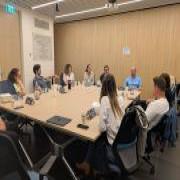
סמינר מחלקה של אינגה אנדראה איריס שפר - הסרת מיקרו מזהמים על ידי ממברנות תגובתיות ננו-נקבוביות

26 בדצמבר 2022, 14:00 - 15:00 
פקולטה להנדסה  
0
סמינר מחלקה של אינגה אנדראה איריס שפר - הסרת מיקרו מזהמים על ידי ממברנות תגובתיות ננו-נקבוביות


School of Mechanical Engineering Seminar
Monday, December 26, 2022 at 14:00
Wolfson Building of Mechanical Engineering, Room 206


Micropollutant removal by nanoporous reactive membranes


Prof Dr-Ing Andrea Iris Schäfer

membrane material and processes research for water treatment

Micropollutants are typically persistent organic chemicals that are toxicologically active at very low concentrations (nano- and micro grams per litre), posing a risk to both environmental and human health. Steroid hormones are endocrine disrupters and micropollutants that reach the aquatic environment mostly from wastewater discharge. Nanofiltration is known for incomplete removal (breakthrough), requires high operating pressure (thus energy) for effective removal, and retained micropollutants accumulate concentrate streams. ‘Reactive’ membranes, such as photocatalytic membranes; are an alternative that addresses such shortcomings. Photocatalyst materials can be immobilized in micro- and ultrafiltration membrane pores (1-200 nm), where reactions occur, and at the same time water permeability is high. Micropollutants are degraded in situ within the short, order of seconds, residence times.

Mechanisms of nanopores of different mechanisms, namely stericexclusion, adsorption and photocatalytic reaction are provided. Current progress of steroid hormone degradation in a flow-through photocatalytic membrane reactor is presented at one material example. The membranes used were a polyethersulfone–titanium dioxide (PES-TiO2) membrane produced by collaborators at IOM Leipzig [1, 2]. The TiO2 nanoparticles (10 nm) were immobilised in the nanopores (220 nm) of the membrane polymers (PES and PVDF). Water quality and operational parameters, including organic matter concentration, were evaluated to determine which processes limit the degradation of steroid hormones. Steroid hormone concentrations ranged from low environmentally relevant concentrations 50 ng/L to near the solubility limit of 1 mg/L. Other examples at IAMT are organic PVDF membrane with a porphyrin photosensitiser [3, 4]. These results are not presented.

It is anticipated that flow-through the photocatalytic membrane increases the ‘contact’, and hence the probability to react, between micropollutants and reactive oxygen species in the pores. The result is high removal (80-95%), despite very short hydraulic residence times.  Indeed, relatively simple materials can achieve a very high removal of micropollutants. Further enhancement can be achieved through potentially smaller pores (nanoconfinement), modified photocatalytic materials and longer residence times. When comparing data, reactive membranes are operated at nanofiltration range fluxes with pressures typical for micro- and ultrafiltration yield significant savings in energy. The ambitious water quality guideline (steroid hormone E2 1 ng/L for drinking water) are reachable.


Relevant publications for data in this presentation

[1] K. Fischer, R. Gläser, A. Schulze, Nanoneedle and nanotubular titanium dioxide–PES mixed matrix membrane for photocatalysis, Applied Catalysis B: Environmental, 160 (2014) 456-464.

[2] S. Lotfi, K. Fischer, A. Schulze, A.I. Schäfer, Photocatalytic degradation of steroid hormone micropollutants by TiO2-coated polyethersulfone membranes in a continuous flow-through process, Nature Nanotechnology, 17 (2022) 417–423.

[3] R. Lyubimenko, O.I.G. Cardenas, A. Turshatov, B.S. Richards, A.I. Schäfer, Photodegradation of steroid-hormone micropollutants in a flow-through membrane reactor coated with Pd (II)-porphyrin, Applied Catalysis B: Environmental, 291 (2021) 120097.

[4] R. Lyubimenko, B.S. Richards, A.I. Schäfer, A. Turshatov, Noble-metal-free photosensitizers for continuous-flow photochemical oxidation of steroid hormone micropollutants under sunlight, Journal of Membrane Science, 642 (2022) 119981.

Short Bio

Andrea Schäfer is Professor of Water Process Engineering, Faculty of Chemical and Process Engineering and (founding) Director of the Institute for Advanced Membrane Technology (IAMT) at the Karlsruhe Institute of Technology (KIT).

Previously she was Professor at the Nelson Mandela African Institute of Science and Technology in Tanzania, East Africa. 2006 to 2013 she was the Chair of Environmental Engineering at the University of Edinburgh, Scotland, UK following 3 years as a senior lecturer at the University of Wollongong, Australia and 3 years as postdoc & lecturer at the University of New South Wales, Sydney Australia. She holds four engineering degrees from three countries (Germany, France (2) & Australia) including a PhD from the UNESCO Center for Membrane Science and Technology at the University of New South Wales in Chemical engineering and has worked in many countries.

Passionate about membrane process engineering she has experience with several membrane processes encompassing predominantly water treatment, desalination, water recycling, remote water supplies and international development. Her work spans from fundamental research, nanomembrane materials through to commercialization projects, from water chemistry and engineering to socio-economic issues relevant to water.

Prof Schäfer has published extensively in high impact journals and authored or edited several books, including ‘Nanofiltration: Principles, Applications and New Materials’. She collaborates extensively with colleagues in many leading academic institutions worldwide and works towards her long term vision ‘I have a dream: safe water for all children’.


https://tau-ac-il.zoom.us/j/4962025174?pwd=bVJUeElXRUUya3BERisyNllLOE9EZz09

Multiple and Hierarchical Universality | Prof. Meir Feder (TAU): סמינר מחלקת מערכות EE Systems Seminar

12 בדצמבר 2022, 15:00 
הפקולטה להנדסה אוניברסיטת תל אביב, בנין כיתות ,אולם 011  
Multiple and Hierarchical Universality | Prof. Meir Feder (TAU):  סמינר מחלקת מערכות EE Systems Seminar

(The talk will be given in English)


Speaker:     Prof. Meir Feder

School of Electrical Engineering, Tel Aviv University 

011 hall, Electrical Engineering-Kitot Building                                                                                                    ‏

Monday, December 12th, 2022

15:00 - 16:00


Multiple and Hierarchical Universality

Abstract

Universal coding, prediction and learning usually consider the case where the data generating mechanism is unknown or non-existent, and the goal of the universal scheme is to compete with the best hypothesis from a given hypothesis class, either on the average or in a worst-case scenario. Multiple universality considers the case where the hypothesis class is also unknown: there are several hypothesis classes with possibly different complexities. In hierarchical universality, the simpler classes are nested within more complex classes. The main challenge is to correctly define the universality criterion so that the extra “regret” for not knowing the class is monitored. We propose several possible definitions and derive their min-max optimal solutions. Interestingly, the proposed solutions can be used to obtain Elias codes for universal representation of the integers. We also utilize this approach for variable-memory Markov models (unifilar models), presenting a new interpretation for the bound over the regret of the celebrated context-tree weighting algorithm and propose a 3-part code that (slightly) out-performs it.

Finally, we conjecture that multiple universality with its non-uniform regret bounds can be used in “overparameterized” model classes including deep neural networks.

Joint work with Yaniv Fogel


Short Bio

Meir Feder received the Sc.D degree in Electrical Engineering and Ocean Engineering in 1987 from the Massachusetts Institute of Technology (MIT) and the Woods Hole Oceanographic Institution (WHOI). After being a Research Associate and a Lecturer in MIT, he joined in 1990 the School of Electrical Engineering, Tel-Aviv University, where he is now the Jokel Chair Professor and the head of the newly established Tel-Aviv university center for Artificial intelligence and Data science (TAD). He is also a Visiting Professor with the Department of EECS, MIT.

Parallel to his academic career, he is closely involved with the high-tech industry. He founded 5 companies, among them are Peach Networks that developed an interactive TV solution (Acq: MSFT) and Amimon that provided the highest quality, robust and no delay wireless high-definition A/V connectivity (Acq:LON.VTC). Recently, with his renewed interest in machine learning and AI, he cofounded Run:ai, a virtualization, orchestration, and acceleration platform for AI infrastructure. He is also an active angel investor and serves on the board/advisory board of several US and Israeli companies.

Prof. Feder received several academic and professional awards including the IEEE Information Theory Society best paper award for his work on universal prediction, the “creative thinking” award of the Israeli Defense Forces, and the Research Prize of the Israeli Electronic Industry, awarded by the President of Israel. For the development of Amimon’s chip-set, that uses a unique MIMO implementation of joint source-channel coding for wireless video transmission he received the 2020 Scientific and Engineering Award of the Academy of Motion Picture Arts and Sciences.


השתתפות בסמינר תיתן קרדיט שמיעה = עפ"י רישום שם מלא + מספר ת.ז. בטופס הנוכחות שיועבר באולם במהלך הסמינר


הפקולטה להנדסה באוניברסיטת תל אביב

07 דצמבר 2022

הפקולטה להנדסה מברכת את המרצות והמרצים, האסיסטנטים והמתרגלים.ות על דירוגם הגבוה במיוחד בסקר שביעות רצון הסטודנטים/יות מההוראה. אנחנו רואים בהגברת שביעות רצון הסטודנטים מההוראה מטרה חשובה ביותר. 


מצטייני רקטור  בהוראה:


סגל בכיר

ד"ר לודמילה מרקוס

תכנית מדעים דיגיטליים להייטק

ד"ר ירדן מזור

 ביה"ס להנדסת חשמל

סגל זוטר

  • גב' הדר אהרון – ביה"ס להנדסת חשמל
  • מר עידו בירן – המחלקה למדע והנדסה של חומרים
  • גב' אשרת קליין עמית–  ביה"ס להנדסה מכנית

מצטייני דקאן  בהוראה:


ביה"ס להנדסת חשמל


סגל בכיר

מורה מצטיינת:

  • ד"ר אסיה בן כהן – מצטיינת דקאן

ציון לשבח:

  • פרופ' אבישי אייל – ציון לשבח
  • ד"ר יובל בק – ציון לשבח
  • מר צבי ווב – ציון לשבח
  • פרופ' אבישי וול – ציון לשבח
  • פרופ' ג'ורג' וויס – ציון לשבח


מרצה מן החוץ

מתרגל מצטיין:

  • מר אברהם אבינו אהרונוב

ציון לשבח:

  • מר אומקר ג'וגליקר
  • מר חן הנמן
  • מר איל נאור
  • מר מאור נפתלי
  • מר אלעד סימניאן
  • גב' מור פייגנבאום-רז
  • מר אור רוב 


ביה"ס להנדסה מכנית


סגל בכיר

מורה מצטיין:

  • ד"ר יורם קוזק – מצטיין דקאן

ציון לשבח:

  • ד"ר ויטלי פאליי – ציון לשבח
  • ד"ר אבינעם רבינוביץ – ציון לשבח


מורה מן החוץ

מתרגל מצטיין:

  • מר שי מונט – מצטיין דקאן

ציון לשבח:

  • מר אושר אזולאי
  • גב' שיר ורטהיימר 


המחלקה להנדסה ביו-רפואית


סגל בכיר

מורה מצטיין:

  • מר דביר רדונסקי – מצטיין דקאן

ציון לשבח:

  • ד"ר טלי אילוביץ – ציון לשבח


מורה מן החוץ

מתרגלת מצטיינת:

  • גב' מעין לוסטיג – מצטיינת דקאן

ציון לשבח

  • ד"ר רונן שושניק 


המחלקה להנדסת תעשייה


סגל בכיר

מורה מצטיין:

  • ד"ר עמיחי פיינסקי – מצטיין דקאן

ציון לשבח:

  • ד"ר אוהד אייזנהנדלר – ציון לשבח


מרצה מן החוץ 

מתרגלת מצטיינת:

  •  גב' מירב מופז – מצטיינת דקאן

ציון לשבח: 

  • מר מתן אל יחזקאל


המחלקה למדע והנדסה של חומרים


סגל בכיר

מורה מצטיין:

  • ד"ר מקסים סוקול – מצטיין דקאן


מרצה מן החוץ 

מתרגלת מצטיינת:

  • גב' אסתר-ספיר ברוך – מצטיינת דקאן


מדעים דיגיטליים להיי-טק


מורה מצטיין:

  • ד"ר יונתן אוסטרומצקי


מתרגל מצטיין:

  • מר רפאל שוכהנדלר – מצטיין דקאן


קורסי שירות


מרצים מצטיינים:

  • ד"ר גיא לנדסמן – ביה"ס למתמטיקה
  • ד"ר יעקוב יעקובוב – ביה"ס למתמטיקה
  • ד"ר בנימין טרכטנברוט – ביה"ס לפיזיקה
  • ד"ר עומר ברומברג – ביה"ס לפיזיקה
  • מר איתמר צימרמן – ביה"ס למדעי המחשב


מתרגלים מצטיינים:

  • גב' נטלי לירן – ביה"ס למתמטיקה
  • מר סהר דיסקין – ביה"ס למתמטיקה
  • מר גיא רוטמן – ביה"ס למתמטיקה
  • מר עמרי פלג – ביה"ס למתמטיקה
  • מר גרישה זלטין – ביה"ס לפיזיקה
  • מר נדב שרייר – ביה"ס לפיזיקה
  • מר צבי גרגורי גפט – ביה"ס למדעי המחשב


LMI seminar - מרכז אור וחומר

11 בדצמבר 2022, 13:00 
הפקולטה להנדסה אוניברסיטת תל אביב, בנין כיתות ,אולם 011  
 LMI  seminar  - מרכז אור וחומר

LMI Seminar:

Tackling longstanding challenges in ultrafast nonlinear optics via foreign but familiar physics

Prof. Jeffrey Moses

School of Applied and Engineering Physics,

Cornell University NY

Sunday December  11th,  2022

13:00-14:00

Light refreshments and drinks will be served at 12:30

Auditorium 011, Engineering Classroom Building,  Faculty of Engineering, Tel-Aviv University


Abstract:

Optical nonlinearities have expanded the optics and photonics toolset for applications as diverse as high intensity laser science, quantum information processing, and the imaging and spectroscopy of biological systems. Key to many applications is use of the nonlinear polarizability of materials to couple photons between optical fields, giving rise to amplification and frequency conversion methods that expand the reach of lasers and other photon sources, both classical and non-classical. Other applications use light 'self-effects' to guide, switch, and modulate. However, optical nonlinearities are often small, and even when large enough, the spatiotemporal and spectral inhomogeneities in nonlinear optical systems can severely hamper the efficiency and bandwidth of power flow between waves. 
 
Our group has been seeking ways to 'trick' nonlinear systems into modes of evolution that can avoid the normal limiting behaviors or to make use of unconventional nonlinear interactions. I will discuss two examples that possess familiar physics that are somewhat foreign to optical light pulses. First, I will discuss how hybridized nonlinear processes can be used to achieve dissipative, non-Hermitian-like dynamical behavior in parametric frequency conversion despite no loss, and how this can be used to overcome a longstanding barrier to efficient parametric amplification. Second, I will discuss the phenomenon of optical polarizability involving coherent phonon coupling, which we predict gives rise to a giant Raman scattering susceptibility and a new way to control the optical properties of materials with mid-IR and THz light.

Bio:

Jeff Moses joined the faculty at Cornell University in 2014, where he leads the Ultrafast Phenomena and Technologies Group in the School of Applied and Engineering Physics. He received his B.S. from Yale University and Ph.D. from Cornell University, with both degrees in applied physics, and spent 2007-2014 at the Optics & Quantum Electronics Group in the Research Laboratory of Electronics at MIT as a postdoctoral associate and research scientist. He has received the US National Science Foundation CAREER award and was an US Air Force Office of Scientific Research Young Investigator.

יום זרקור חברת Istra Research

14 בדצמבר 2022, 12:00 
תל אביב  
istra Research


סטודנטים וסטודנטיות חברת Istra Research מגיעה לפגוש אתכם.ן ביום זרקור חדשני.

בואו לשמוע על אלגוטריידינג, Big Data וטכנולוגיות נוספות ממיטב המומחים.ות של החברה.

ניפגש למינגלינג מקצועי ולחגיגה של סופגניות.


מתי: 14.12.22 בשעה 12:00

מיקום: לובי בניין צ'ק פוינט


עד שניפגש נסו לפתור את חידת המונדיאל של איסתרא.


על הזוכה נכריז ב-26.12 והוא יזכה באוזניות פרימיום של חברת סוני.


נתראה


לאירועים נוספים עשו לנו לייק בדף הפייסבוק

סמינר מחלקה של שי אלכסנדרוני -חיפוש מושגים מספקים תחת מטרות מרובות

01 בפברואר 2023, 14:00 - 15:00 
פקולטה להנדסה  
0
סמינר מחלקה של שי אלכסנדרוני -חיפוש מושגים מספקים תחת מטרות מרובות


School of Mechanical Engineering Seminar
Wednesday, January 11, 2023 at 14.00
Wolfson Building of Mechanical Engineering, Room 206

Searching for Satisficing Concepts under Multiple Objectives

Shai Alexandroni

M.Sc. student of Dr. Amiram Moshaiov

The Computational Intelligence Research Group

Concept selection is one of the critical decisions of the engineering design process. However, decision-making during the conceptual design stage is challenged by the large variety of possible designs, high uncertainties, and the biases of the Decision Makers (DMs). Thus, computer-supported conceptual design methods have been suggested in recent years. One such method is the Window-of-Interest based Satisficing Concept Search (WoISCS). This method involves the representation of a conceptual solution as a set of particular solutions and on predefined performance requirements. These requirements are presented as a set of acceptable performance vectors which has been termed Window-of-Interest (WoI). A concept is considered as satisficing if it is associated with at least one particular solution that has a performance vector within the WoI. Prior to this study, WoISCS has been researched to a limited extent, and only one dedicated search algorithm, which is termed WoISR, has been suggested in the literature.

The current research goal is to develop and compare new search algorithms for WoISCS. First, dedicated methods and tools are developed for evaluating WoISCS algorithms. Then, a first attempt on algorithm development is carried out by repurposing of existing Multi-Objective Evolutionary Algorithms (MOEAs), which were originally designed for Pareto optimization. A total of eight MOEAs were tested and compared to WoISR. The MOEAs performed surprisingly well, and some were comparable to the dedicated WoISR algorithm. Subsequently, a novel algorithm for WoISCS was developed based on the lessons of the MOEAs evaluation. The new algorithm was tested and compared to the other algorithms. Based on the numerical experiments it has been statistically inferred that the proposed algorithm outperforms both WoISR and the MOEAs in nearly all the test problems.


Join Zoom Meeting

https://tau-ac-il.zoom.us/j/4962025174?pwd=bVJUeElXRUUya3BERisyNllLOE9EZz09

סדנת קורות חיים וסדנת לינקדאין

בחסות חברת אנבידיה

07 בדצמבר 2022, 10:00 
פקולטה להנדסה  
סדנאות אנבידיה

סטודנטיות וסטודנטים יקרים,


יש לכם.ן ראיון עבודה ואין לכם.ן מושג איך להתחיל להתכונן אליו? פתחתם.ן חשבון לינקדאין אבל אתם.ן לא יודעים.ות איך להמשיך מכאן?

צוות הגיוס של חברת NVIDIA מגיע לפגוש אתכם.ן כאן בקמפוס, וכל מה שאתם.ן צריכים.ות לעשות זה להירשם ולהגיע.

נתחיל מסדנה בנושא הכנה לראיונות עבודה, ונעבור לסדנת לינקדאין.

בסוף נשאיר גם זמן לשאלות עם המגייסות על כל דבר שהייתם.ן רוצים.ות לדעת.


מתי? 

יום רביעי 07.12.22 בשעה 10:00 

איפה?

כיתה 011 בניין כיתות


להרשמה לחץ כאן


מוזמנים.ת להמשיך להתעדכן בכל עת בדף הפייסבוק שלנו.


הרצאת אונליין של חברת אינטל

05 בדצמבר 2022, 19:00 
וירטואלי  
הרצאת אונליין של חברת אינטל

סטודנטים וסטודנטיות, חברת אינטל מזמינה אתכם.ן להרצאת אונליין מרתקת !

אבי סלמון, מנהל החדשנות והיזמות באינטל ישראל, הולך לצלול לאחד הנושאים החשובים והמסקרנים (ספוילר – תציצו בשם ההרצאה) שבטח מעסיקים אתכם.ן בתקופה הזו בחיים (ואם לא- אז כדאי).


לפרטים נוספים והרשמה

סמינר מחלקה של ג'אן לגרוואל - אלסטומרים של גביש נוזלי כמפעילים וחיישני מתח לא שגרתיים

07 בדצמבר 2022, 14:00 - 15:00 
הסמינר יתקיים בזום  
0
סמינר מחלקה של ג'אן לגרוואל - אלסטומרים של גביש נוזלי כמפעילים וחיישני מתח לא שגרתיים


School of Mechanical Engineering Seminar

Wednesday, December 7, 2022 at 14:00
ZOOM SEMINAR

Liquid crystal elastomers as unconventional actuators and strain sensors

Jan Lagerwall

Experimental Soft Matter Physics group, Department of Physics & Materials Science University of LuxembourgCLCE stretch illustration.jpg

www.lcsoftmatter.com

A lively development in todays materials science research is the creation of new smartmaterials that respond to specific stimuli by changing their appearance or shape. Importantly, this adaptive nature is inherent to the material, rather than arising from the interaction of multiple components. This allows single elements in a garment, a construction or any other artifact to be their own actuator or sensor, while at the same time filling the basic passive function that they were designed for. Liquid Crystal Elastomers (LCEs) constitute an exciting example of smart and adaptive materials. They can be designed to change their color in response to mechanical strain [1,2] (top figure) or, conversely, to change their shape—fully reversibly— in response to heat [3] (bottom figure), light, humidity or electric fields. Because the order that gives rise to their remarkable behavior develops by self-assembly in a liquid precursor, they can be made quickly and at low cost, in arbitrary shape, and the rubbery nature of their final state makes them easy to handle and integrate in a variety of structures.LCE shell actuation.jpg

The adaptive nature and versatile and easy processing of LCEs give them tremendous application potential across a variety of fields, from sun-powered kinetic building facades that autonomously adapt to daily and seasonal variations in temperature and humidity [4], saving energy and creating a better indoor climate for the building occupants, to garments that reveal the pressure they apply on the body as a function of location or illustrate the strains involved during motion [2]. In my talk, I will give a brief introduction to what LCEs are, how they work, and how they might be applied in the future, based on recent results from our group [1–3] and interdisciplinary collaborations [4].


[1] Rijeesh Kizhakidathazhath et al. Facile Anisotropic Deswelling Method for Realizing LargeArea Cholesteric Liquid Crystal Elastomers with Uniform Structural Color and BroadRange Mechanochromic Response. Adv. Funct. Mater. 30, 1909537 (2020).

[2] Y. Geng, R. Kizhakidathazhath. & J. P. F. Lagerwall, Robust cholesteric liquid crystal elastomer fibres for mechanochromic textiles. Nat. Mater. (2022). DOI: 10.1038/s41563-022-01355-6.

[3] A. Sharma,  A.M. Stoffel, & J.P.F. Lagerwall. Liquid crystal elastomer shells with topological defect-defined actuation: Complex shape morphing, opening/closing, and unidirectional rotation. J. Appl. Phys. 129, 174701 (2021).

[4] M. Schwartz & J.P.F. Lagerwall, Embedding intelligence in materials for responsive built environment: A topical review on Liquid Crystal Elastomer actuators and sensors. Building and Environment 226, 109714 (2022).


Jan Lagerwall (M.Sc. Physics 1997; Ph.D. Materials Science, 2002) is professor in physics at University of Luxembourg. His research focuses on soft matter physics, chemistry and materials science, connecting liquid crystals with many other fields, from fiber spinning and microfluidics to art, architecture, robotics and security. The motivation ranges from the scientific beauty to the diverse application opportunities arising through cross fertilization with other disciplines. He is a threefold ERC grant recipient (one CoG and two PoC grants). As postdoctoral researcher Jan worked with N.A. Clark (Boulder), G. Heppke (Berlin) and F. Giesselmann (Stuttgart). He previously held group leader positions at Martin Luther University Halle-Wittenberg (Germany) and Seoul National University (Korea). He is actively working to bring the fruits of his groups academic research to use for society and industry through a multitude of collaborations and the foundation of spin-off companies.

This study shed light on the effects of pump configuration on the performance and risk of blood damage, indicating the roles of the hub shape and angular velocity as dominant parameter. These findings can be utilized to improve future designs of p-LVAD.

Join Zoom Meetinghttps://tau-ac-il.zoom.us/j/4962025174?pwd=bVJUeElXRUUya3BERisyNllLOE9EZz09

סמינר מחלקת מערכות EE Systems Seminar: The Information Velocity of Packet-Erasure Links | Dr. Anatoly Khina

28 בנובמבר 2022, 15:00 
הפקולטה להנדסה אוניברסיטת תל אביב, בנין כיתות ,אולם 011  
 סמינר מחלקת מערכות EE Systems Seminar: The Information Velocity of Packet-Erasure Links | Dr. Anatoly Khina

(The talk will be given in English)


Speaker:  Dr. Anatoly Khina

School of Electrical Engineering, Tel Aviv University

 011 hall, Electrical Engineering-Kitot Building 

Monday, November 28th, 2022

15:00 - 16:00

The Information Velocity of Packet-Erasure Links

Abstract

What is the maximal speed—the information velocity—at which information can propagate reliably in a network through a cascade of links? 

Information theory tells us what is the maximal rate of reliable communications through a small number of such links when delay is not important. However, if we want to communicate in real time, answering this question becomes much more challenging. In fact, even for the simple case of transmitting a single bit over a tandem of links, where each flips its input independently (across time & links), an answer was given only very recently.

In this talk, I will present some recent results for this problem for packet-based links with ACK signals. In particular, I will derive the information velocity for a causally arriving stream of packets, and determine the arrive-failure exponential decay rate below the information velocity.

No prior knowledge of information theory or queueing theory will be assumed.

Joint work with Elad Domanovitz & Tal Philosof.

Short Bio

Anatoly Khina is a faculty member in the School of Electrical Engineering, Tel Aviv University, Tel Aviv, Israel, from which he holds B.Sc. (summa cum laude, 2006), M.Sc. (summa cum laude, 2010), and Ph.D. (2016) degrees, all in Electrical Engineering. Parallel to his studies, he worked as an engineer in various roles focused on algorithms, software and hardware R&D. He was a Postdoctoral Scholar in the Department of Electrical Engineering, California Institute of Technology, Pasadena, CA, USA, from 2015 to 2018, and a Research Fellow at the Simons Institute for the Theory of Computing, University of California, Berkeley, Berkeley, CA, USA, during the spring of 2018. His research interests include information theory, communications, statistics, control theory, and signal processing.

He is a recipient of the Fulbright, Rothschild and Marie Skłodowska-Curie Postdoctoral Fellowships; Clore Scholarship; Trotsky Award; Weinstein Prize in signal processing; Intel award for Ph.D. research; and the first prize for outstanding research work in the field of communication technologies from the Advanced Communication Center's Feder Family Award program.


השתתפות בסמינר תיתן קרדיט שמיעה = עפ"י רישום שם מלא + מספר ת.ז. בטופס הנוכחות שיועבר באולם במהלך הסמינר


עמודים

אוניברסיטת תל אביב עושה כל מאמץ לכבד זכויות יוצרים. אם בבעלותך זכויות יוצרים בתכנים שנמצאים פה ו/או השימוש שנעשה בתכנים אלה לדעתך מפר זכויות
שנעשה בתכנים אלה לדעתך מפר זכויות נא לפנות בהקדם לכתובת שכאן >>