ברכות לזוכים

07 דצמבר 2015
מענקי משרד האנרגיה לשנת 2016

חוקרי הפקולטה שזכו במענקי משרד האנרגיה לשנת 2016:


  • פרופ' אברהם קריבוס ופרופ' יוסי רוזנוקס (יחד עם פרופ אלון הופמן, טכניון)
  • ד"ר ירון טולדו
  • פרופ' אברהם קריבוס יחד עם ד"ר אלכסנדר גולברג (בית ספר פורטר)

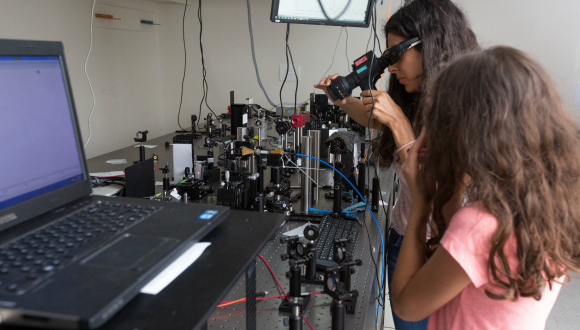
סיור חנוכה לילדי המהנדסים

14 בדצמבר 2015, 9:30 
בניין וולפסון להנדסה מכנית, קומה 2 חדר 206, אווניברסיטת תל אביב  
ללא תשלום
סיור חנוכה לילדי המהנדסים

סיור חנוכה לילדים בפקולטה להנדסה

לילדים בכיתות ה-ו-ז

14/12/2015 יום שני, בין 09:30-11:30

חדר 206 קומה 2 בניין וולפסון הפקולטה להנדסה

אוניברסיטת תל אביב

EE Seminar: A VC-dimension-based Outer Bound on the Zero-Error Capacity of the Binary Adder Channel

~~(The talk will be given in English)

Speaker:   Dr. Or Ordentlich
                        MIT

Tuesday, December 15th, 2015
15:00 - 16:00
Room 206, Wolfson Mechanical Engineering Bldg., Faculty of Engineering
A VC-dimension-based Outer Bound on the Zero-Error Capacity of the Binary Adder Channel

Abstract

 The notion of zero-error capacity of a channel/graph was formalized by Shannon in 1956, and has since then been the subject of many works in information theory, coding theory and combinatorics. Despite the apparent simplicity of the zero-error communication problem, it took more than 20 years until the first non-trivial case, namely, the pentagon graph, was finally solved by Lovasz. For the vast majority of interesting channels, the zero-error capacity is still not known.

We study the zero-error communication problem in a multi-user setting, where the simplest non-trivial channel model is the binary adder. This is a two-user multiple access channel whose inputs are binary and whose output is the real sum of the inputs. We derive a new outer bound (converse) on the zero-error capacity of this channel. To this end, we extend the notion of VC-dimension and prove a corresponding generalization of Sauer's Lemma, which together with new information theoretic arguments yields our bound.

Bio: Or Ordentlich completed his B.Sc. (cum laude), M.Sc. (summa cum laude) and Ph.D. studies in 2010, 2011, and 2015, respectively, all in electrical engineering at Tel Aviv University, Israel. He is currently a postdoctoral fellow in the Laboratory of Information and Decision Systems at the Massachusetts Institute of Technology (MIT), Cambridge.
Or is the recipient of the MIT - Technion Postdoctoral Fellowship, the Adams Fellowship awarded by the Israel Academy of Sciences and Humanities, the Thalheimer Scholarship for graduate students, the Advanced Communication Center (ACC) Feder Family Award for outstanding research work in the field of communication technologies (2011,2014), and the Weinstein Prize for research in signal processing (2011,2013,2014).


15 בדצמבר 2015, 15:00 
חדר 206, בניין וולפסון הנדסה מכנית  

וידאו

07 דצמבר 2015

Meccanoid g15 in israel

מרכיבים את ג'ורג': ד"ר גורן גורדון מקים בימים אלו את מעבדתו באוניברסיטת ת"א העוסקת בחקר הסקרנות של אנשים ושל רובוטים, בעזרת מודלים מתמטיים.
אתמול נתרמו למעבדתו שני רובוטים מסוג G 15 MECCANOID
שזכו לכינוי 'ג'ורג'' ע"ש הקוף ג'ורג' הסקרן.
צפו בסרטון המדגים כיצד ד"ר גורן ותלמידיו מרכיבים את ג'ורג'.

Material Sciences and Engineering: Departmental Seminar

Metal Organic Frameworks: a Platform for Electrocatalytic Fuel Generation

Dr.  Idan Hod

Department of Chemistry, Northwestern University

30 בדצמבר 2015, 16:00 
Room 103, Engineering Class (Kitot) Building  

EE Seminar: Parameterization Driven 3D Surface Modeling from a Single Image

~~
Speaker: Michael Litvin,
M.Sc. student under the supervision of Prof. Ariel Shamir and Prof. Alex Bronstein

Wednesday, January 6th, 2016 at 15:30
Room 011, Kitot Bldg., Faculty of Engineering

Parameterization Driven 3D Surface Modeling from a Single Image

Abstract

We consider the task of retexturing, which is the process of realistically replacing the texture of an object in an image. The user provides a regular 2D image along with an alternative texture, and uses our system to coarsely model the object’s visible 3D geometry. A parameterization implicitly maintained throughout the modeling process induces a warp that fits the texture on the desired object.
In order to lessen required user interaction and skill, we limit the geometry to extrusion surfaces. Most user input is performed by marking simple geometrical features over the 2D image, and entering optional real-world measurements. The process begins with defining an extrusion spine in form of a line segment, and then defining the shape of key cross-sectional profiles along this spine. The profiles are then automatically scaled to fit the object’s silhouette, sampled and connected to form a 3D triangle mesh. This construction induces a natural parameterization with axes based on the spine direction and the profiles’ arc-length parameter.

06 בינואר 2016, 15:30 
חדר 011, בניין כיתות-חשמל  

EE Seminar: Coding For Interactive Communication

~~(The talk will be given in English)

Speaker:  Dr. Ran Gelles
                      Princeton University

Monday, December 21st, 2015
15:00 - 16:00
Room 011, Kitot Bldg., Faculty of Engineering
Coding For Interactive Communication

Abstract:

In his seminal 1948 paper, Shannon conceived the field of coding theory, allowing a sender to deliver a single message to a receiver, despite noise introduced by the communication links. Unfortunately, coding techniques developed since then are insufficient for modern communication systems, where instead of a sender communicating a message to a receiver, two or more parties are involved in an interaction -- a conversation.

The field of coding for interactive communication aims at solving exactly the above question by obtaining coding schemes that allow two or more parties to complete their conversation despite possible noise in the communication channels. In order to be useful, such coding schemes are required to feature desirable properties such as having an efficient computation time, or adding only a small amount of redundancy (i.e. having a good rate).

In this talk I will describe the realm of interactive coding, and a few of the exciting coding techniques developed in recent years, as well as several of the applications derived from these coding techniques. In particular, I will discuss efficient coding schemes for two parties in the presence of stochastic noise, and upper and lower bounds on the communication (i.e., on the rate) of coding scheme in the multiparty case in the presence of stochastic noise.

Short Bio:

Ran Gelles is a postdoctorate researcher in the department of Computer Science, Princeton University.
He received his PhD in 2014 from UCLA, and he holds a Master degree and a Bachelor degree in computer engineering, from the Technion.
Ran's main interest is in communication systems, and in particular, interactive communication systems.
Other than that, his research involves questions in data-streams, cryptography, and quantum cryptography.

21 בדצמבר 2015, 15:00 
חדר 011, בניין כיתות-חשמל  

עמודים

אוניברסיטת תל אביב עושה כל מאמץ לכבד זכויות יוצרים. אם בבעלותך זכויות יוצרים בתכנים שנמצאים פה ו/או השימוש שנעשה בתכנים אלה לדעתך מפר זכויות
שנעשה בתכנים אלה לדעתך מפר זכויות נא לפנות בהקדם לכתובת שכאן >>