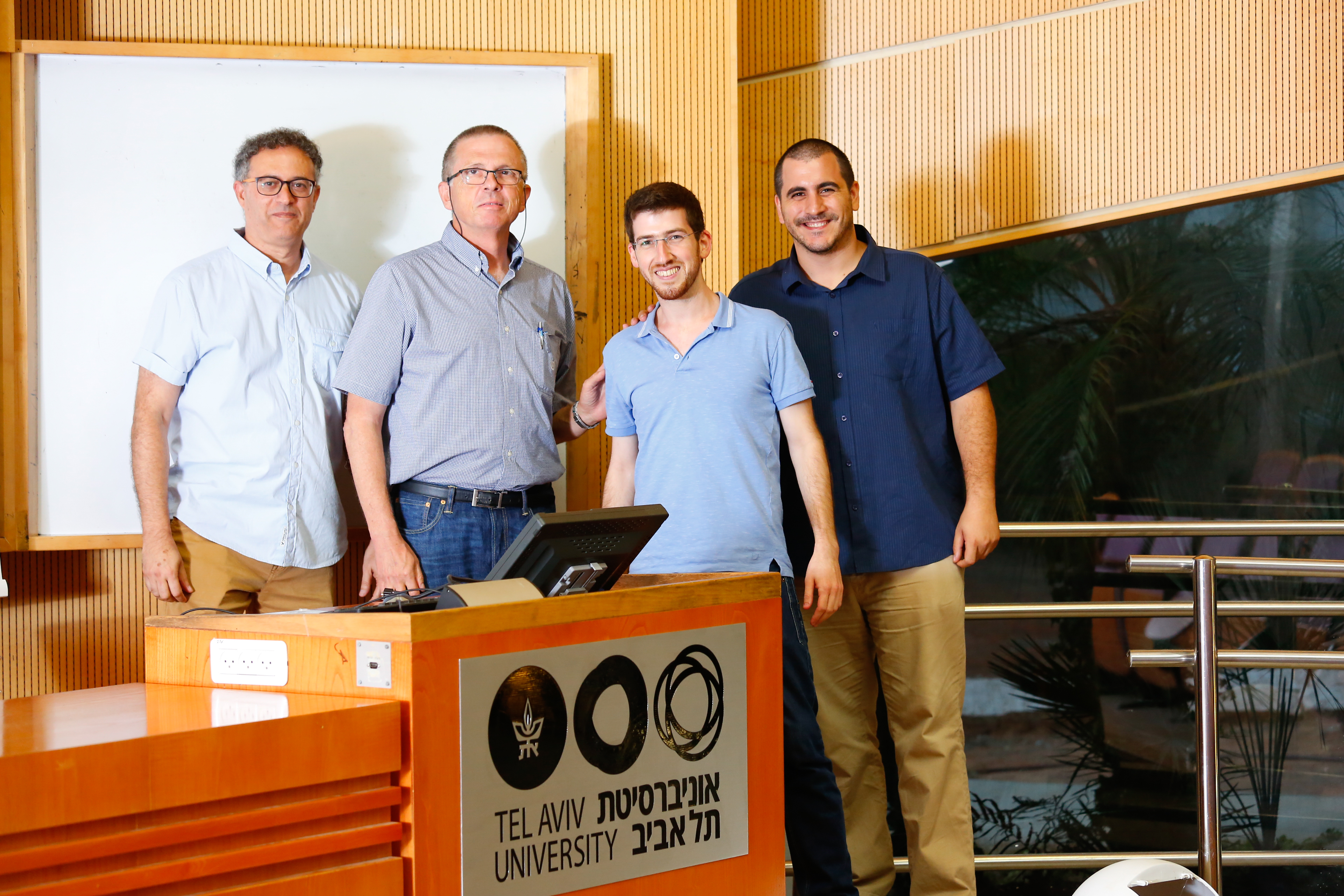
המחקר פורסם בעיתון היוקרתי "Nature Communications" בנושא אלמנטים אופטים משטחיים של ד"ר טל אלנבוגן מהמחלקה לאלקטרוניקה פיזיקלית ואורי אביו סטודנט לתואר שני בבית הספר להנדסת חשמל.

24 אפריל 2017
מחקר פורץ דרך: עדשות דקות פחות מעובי של שערה

אלמנטים אופטים משטחיים

מחקר פורץ דרך שפורסמם בעיתון היוקרתי – Nature Communications בנושא אלמנטים אופטים משטחיים של ד"ר טל אלנבוגן מהמחלקה לאלקטרוניקה פיזיקלית בבית הספר להנדסת חשמל בפקולטה להנדסה ע"ש פליישמן ואורי אביו סטודנט לתואר שני בבית הספר להנדסת חשמל.


לצלם עם עדשות דקות פחות מעובי של שערה.

עדשות קמורות הן אבן הבסיס בכל מכשיר אופטי כמו מצלמות, מיקרוסקופים, טלסקופים וכו'. בד"כ נדרשות מספר רב של עדשות כאלה על מנת לקבל תמונה באיכות גבוהה. אחת הסיבות לכך היא שכאשר  אנו רוצים לדמות (image) תמונה לא מונוכרומטית, כמו למשל בצילום באור יום, אורכי הגל השונים המרכיבים את האור הלבן ייתמקדו למקומות מעט שונים ונקבל תמונה מעוותת. תופעה זו, הקרוייה אברציות כרומטיות chromatic aberration)), מסבכת (ולכן גם מייקרת) את התכנון של מכשירים אופטים, ובנוסף גם מגבילה את העובי המינימלי של המכשיר, כמו למשל בטלפונים חכמים. בעיה זו יוצרת דרישה הולכת וגוברת למציאת תחליפים דקים יותר לעדשות אלה, תוך כדי שמירה על איכות מיקוד האור ועלות ייצור נמוכה.

שלוש עדשות לצבע לבצע אחר

בעבודה שפורסמה בעיתון היוקרתי Nature Communications, הראו אורי אביו וד"ר טל אלנבוגן מהמעבדה לננו אלקטרו-אופטיקה באוניברסיטת תל אביב בשיתוף עם ד"ר אוקלידס אלמידה ופרופ' יחיעם פריאור ממכון וויצמן, כיצד ניתן להשתמש בשלוש שכבות אולטרא-דקות של מטה-משטחים, על מנת לייצר עדשה מתוקנת אברציות כרומטיות. בעדשה זו, השתמשו החוקרים בננוטכנולוגיה על מנת לכתוב מערכים של ננו אנטנות העשוית ממתכות שונות, המגיבות לאור הנראה בצורה ייחודית. באמצעות שילוב של שלוש שכבות של מטה- משטחים אלה הצליחו החוקרים להרכיב שלוש עדשות שונות, אשר כל אחת מיועדת לצבע אחר, וביחד ממקדות אור לבן לנקודה אחת, וכל זאת במבנה בעובי של פחות ממאית עובי השערה. בנוסף הראו החוקרים מגוון של רכיבים אופטיים נוספים מבוססים על הטכנולוגיה החדשה. רכיבים אופטיים כאלו מהווים מוקד התעניינות בתעשייה לצורך פיתוחי מצלמות ואלמנטים אופטיים ממוזערים.

לכתבה המלאה: Composite functional metasurfaces for multispectral achromatic optics

יום פתוח 24.05.2017

אוניברסיטת תל-אביב מזמינה אתכם ליום פתוח ב 24.05.2017 בשעות 10:00-14:00 רוצה לדעת עוד על היום הפתוח? לחץ על התמונה.

School of Mechanical Engineering Mirna Shahin

22 במאי 2017, 14:00 - 15:00 
בניין וולפסון חדר 206  
ללא תשלום
School of Mechanical Engineering Mirna Shahin


School of Mechanical Engineering Seminar
Monday, May 22, 2017 at 14:00
Wolfson Building of Mechanical Engineering, Room 206


 Critical aspects of crack dynamics in single crystals


Merna Shaheen-Mualim

PhD. Student of Prof, Dov Sherman

1Dept. of Materials Science and Engineering, Technion, Haifa, Israel

2School of Mechanical Engineering, Tel-Aviv University, Tel-Aviv, Israel


 We investigated two critical aspects of the physics of fast crack propagation in ideal brittle crystals when loaded by time independent (quasi-static) loading. The first is a rate dependent cleavage energy, the second is the effect of reflected stress wave on crack speed with this type of materials and loading. Silicon crystal was used as a model material in this investigation.

It was found that the cleavage energy is crack extension dependent of the driving force, G0, namely, dG0/da. The dynamic cleavage energies at high  of cracks propagating on two low energy cleavage systems of silicon crystal, (110)[1 0] and (111)[11 ], were evaluated using our Coefficient of Thermal Expansion Method (CTEM). Previous studies [1,2] showed that when  is low, the cracks are subjected to stress corrosion cracking mechanisms. At high , however, these mechanisms are vanished, and higher energy than the theoretical Griffith barrier is required to initiate and propagate the crack. We suggest that this complex behavior is due kinking mechanisms along the propagating crack front, which are governed by various energies. 1 2

We further show that crack speed under time independent loading is only slightly affected by stress wave reflecting from the specimen boundary. The maximal speed reduction was estimated by comparing the experimental energy-speed relationship to that of Freund equation of motion. It was found to be less than 8.5% and occurred at speed above 2,500 m/sec in our specimens.

1. A. Gleizer, M. Shaheen-Mualim, D. Sherman. " cracks dynamics in silicon crystal at the low energy and speed: from macroscopic energy flow to atomistic kinks", Submitted (2017).

2. A. Gleizer, M. Shaheen-Mualim, D. Sherman. "Complex and divers dynamic stress corrosion cracking in silicon crystal", Submitted (2017).


Departmental Seminar - Materials Science and Engineering: Mirit Sharabi

08 במאי 2017, 15:00 - 16:00 
בניין וולפסון, חדר 118  
ללא תשלום
Departmental Seminar: Materials Sciences and Engineering

Soft tissues can be idealized as fiber-reinforced composite materials. From a mechanical point of view, collagen fibers are the main load bearing constituent of the tissue.  As such, they are responsible for its stiffness and strength.

The growing need in soft tissue substitutes led to massive efforts to produce new materials that can replace damaged native tissue. Although biological compatibility is an important property of these biomaterials, mechanical biocompatibility is as crucial aspect that often does not get enough attention.

The objectives of the present work were to create a new type of biocomposite materials and constructs.  To that end, biomimetics principles were applied by using the shape and structure of native soft tissues.  Hence, ultra-long collagen fibers extracted from soft coral were combined with alginate-based hydrogel matrix having different fiber fractions and orientations. The proposed material combinations allowed tailor-designed and hyperelastic mechanical behavior similar to native tissues, e.g. cornea, blood vessels and annulus fibrosus. The new materials and constructs were fabricated and mechanically tested alongside with predictive finite-element (FE) material and structural models that can help in the design of complicated bio-composite constructs. This work enhanced our understanding to the structure-function behavior and the influence of the isolated bio-composite components on the overall mechanical behavior. These new materials and constructs with a combination of numerical simulations have a great potential to create the next-generation of tailor-designed biomaterials for soft issue substitutes.

EE Seminar: Fog mapping using measurements from commercial microwave networks

26 באפריל 2017, 15:30 
חדר 011, בניין כיתות-חשמל  


Speaker: Ori Cohen

M.Sc. student under the supervision of Prof. Hagit Messer-Yaron


Wednesday, April 26th 2017 at 15:30

Room 011, Kitot Bldg., Faculty of Engineering


Fog mapping using measurements from commercial microwave networks


Abstract


Fog may affect human in many ways, but existing technologies for fog monitoring are limited. 

In this work I present a method for generation a two-dimensional fog map from a near-ground sensors network of Commercial Microwave Links (CMLs). Treating the CMLs as multi-sensor and adopting methods from the data fusion domain, I demonstrate large spatial observations of fog, which were acquired based on received signal level measurements from hundreds of CMLs that were deployed over a country wide area. The suggested algorithm combines data from a standard cellular communication networks with topographic prior information about the area where the network is deployed. 

In addition, it enhances the spatial coverage and reduces the false alarm detection by using side information from other types of sensors as relative humidity measurement provided by the Israeli Meteorological Service.

The performance of the suggested procedure is tested and validated using real measurements from CML, satellite and humidity gauges. 


בנות הפרויקט להעצמת בנות במדעים בסיור והרצאה מרתקת במעבדת פרוייקט הרכב של הפקולטה להנדסה

20 אפריל 2017
סברינה, סטודנטית שנה ד' בבית הספר להנדסה מכנית מעבירה לתלמידות הרצאה מרתקת

פרויקט להעצמת בנות במדעים

שבוע שעבר, במסגרת חוג המדע ובהובלת מיכל גרינבאום מנהלת הפרויקט להעצמת בנות במדעים, התקיים סיור של תלמידות כיתה ד' מבית ספר יסודי גרץ, תל-אביב, אצלנו בפקולטה להנדסה במעבדת פרוייקט הרכב. בסיור הפגשנו את התלמידות בפרויקט בניית הרכב של אוניברסיטת ת״א.

מי יבנה את הרכב הבא?

סברינה, סטודנטית שנה ד' בבית הספר להנדסה מכנית שמשתתפת בפרוייקט הרכב, העבירה לתלמידות הרצאה מרתקת שנמשכה כשעה. הסיור היווה חוויה מעצימה, מרגשת ופותחת אופקים עבור הבנות, אשר אחרי המפגש הארוך עם סברינה גם הן חולמות להגיע לצוות שיבנה רכב מירוץ.

מילות סיכום ומכתב תודה 

במסגרת חוג מדע, הכרנו את פרויקט בניית הרכב של אוניברסיטת ת״א.

לאחר ששמענו רבות אודות הפרויקט, זכינו להזדמנות חד פעמית לראות את הרכב בסוף בנייתו, ולשמוע הרצאה מפי אחת הסטודנטיות השותפות לדרך הלמידה המקורית והמעניינת הזו.

היא סיפרה לנו על הפרויקט עצמו, על מערכות הרכב, על השיווק, היצור, העיצוב, ולבסוף - התחרות.

בכל שנה הם שולחים את הרכב למספר תחרויות בינלאומיות. היא סיפרה לנו הן חוויות אישיות מהתחרות, והן שיטת התחרות.

שמענו הרצאה מרתקת ומלהיבה, שבהחלט היה שווה לפספס יום לימודים עבורה.


אז תודה מיוחדת לסברינה, ולכל משתתפי הפרויקט, על שנתנו לנו הזדמנות לשמוע הרצאה חד פעמית ומרתקת זו!

בנות הפרויקט להעצמת בנות במדעים, כיתות ד3  ו-ד4   בית ספר יסודי גרץ, תל-אביב

EE Seminar: Sampling Multiple Output Channel to Maximize the Capacity

07 ביוני 2017, 15:30 
חדר 011, בניין כיתות-חשמל  


Speaker: Lital Yodla

M.Sc. student under the supervision of Prof. Meir Feder


Wednesday, June 7th, 2017 at 15:00

Room 011, Kitot Bldg., Faculty of Engineering


Sampling Multiple Output Channel to Maximize the Capacity


Standard analysis of Single Input Multiple Output (SIMO) assumes sampling each of the output signals at the full Nyquist rate. In the noiseless case, Papoulis’ Generalized Sampling Expansion (GSE) shows that for a SIMO channel a unique reconstruction of the input signal is possible when sampling each output signal at 1/N the Nyquist rate.


In this work we consider the problem of maximizing the capacity of a single input, two outputs additive Gaussian noise channel at various output sampling regimes. The goal is to find which sampling rates and relative delay between the output channels attain the maximal capacity.

EE Seminar: Temporal Tessellation for Video Annotation and Summarization

17 במאי 2017, 15:30 
חדר 011, בניין כיתות חשמל  

Speaker: Dotan Kaufman

M.Sc. student under the supervision of Prof. Lior Wolf


Wednesday, May 17th  2017 at 15:30

Room 011, Kitot Bldg., Faculty of Engineering


Temporal Tessellation for Video Annotation and Summarization


Abstract


We present a general approach to video understanding, inspired by semantic transfer techniques successfully used for 2D image understanding. Our method considers a video to be a 1D sequence of clips, each one associated with its own semantics. The nature of these semantics -- natural language captions or other labels -- depends on the task at hand. A test video is processed by forming correspondences between its clips and the clips of reference videos with known semantics, following which, reference semantics can be transferred to the test video. We describe two matching methods, both designed to ensure that (a) reference clips appear similar to test clips and (b), taken together, the semantics of selected reference clips is consistent and maintains temporal coherence. We use our method for video captioning on the LSMDC'16 benchmark and video summarization on the SumMe benchmark. In both cases, our method not only surpasses state of the art results, but importantly, it is the only method we know of that was successfully applied to both video understanding tasks.

School of Mechanical Engineering Alon Lidor

24 במאי 2017, 14:00 - 15:00 
בניין תוכנה חדר 101  
ללא תשלום
School of Mechanical Engineering Alon Lidor


School of Mechanical Engineering Seminar
Wednesday, May 24, 2017 at 14:00

Tokhna Building, Room 101


Theoretical Study of the 3-branches Explosion Limits of a Flammable System

Alon Lidor

Faculty of Aerospace Engineering

Technion – Israel Institute of Technology


The phenomenon of explosion (or self-ignition, not to be confused with detonation) of fuel mixtures is well known, both as a desired phenomenon, such as the ignition of the fuel in Diesel engines, and as a phenomenon to be avoided, like knocking in SI engines or the risk of fires on oil and gas platforms. The explosion limits are defined as the curve on a pressure-temperature diagram which describes the threshold between the explosive and non-explosive regions of a fuel mixture. These limits are uniquely defined for a specific fuel-oxidizer pair, under a specific ratio and are also partially dependent on the vessel wall surface. For hydrogen and many hydrocarbon fuels distinctive 3-branched limits exist. Although the explosion limits have been studied extensively (experimentally and theoretically) for many years, there exists no model to date which can accurately predict the explosion limits over the complete range, capturing this unique branching behavior.

This research is composed of theoretical investigation of the explosion limits of an H2-O2 mixture, with the objective of understanding fundamental governing physics of the explosion limits, especially in regards to the uniqueness of the branching limits. We also aim to develop a universal explosion criterion for H2-O2 mixtures, and gain insights into the explosion process for other fuel types. By using a novel approach, combining elements of chain ignition theory and linking between the explosion limits and the ignition delay, we present a unified model capable of accurately predicting the explosion limits of H2-O2 mixture. We also investigate the effects of fluctuations at the molecular level, to evaluate the effect of different impurities in the mixture on the explosion initiation and the thermodynamic stability of the system. Our results from the different models developed and the conclusions and insights gained about the explosion phenomenon will be presented in the talk.

Biography

BSc in Mechanical Engineering from Ben-Gurion University in the Negev in 2011

MSc in Aerospace Engineering from the Technion in 2013

Currently studying towards a PhD in the Faculty of Aerospace Engineering at the Technion

סמינר מחלקתי- הנדסה ביו רפואית

23 באפריל 2017, 14:30 
 
ללא תשלום
סמינר מחלקתי- הנדסה ביו רפואית

אסף ליברמן

תלמיד התואר השלישי במחלקה להנדסה ביו רפואית

אוניברסיטת תל אביב


Cell Studio: a platform for real-time, interactive 3D Graphical simulation of immunological processes

In the core of systems biology are computer models, which integrate static experimental ‘omics’ data into dynamic representations of the researched biological system. These representations are then simulated - run on a computer – to promote understanding of the system. The field of computer modeling and simulation of biological systems is rapidly advancing, with many simulation systems created in the past 20 years. It is backed by significant progress in the fields of experimentation techniques, computer hardware and programming software. The result of a simulation may be delivered in several ways, from numerical results, through graphs of the simulated run, to a visualization of the simulation. The vision of an in-silico experiment viewed as if it was undertaken in reality under a microscope is appealing, but technically demanding and computationally-intensive. We use game engines - generic programs for game creation that offer ready-made assets and tools - to create a visualized, interactive simulation. We also utilize a scalable architecture that delegates the computational load into a scalable server. Together, these may aid in overcoming technical challenges.


Here we report “Cell Studio”, a generic, hybrid platform to simulate an immune microenvironment with biological and biophysical rules. The simulation may be visualized in interactive real-time 3D: The user may view the simulation, move the ‘camera’ around, stop, fast-forward and rewind it, and inject soluble molecules into the extracellular medium at any point in time. During simulation, graphs are created in real time for a broad view of system wide processes. The model is parametrized using a user-friendly Graphical User Interface (GUI). We believe that real-time, interactive 3D visualization may improve insight generated from the simulation, and encourage intuition about emergent behavior in the modelled biological system.


העבודה נעשתה בהנחיית ד"ר אורי נבו מהמחלקה להנדסה ביו-רפואית,  אוניברסיטת תל-אביב

ההרצאה תתקיים ביום ראשון 23.04.17, בשעה 14:30

בחדר 315, הבניין הרב תחומי, אוניברסיטת תל אביב

עמודים

אוניברסיטת תל אביב עושה כל מאמץ לכבד זכויות יוצרים. אם בבעלותך זכויות יוצרים בתכנים שנמצאים פה ו/או השימוש שנעשה בתכנים אלה לדעתך מפר זכויות
שנעשה בתכנים אלה לדעתך מפר זכויות נא לפנות בהקדם לכתובת שכאן >>