סמינר מחלקה אלקטרוניקה פיזיקאלית: Shlomi Kotler

02 בינואר 2020, 15:00 
פקולטה להנדסה, בניין כיתות חדר 011  
סמינר מחלקה אלקטרוניקה פיזיקאלית:  Shlomi Kotler

סמינר שלומי

~~You are invited to attend a department seminar on

Experimental generation and verification of non-classical states of engineered mechanical objects
By:
Shlomi Kotler
Advanced Microwave Photonics Group at NIST/Boulder
Abstract

Why control mechanics at the quantum level?

First and foremost, placing macroscopic objects in superposition states has captured the imagination and interest of physicist for over a century. Today, at 2019, researchers are able to fulfill some of these dreams and gendanken experiments with bigger and bigger objects (heavier, larger and involving more atoms). On a log scale, we moved from controlling the mechanical motion of a single atom (~10-100 x 10^-27 Kg) to controling the collective motion of 10^12 atoms (~ 50 pg) or more. Mechanical quality factors of various systems have been improving, from 10^5-10^6 to more than 10^9,  in the past 5 years alone (!). Since no inherent obstacle has been found to prohibit quantum mechanical control of even larger objects, the quest goes on.
 
Second, engineered mechanical systems stand out also in the context of Quantum Information Processing. They can be compact, and easily fabricated. Their good quality factors means they are good quantum memories. They can accommodate multiple transduction mechanisms (electric, magnetic, piezo-electric etc.). Finally, because their frequency can be very different than their environment resonances, mechanical elements can decouple from the outside world, and couple only when needed.

Here we will review some of the work done at NIST and JILA in pursuit of these goals:

1. What kind of resources are needed to generate non-classical states. Specifically I will talk about membrane to ion coupling (resonant), superconducting qubit to mechanical drum coupling (dispersive) and superconducting resonator to mechanical drum(s) (parametric).

2. Why verifying that indeed the state is non-classical is important and in some cases takes most of the work. Here we will focus on the Simon-Duan criteria for Gaussian states, when we analyze entangled states of two mechanical drums.

On Thursday, January 2, 2019, 15:00
Room 011, EE-Class Building


מרכז המסייע לקידומם של אנשים עם לקויות ראייה או עיוורון לקראת תפקוד עצמאי ושילוב בתעסוקה.

24 דצמבר 2019

מגדל אור הוא מרכז רב-שירותי, חלק מעמותת יעדים לצפון, מיסודה של קרן רש"י. המרכז המסייע לקידומם של אנשים עם לקויות ראייה או עיוורון לקראת תפקוד עצמאי ושילוב בתעסוקה. החזון של המרכז הוא שכל אדם עם עיוורון או לקות ראייה יצליח לממש את הפוטנציאל הגלום בו כאדם.

המרכז מחזיק מפעל המספק מסגרת תעסוקתית וחברתית למשתקמים אשר מקבלים תשלום לפי כישוריהם והספק עבודתם. במפעל כ-120 עובדים מאזור חיפה והקריות, רובם בגילאי 55 ומעלה.

בין לקוחותיו אפשר למנות חברות אלקטרוניקה וביניהן פלקסטרוניקס,  ,PCBא.ל אלקטרוניקה ועוד. המפעל מוסמך לתקן ISO9001 בתחומי הייצור להם הוא מספק שירות.

"יש לי למה לקום בבוקר, אני קמה, מתלבשת ובאה לעבודה להשתחרר ממחשבות אחרות", אומרת מולו רדה, עיוורת מלידה העובדת במפעל המקדם של מגדל אור, "בסוף היום אני יוצאת בהרגשה שעשיתי משהו משמעותי".

מולו עובדת שנתיים במחלקת ההרכבות במפעל, סוגי ההרכבות משתנים וכרגע היא עובדת על פיות מים לברזים. ישנם כ-120 עובדים נוספים במפעל עם עיוורון או לקות ראייה או מגבלה אחרת, שכמו מולו, לא הצליחו להשתלב בתעסוקה בשוק הפתוח, ומצאו בית במפעל המקדם של "מגדל אור" בקרית חיים. המפעל נתמך על ידי משרד הרווחה, אך מתפקד כעסק לכל דבר ועניין.

בנוסף נפתחה במרכז חממה טכנולוגית שמטרתה להנגיש לאוכלוסיית האנשים עם עיוורון או לקות ראייה טכנולוגיות חדשות וקיימות לשיפור איכות החיים. לצורך כך מיזם החממה מתמקד בגיוס מפתחים, בעלי טכנולוגיות וגורמים מממנים. 

בין מגוון התכניות של מגדל אור ניתן למצוא דירות מכינה לחיים עצמאיים בקהילה, תכנית בחירה קריירה, אימון לתעסוקה ומציאת עבודה, תכנית מנטורים לתעסוקה ועוד.

EE Seminar: Graph Embedded Pose Clustering for Anomaly Detection

29 בינואר 2020, 15:00 
Room 011, Kitot Building  

Speaker: Amir Markovitz

M.Sc. student under the supervision of Prof. Shai Avidan


Wednesday, January 29th 2020 at 15:00

Room 011, Kitot Bldg., Faculty of Engineering


Graph Embedded Pose Clustering for Anomaly Detection

Abstract

We propose a new method for anomaly detection of human actions. Our method works directly on human pose graphs that can be computed from an input video sequence using a pose estimation model. This makes the analysis independent of nuisance parameters such as viewpoint or illumination. We map these graphs to a latent space and cluster them. Each action is then represented by its soft-assignment to each of the clusters. This gives a kind of ”bag of words” representation to the data, where every action is represented by its similarity to a group of base action-words. Then, we use a Dirichlet process based mixture, that is useful for handling proportional data such as our soft-assignment vectors, to determine if an action is normal or not. We evaluate our method on two types of data sets. The first is a fine-grained anomaly detection data set (e.g. ShanghaiTech) where we wish to detect unusual variations of some action. The second is a coarse-grained anomaly detection data set (e.g., a Kinetics-based action classification data set) where few actions are considered normal, and every other action should be considered abnormal. Extensive experiments on the benchmarks show that our method performs considerably better than other state of the art methods.

EE Seminar: Efficient Privacy Preserving Computation

08 בינואר 2020, 15:00 
Room 011, Kitot Building  

(The talk will be given in English)


Speaker:     Dr. Hayim Shaul
                     IDC & Haifa University


Wednesday, January 8th, 2020
15:00 - 16:00

Room 011, Kitot Bldg., Faculty of Engineering


Efficient Privacy Preserving Computation

Abstract

Privacy preserving multi-party computation enables several parties to collaboratively compute a function over their secret inputs. Recent advances show that privacy preserving arithmetic operations can be done efficiently, however, comparisons remain impossible since they compromise the privacy of the data. This introduces a new computational model: the arithmetic circuit model. Many algorithms that are efficient in comparison model become inefficient or even infeasible in the arithmetic circuit model.
In this talk we'll demonstrate two techniques for designing efficient algorithms in the arithmetic circuit model:

1. We introduce a double-blinded coin toss and show how to use it for an efficient approximation for the k-nearest neighbors classifier.
2. Inspired by von Neumann's work on fault tolerant computation we show how to reduce the noise in a floating-point arithmetic circuit and thus reduce the bit size of the numbers.

Although motivated by privacy preserving algorithms these techniques are interesting outside the crypto world as well. In this talk we will consider the underlying cryptographic schemes as a black box. No prior knowledge in cryptography is needed.
 

Short Bio
Hayim has done his postdoc in MIT as an applied cryptographer in a robotics lab, and then in IDC and in Uni. of Haifa. His research focuses on practical privacy preserving multi party computation, and especially on fully homomorphic encryption (FHE). Prior to that Hayim completed his PhD in computational geometry under the supervision of Micha Sharir in Tel Aviv University. In the time between his PhD and his postdoc, Hayim spent a few years co-founding and CTO-ing a network optimization company funded by the IFC (world bank).


EE Seminar: Ambiguity Function Based Radar Waveform Classification and Unsupervised Adaptation Using Deep CNN Models

01 בינואר 2020, 15:00 
Room 011' Kitot Building  

Speaker: Pavel Itkin

M.Sc. student under the supervision of Prof. Nadav Levanon


Wednesday, January 1st, 2020, at 15:00

Room 011, Kitot Bldg., Faculty of Engineering


Ambiguity Function Based Radar Waveform Classification and Unsupervised Adaptation Using Deep CNN Models

Abstract

We present a general and robust approach to classification and an unsupervised adaptation of phase and frequency modulated low-probability-of-intercept (LPI) Radar waveforms. Our model is inspired by deep convolutional neural networks (CNNs) that have been successfully used for multi-class image classification and domain adaptation.

Our method considers a non-cooperative and intercepted Radar signal to be a 1D sequence of complex samples assembling a single pulse. Each one is transformed into a square and complex Ambiguity Function (AF) matrix as a pre-processing step and associated with its waveform characteristics for correct classification.

A test signal is processed and mapped onto a 256-dimensional feature embedding vector, representing the waveform class space, following which, a waveform metric classification, as well as adaptation to an unlabeled reference target domain, is performed.

We use our method on a diverse simulated dataset, consisting of different encodings, pulse widths, bandwidths, a wide range of noise levels, and different signal and noise distributions as the unlabeled target domain.

Our method achieves state-of-the-art performance on classification problems on multi-encoding and multi-feature waveform datasets while incorporating only one Radar pulse and proved to be robust to diverse and extremely intense noise conditions, along with excellent generalization to other Radar related problems.

Furthermore, our novel approach to an unlabeled Radar waveform adaptation reveals an impressive classification performance improvement to a domain-shifted, differently distributed datasets.

 

סמינר מחלקה אלקטרוניקה פיזיקאלית: Natalia Kuritz

29 בדצמבר 2019, 16:30 
פקולטה להדנסה, בניין כיתות חדר 011  
סמינר מחלקה אלקטרוניקה פיזיקאלית:  Natalia Kuritz

סמינר נטלי

You are invited to attend a department seminar on

Classical and Statistical Learning based methods for materials modeling for energy applications.
By:
Natalia Kuritz
PhD student under the supervision of Dr. Amir Natan
Abstract
Atomistic level simulations are important for the understanding of complex materials and systems. Energy applications as well as the development of new optical-active materials require the understanding of both quantum level, single particle phenomena, and a collective, statistical behavior of an ensemble of molecules/atoms. A computationally affordable approach to describe a material behavior at an atomistic level is the use of classical Molecular Dynamics (MD) simulations. To describe the electronic structure, more expensive quantum calculations, such as Density Functional Theory (DFT), are needed. In this PhD work I use both classical MD and DFT to provide theoretical trends and understanding in the fields of metal-air batteries [1,2] and bio-inspired materials [3.4]. In the second part of this work I present a local deep learning model which I developed to predict atomic forces with DFT accuracy but at a much lower computational cost [5]. Such a model can combine the advantages of classical MD speed and scaling with the accuracy of DFT calculations and hence allow the calculation of larger interfaces and surfaces.

References: [1] J. Phys. Chem. B 120 (13), pp 3370–3377 (2016), [2] J. Electrochem. Soc. (JES) 165 (13) A3095-A3099 (2018), [3] Langmuir 32, 2847 (2016), [4] J. Phys. Chem. A, 123 (9), 1758-1765 (2019), [5] Phys. Rev. B 98, 094109 (2018)

On Sunday, Dec 29th, 2019, 16:30
Room 011, EE-Class Building

התעשייה תורמת להתחדשות הטכנולוגית והמחקרית של האקדמיה

חלק מהותי משיתוף הפעולה של האקדמיה עם התעשייה הוא בנתיב המחקרי וסיוע בקידום המחקר והטכנולוגיה.

ציוד מתקדם, מחקר ממומן והוצאות אחרות ממומנות פעמים רבות ע"י גורמי תעשייה, וזאת בכדי לסייע לאקדמיה להדביק את ההתחדשות הטכנולוגית של מרחב המחקר שלה.


אנו מזמינים את עמיתנו מהתעשייה לחבור אל חוקרי הפקולטה ולהשפיע על המחקר העתידי.

כמובן שאנו קוראים לחוקרי הפקולטה להסב את תשומת ליבנו לאפשרויות לשיתוף פעולה עם התעשייה אצלם במעבדות.


לרשימת החוקרים ותחומי מחקרם: 

למידע נוסף מוזמנים לפנות אלינו.

למידע אודות המחקר והמעבדות בפקולטה 

למידע אודות המחקר והמעבדות בבית הספר למדעי המחשב


בואו להגיש מועמדות לקבלת מלגות

חברות רבות בתעשייה רואות את הערך הטמון בהענקת מלגות הצטיינות עבור הסטודנטיות והסטודנטים שלנו.

מעת לעת יפורסמו קולות קוראים המזמינים את הסטודנטים.ות שלנו להגיש מועמדות עבור המלגות השונות.


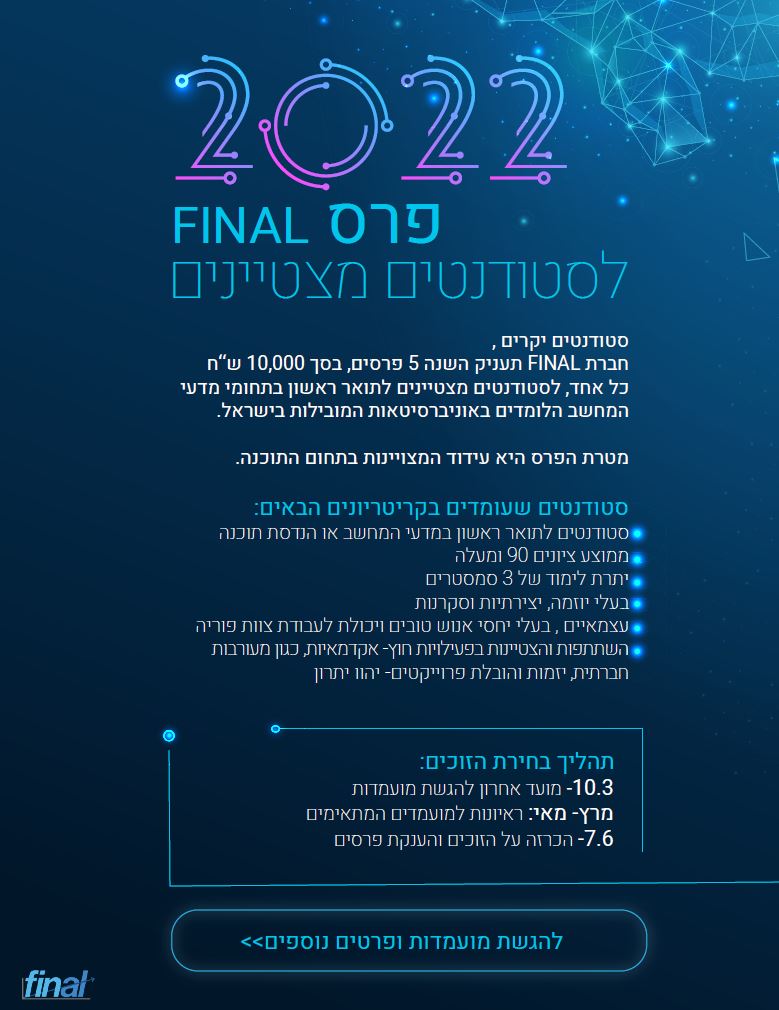
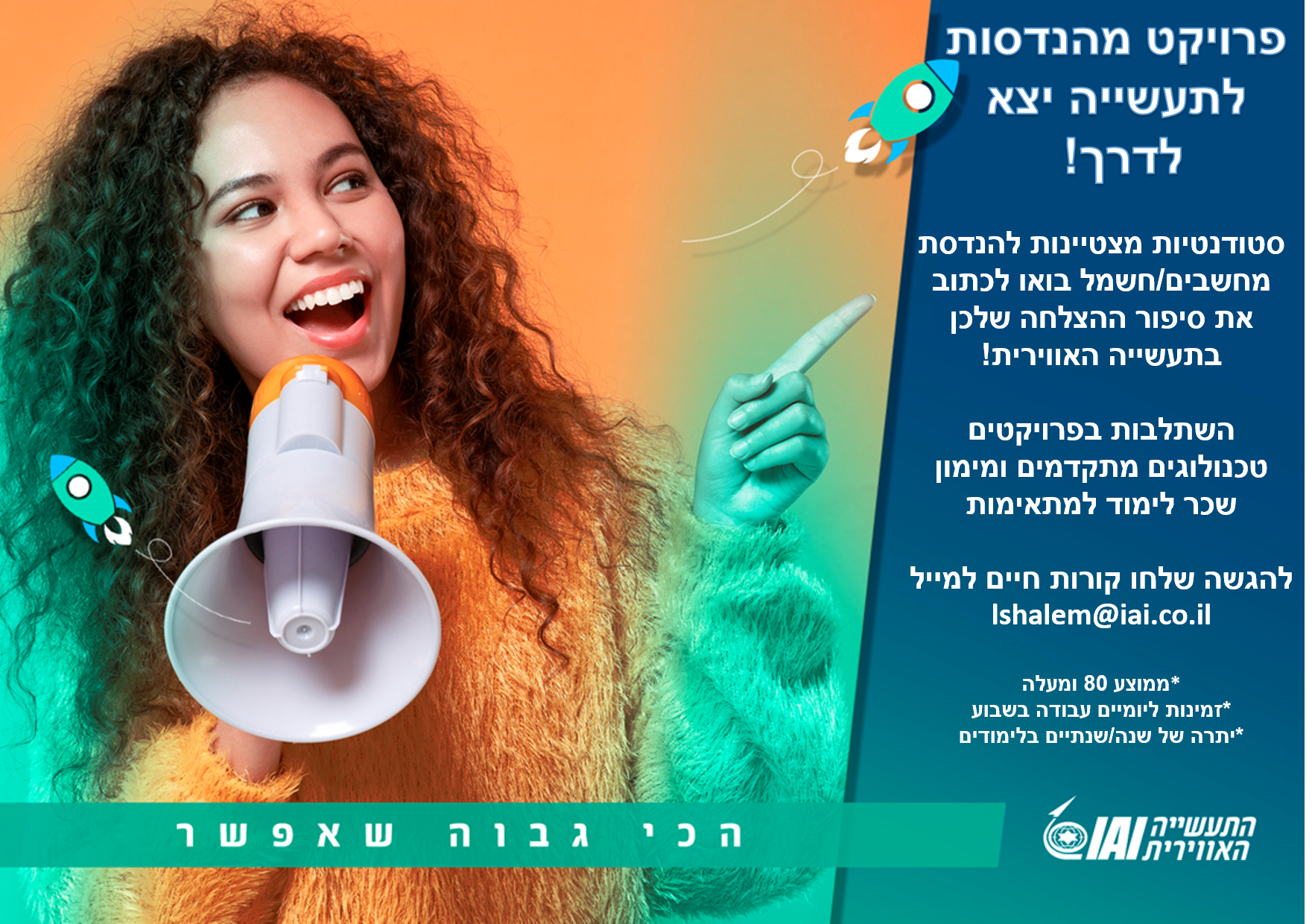
מלגות פתוחות להרשמה-


אודות מלגות העבר 


מלגות סטודנטים.ות בחסות התעשייה

המרכז לקשרי תעשייה רואה את הסטודנטים.ות של אוניברסיטת תל אביב כפורצי הדרך של המחר, ומסייע להם בדרך לפסגה.


אנו רואים בסטודנטים.ות את המהפכנים הטכנולוגיים הבאים, וניכר כי סביבת עבודה מגוונת בשילוב מצוינות הן המפתח להצלחה. לכן אנו משקיעים רבות בפיתוח תוכניות מלגות וסיוע אשר מחברות בין הסטודנטים.ות המצטיינים לבין עמיתינו מהתעשייה. תוכניות אלו מאפשרות לסטודנטים להצטיין ולהכיר לעומק את התעשייה כבר בשלב הלימודים, תוך קבלת תגמול כספי על פועלם והישגיהם המרשימים.


אנו מזמינים את חברינו מהתעשייה להמשיך ולסייע לנו בקידום מטרות ברוכות אלו, שמאפשרות חשיפה והשקעה במובילים הטכנולוגיים הבאים, וכן מובילות לשינוי חברתי והעצמה של אוכלוסיות מגוונות. אנו כמובן נסייע בהנגשת ההזדמנות לסטודנטים, וכן בכל תהליכי המיון וההחלטה.


דוגמאות מן העבר:

הצטרפו אלינו כדי לגלות את הדבר הגדול הבא

Lorem ipsum dolor sit amet, consectetur adipiscing elit, sed do eiusmod tempor incididunt ut labore et dolore magna aliqua. Orci dapibus ultrices in iaculis nunc sed augue lacus. Hac habitasse platea dictumst vestibulum. Senectus et netus et malesuada fames ac turpis egestas. Faucibus ornare suspendisse sed nisi lacus sed viverra tellus. Aliquet sagittis id consectetur purus ut faucibus pulvinar elementum integer. Feugiat nibh sed pulvinar proin gravida. Sapien pellentesque habitant morbi tristique senectus et netus et. Nisl suscipit adipiscing bibendum est ultricies integer quis. Tellus integer feugiat scelerisque varius morbi enim. Pharetra sit amet aliquam id diam maecenas ultricies. Lacinia quis vel eros donec. Sodales neque sodales ut etiam. Magna fringilla urna porttitor rhoncus dolor purus non enim. Quam viverra orci sagittis eu volutpat. Eu feugiat pretium nibh ipsum consequat nisl vel pretium. Vel eros donec ac odio tempor orci dapibus. Augue mauris augue neque gravida. Eu facilisis sed odio morbi quis commodo odio aenean. Faucibus purus in massa tempor nec feugiat nisl.

Enim nunc faucibus a pellentesque sit. Dignissim suspendisse in est ante in nibh mauris. Malesuada nunc vel risus commodo viverra. Ultricies tristique nulla aliquet enim tortor at auctor. Auctor neque vitae tempus quam pellentesque. Nisi lacus sed viverra tellus. Pellentesque elit ullamcorper dignissim cras tincidunt lobortis feugiat vivamus at. Amet nisl purus in mollis nunc sed id semper. Feugiat nibh sed pulvinar proin gravida hendrerit. Vivamus at augue eget arcu dictum varius duis at.

Ornare massa eget egestas purus viverra accumsan. Eget mi proin sed libero enim sed. Tellus elementum sagittis vitae et leo. Sit amet consectetur adipiscing elit duis tristique sollicitudin nibh. Adipiscing at in tellus integer feugiat scelerisque varius morbi enim. Non odio euismod lacinia at quis risus sed. Viverra aliquet eget sit amet tellus cras. Sem nulla pharetra diam sit amet nisl suscipit adipiscing bibendum. Venenatis a condimentum vitae sapien pellentesque habitant. Risus nullam eget felis eget. Pretium viverra suspendisse potenti nullam ac tortor vitae purus faucibus. Mi eget mauris pharetra et ultrices. Eget egestas purus viverra accumsan in nisl nisi scelerisque eu. Iaculis at erat pellentesque adipiscing commodo elit at imperdiet dui. Est lorem ipsum dolor sit amet consectetur. Turpis egestas maecenas pharetra convallis. Malesuada proin libero nunc consequat interdum varius. Aenean sed adipiscing diam donec adipiscing tristique. Id cursus metus aliquam eleifend mi.

Feugiat in fermentum posuere urna nec tincidunt. Pellentesque massa placerat duis ultricies lacus sed turpis tincidunt. Quam pellentesque nec nam aliquam sem et tortor. Purus in massa tempor nec feugiat. Ac turpis egestas maecenas pharetra convallis posuere morbi leo urna. Lectus magna fringilla urna porttitor rhoncus. In egestas erat imperdiet sed. Enim nunc faucibus a pellentesque. Commodo sed egestas egestas fringilla. Viverra tellus in hac habitasse platea dictumst vestibulum rhoncus est. Elementum sagittis vitae et leo. Velit dignissim sodales ut eu. Sit amet nulla facilisi morbi tempus iaculis. Vel turpis nunc eget lorem dolor sed. Consectetur lorem donec massa sapien faucibus et molestie ac.

Urna id volutpat lacus laoreet non curabitur gravida arcu. Nisi vitae suscipit tellus mauris. Cursus sit amet dictum sit amet justo. Pretium quam vulputate dignissim suspendisse in est ante in nibh. Vel quam elementum pulvinar etiam. Sed pulvinar proin gravida hendrerit lectus a. Ipsum nunc aliquet bibendum enim facilisis gravida neque convallis a. Sem nulla pharetra diam sit amet. Lacus luctus accumsan tortor posuere ac. Nulla facilisi morbi tempus iaculis urna id volutpat lacus laoreet. Commodo elit at imperdiet dui accumsan sit amet. Nullam non nisi est sit amet facilisis magna etiam tempor. Morbi tristique senectus et netus. Tortor posuere ac ut consequat semper viverra nam libero justo. Magna etiam tempor orci eu. Morbi tristique senectus et netus et. Et ultrices neque ornare aenean euismod elementum nisi quis eleifend. Ipsum suspendisse ultrices gravida dictum fusce ut.

Urna nec tincidunt praesent semper feugiat nibh. Mattis molestie a iaculis at erat pellentesque. Aliquam eleifend mi in nulla posuere sollicitudin aliquam ultrices sagittis. In mollis nunc sed id. Volutpat sed cras ornare arcu dui vivamus arcu. Quis ipsum suspendisse ultrices gravida dictum fusce ut placerat. Platea dictumst quisque sagittis purus sit amet volutpat consequat. Elit duis tristique sollicitudin nibh sit amet commodo. Faucibus scelerisque eleifend donec pretium vulputate sapien nec sagittis. Tellus elementum sagittis vitae et leo duis ut diam. Sollicitudin ac orci phasellus egestas tellus rutrum tellus.

Ut sem viverra aliquet eget sit. Quam lacus suspendisse faucibus interdum posuere. In mollis nunc sed id semper risus in hendrerit gravida. Tristique nulla aliquet enim tortor at auctor urna nunc. Lobortis feugiat vivamus at augue eget arcu dictum varius. Ut ornare lectus sit amet est placerat in. Fringilla ut morbi tincidunt augue interdum velit euismod in. A condimentum vitae sapien pellentesque habitant morbi tristique senectus. Libero id faucibus nisl tincidunt eget nullam. Turpis nunc eget lorem dolor sed viverra ipsum nunc. Pharetra sit amet aliquam id. Diam maecenas ultricies mi eget mauris pharetra et ultrices. Elementum integer enim neque volutpat ac tincidunt vitae semper. Blandit cursus risus at ultrices. Fermentum iaculis eu non diam phasellus. Nulla malesuada pellentesque elit eget gravida cum sociis.


עמודים

אוניברסיטת תל אביב עושה כל מאמץ לכבד זכויות יוצרים. אם בבעלותך זכויות יוצרים בתכנים שנמצאים פה ו/או השימוש שנעשה בתכנים אלה לדעתך מפר זכויות
שנעשה בתכנים אלה לדעתך מפר זכויות נא לפנות בהקדם לכתובת שכאן >>