EE Seminar: Can We Bypass the Curse of Dimensionality in Private Data Analysis

22 בדצמבר 2024, 15:00 
אולם 011, בניין כיתות חשמל  
EE Seminar: Can We Bypass the Curse of Dimensionality in Private Data Analysis

(The talk will be given in English)


Speaker:     Dr. Eliad Tsfadia

                              Department of Computer Science at Georgetown University


011 hall, Electrical Engineering-Kitot Building‏

Sunday, December 22nd, 2024

15:00 - 16:00


Can We Bypass the Curse of Dimensionality in Private Data Analysis?


Abstract


Differentially private (DP) algorithms typically exhibit a significant dependence on the dimensionality of their input, as their error or sample complexity tends to grow polynomially with the dimension. This cost of dimensionality is inherent in many problems, as Bun, Ullman, and Vadhan (STOC 2014) showed that any method that achieves lower error rates is vulnerable to tracing attacks (also known as membership inference attacks). Unfortunately, such costs are often too high in many real-world scenarios, such as training large neural networks, where the number of parameters (the ambient dimension) is very high.
On the positive side, the lower bounds do not rule out the possibility of reducing error rates for "easy" inputs. But what constitutes "easy" inputs? And how likely is it to encounter such inputs in real-world scenarios?
In this talk, I will present a few ways to quantify "input easiness" for the fundamental task of private averaging and support them with upper and lower bounds. In particular, I will show types of properties that are both sufficient and necessary for eliminating the polynomial dependency on the dimension.

I will conclude by outlining future research directions and providing a broader perspective on my work.


The talk is mainly based on the following three papers:
(1) FriendlyCore https://arxiv.org/abs/2110.10132 (joint with Edith Cohen, Haim Kaplan, Yishay Mansour, and Uri Stemmer, ICML 2022),


(2) https://arxiv.org/abs/2307.07604 (joint with Naty Peter and Jonathan Ullman, COLT 2024),

Short Bio

Eliad Tsfadia is a postdoctoral researcher in the Department of Computer Science at Georgetown University, hosted by Prof. Kobbi Nissim. He completed his Ph.D. in the Department of Computer Science at Tel Aviv University under the supervision of Prof. Iftach Haitner. In addition, Eliad was a research intern at Google Research - Israel (2019-2022), a part-time security researcher at IBM Research - Haifa (2017-2019), and a full-time software engineer, team leader, and officer (Major) in the technological unit of the Intelligence Corps at IDF (2008-2017). Eliad's primary research interests lie in Data Privacy, particularly at the intersections with Cryptography and Machine Learning.


השתתפות בסמינר תיתן קרדיט שמיעה = עפ"י רישום שם מלא + מספר ת.ז. בטופס הנוכחות שיועבר באולם במהלך הסמינר



EE Seminar: Polynomial Time Cryptanalytic Extraction of Neural Network Models

09 בדצמבר 2024, 12:00 
אולם 011, בניין כיתות-חשמל  
EE Seminar: Polynomial Time Cryptanalytic Extraction of Neural Network Models

(The talk will be given in English)


Speaker:     Prof. Adi Shamir

                                Computer Science and Applied Mathematics,Weizmann Institute of Science


011 hall, Electrical Engineering-Kitot Building‏

Monday, December 9th, 2024

12:00 - 13:00


Polynomial Time Cryptanalytic Extraction of Neural Network Models


Abstract

Abstract. Billions of dollars and countless GPU hours are currently spent on training Deep Neural Networks (DNNs) for a variety of tasks. Thus, it is essential to determine the difficulty of extracting all the parameters of such neural networks when given access to their black-box implementations. Many versions of this problem have been studied over the last 30 years, and the best previous attack on ReLU-based deep neural networks was presented at Crypto’20 by Carlini, Jagielski, and Mironov. It resembled a differential chosen plaintext attack on a cryptosystem, which has a secret key embedded in its black-box implementation and required a polynomial number of queries but an exponential amount of time (as a function of the number of neurons).

In this talk, I will improve this attack by developing several new techniques that make it possible to extract with arbitrarily high precision all the real-valued parameters of a ReLU-based DNN using a polynomial number of queries AND a polynomial amount of time. We demonstrated its practical efficiency by applying it to a full-sized neural network for classifying the CIFAR10 dataset, which has 3072 inputs, 8 hidden layers with 256 neurons each, and about 1.2 million neuronal parameters. An attack following the approach by Carlini et al. requires an exhaustive search over 2^256 possibilities, whereas our attack requires only 30 minutes on a 256-core computer. In the last part of the talk I will show a recent extension of the attack which can extract in polynomial time all the parameters of the network even when the attacker receives only the label (e.g., a “cat” or a “dog”) of any given input, rather than the numeric values of its logits.


השתתפות בסמינר תיתן קרדיט שמיעה = עפ"י רישום שם מלא + מספר ת.ז. בטופס הנוכחות שיועבר באולם במהלך הסמינר


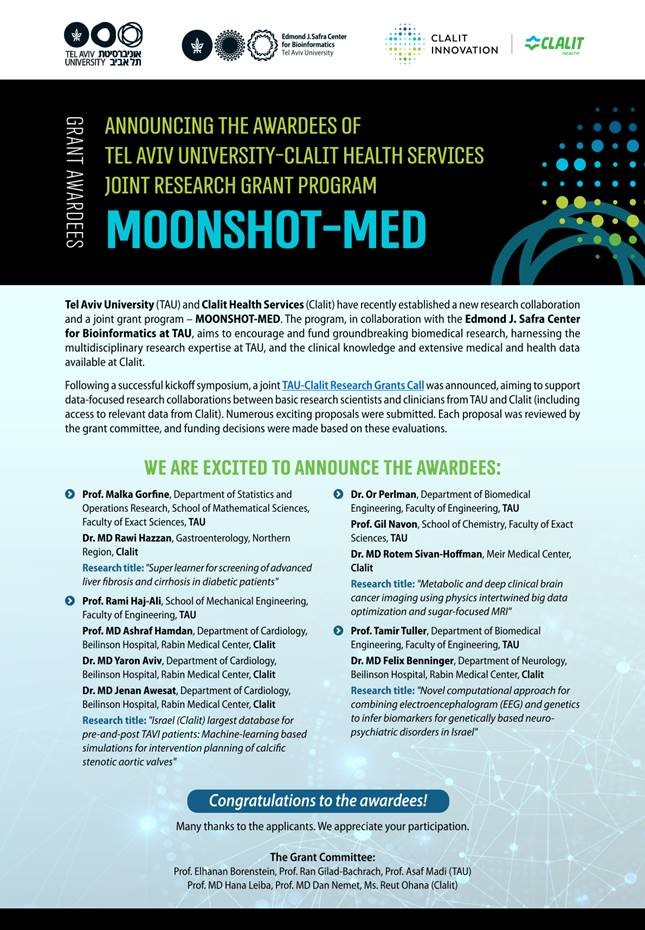
ברכות חמות לפרופ' ראמי חג'-עלי על זכייתו במענק המשותף MOONSHOT-MED של אוניברסיטת תל אביב ושירותי בריאות כללית

ראמי, מחקר שתורם משמעותית לקידום הידע בתחום ומוביל לתוצאות פורצות דרך.

הצלחה רבה בהמשך דרכו

TAUSAT1

TAUSAT2

TAUSAT3
Tevel1


Tevel2

Optical communications 
 
Hyperspectral remote sensing

תכנית ת.ב.ל- תלמידים בונים לוויינים

תכנית לאומית לבנייה ושיגור להק לוויינים על ידי תלמידי תיכון מכל רחבי הארץ!


על התכנית:

תבל הינה תכנית מדעית חינוכית של סוכנות החלל הישראלית ואוניברסיטת תל אביב במסגרתה תלמידי תיכון בונים לווייני מחקר זעירים ומשגרים אותם לחלל. התכנית נועדה לחשוף את התלמידים לתחום של הנדסת חלל ולאפשר להם להתנסות בפרויקט הנדסי אמיתי. במהלך הפרויקט התלמידים עוברים את כל שלבי המחקר והפיתוח החל מתכנון ראשוני של הלוויין, הגדרת המשימה המדעית ודרישות המערכת ועד לפיתוח התוכנה המוטסת, בדיקות מוכנות לשיגור ותפעול הלוויינים בחלל.

בתכנית משתתפים תלמידים מ-9 רשויות: שער הנגב, מעלה אדומים, גבעת שמואל, טייבה, כפר קרע, עין מאהל, ירכא, ירוחם והרצליה. בכל קבוצה נבנה לוויין בחדר הנקי שהוקם בבית הספר. יחד ישוגרו כל 9 הלוויינים לחלל ויבצעו מחקר מדעי משותף.

הלמידה בתכנית כוללת למידה תיאורטית של נושאים מדעיים וטכנולוגיים בהם פיזיקה, אלקטרוניקה, תוכנה, הנדסה מכאנית, תקשורת רדיו, לצד התנסות מעשית (hands-on) בפיתוח הלוויינים, כתיבת תוכנה מוטסת, בדיקות מערכת, תפעול תחנת תקשורת לוויינים, תכנון מכאני ותרמי, תכנון מסלולים ועוד. התלמידים מתמודדים עם אתגרים אמיתיים הדורשים מהם יכולת למידה והכוונה עצמית, חשיבה ביקורתית, חשיבה יצירתית, התנסות בתהליכי פתרון בעיות ועבודת צוות.

(לשים תמונה של לתמידים בכיתה- ילדים עובדים יחד)

על הלוויינים:

בתכנית מפותחים 9 ננו לוויינים מסוג לווייני קובייה (cubesat) בגודל U1- 10*10*11.3 ס"מ

משימות מדעיות לווייני תבל2: ללווייני תבל2 שתי משימות מדעיות:

  • מדידת קרינה מהחלל: מטע"ד המפותח ע"י מחלקת סביבת חלל במרכז למחקר גרעיני שורק (ממ"ג) ועתיד לבצע ניסוי למדידת שטף חלקיקים אנרגטיים הנפלטים מהשמש ומקרניים קוסמיות. המדידה תבוצע ע"י ספירת מספר היפוכי הביט, תיעוד קצרים וקרינה מצטברת הנמדדת ברכיבי האלקטרוניקה והחיישנים שבמטע"ד.
  • תקשורת חובבות רדיו באמצעות משיב אנלוגי

שיגור: מרץ 2025, SpaceX

מרכז בקרה ושליטה: הלוויינים נשלטים מתוך תחנת הקרקע לתקשורת לוויינים באוניברסיטת תל אביב.

A group of young men looking at a computer screen

Description automatically generatedA group of people sitting in chairs using computers

Description automatically generated

סמינר שמיעה לתלמידי תואר שני ושלישי

03 בדצמבר 2024, 14:00 
בניין וולפסון, חדר 206  
Involving humans in AI-supported fake news detection

Join us with Zoom

Involving humans in AI-supported fake news detection

Amit Miller, M.Sc. student at the department of Industrial  Advisor: Prof. Joachim Meyer


Abstract:

“Fake News” refers to false or misleading information presented as news, often spread online or through social media. It is typically created to manipulate public opinion, generate revenue through sensationalism, or promote specific agendas .An overwhelming amount of fake news is circulating online, making it increasingly difficult to distinguish truth from falsehood. This vast spread creates confusion, as fake news often mimics credible sources, blurring the line between real and fabricated information. Our research analyzes a system, such as a news desk at a media site, that receives a stream of incoming news items from various sources and has to decide which items to publish and which to discard as fake. To do so, one or more people can view items and there is also an AI system that classifies the incoming items. We evaluated various configurations within this hybrid setup with a computational model. We reviewed performance metrics in order to provide recommendations on the use of such a system as a function of properties of the AI and the human, the costs and benefits of publishing or not publishing fake or true items, and the relative frequency of fake items in the incoming stream. The results show that a clear recommendation can be given in most cases, and that some configurations are superior to others in the cases we reviewed. Additionally, we were able to show that some parameters can be combined to reduce the complexity of the problem.


Bio:

Amit Miller is a M.Sc. student in the department of industrial engineering in Tel Aviv university. He works as a professional in the gaming industry, using data, analytics & AI in order to optimize business decisions. He also holds a B.Sc. degree in Civil engineering from the Technion.

ד"ר גלי פיכמן-Bio inspired Design of Peptide-Baseded Infections Functional Gels for Preventing Implant-Relat

15 בדצמבר 2024, 14:00 
חדר סמינרים -חדר 315  
ד"ר גלי פיכמן-Bio inspired Design of Peptide-Baseded Infections Functional Gels for Preventing Implant-Relat

Abstract: Self-assembling peptides offer great potential as versatile building blocks for developing functional hydrogels suitable for various applications.

This presentation will focus on the mussel inspired design of peptide-based antibacterial hydrogels.

These bioinspired materials combat bacteria through a dual mechanism involving surface-contact membrane disruption and oxidative killing facilitated by hydrogen peroxide (H2O2) production. The leading formulation, MIKA2, has shown its potential as an injectable hydrogel capable of preventing implant-related bacterial infections, effectively reducing bacterial colonization on titanium implants in mice.

LMI Seminar: Time-resolved attosecond interferometry

04 בדצמבר 2024, 13:00 
הפקולטה להנדסה אוניברסיטת תל אביב, בנין כיתות ,אולם 011  
LMI Seminar: Time-resolved attosecond interferometry


עמודים

אוניברסיטת תל אביב עושה כל מאמץ לכבד זכויות יוצרים. אם בבעלותך זכויות יוצרים בתכנים שנמצאים פה ו/או השימוש שנעשה בתכנים אלה לדעתך מפר זכויות
שנעשה בתכנים אלה לדעתך מפר זכויות נא לפנות בהקדם לכתובת שכאן >>