להענקת מלגות לחדשנות בתחום התחבורה החכמה

מכון שלמה שמלצר לתחבורה חכמה באוניברסיטת תל אביב שם לו למטרה לקדם מחקר יישומי ולעודד שיתופי פעולה עם התעשייה בעולם התחבורה החכמה.

קול קורא להגשת הצעות למענקי מחקר

קול קורא לתמיכה בתשתית מחקרית כמעבדה ניידת


CityZoom, מכון שלמה שמלצר לתחבורה חכמה, ומרכז העיר

28 יוני 2018

המפגש הראשון של "פורום ערים חכמות" של אוניברסיטת תל אביב התקיים ב-17 ביוני 2018. המפגש היה שיתוף פעולה מיוחד של מכון שלמה שמלצר לתחבורה חכמה, המרכז לחקר העיר והעירוניות וקהילת City Zoom.

מודים לכל מי שבא והשתתף! 

לתמונות מהארוע

ידיעות נוספות בנושא

School of Mechanical Engineering Omer Halevy and Dimitry Groylich

09 ביולי 2018, 13:40 
בניין תכנה 103  
0
 School of Mechanical Engineering  Omer Halevy and Dimitry Groylich


School of Mechanical Engineering Seminar
Monday, July 9 2018 at 14:00
Tokhna Building of Mechanical Engineering, Room 103


Design of the wall surface wetting properties for stabilization of desired separated flow configurations in micro channels.

Dmitriy Goykhman

M.Sc. student of Prof. Neima Brauner and Prof. Amos Ullmann


Stratified flow of two immiscible phases can be found in a variety of processes and equipment. In the last two decades, the microfluidics discipline has seen a phenomenal growth with increasing ranges of applications. Naturally, in macro systems, it is always the heavier fluid that forms the lower layer. In mini and micro channels, the role of gravity diminishes and surface tension and wall adhesion forces, along with viscous forces, become dominant. The flow pattern in the channel can be affected by the affinity of the fluids and the channel surface. This study examines to what extent the design of the wall surface wetting properties can be used as a mean to stabilize a desired separated flow configuration in micro channels. For example, performance considerations of the microfluidic system may show advantages of stabilizing configurations where the heavier phase flows above the light phase.

A practical design tool is obtained by introducing the constant curvature approximation to represent the shape of the phases interface and their stable location (e.g., top light or top heavy). The stable configuration is considered as the one associated with the lower free (gravitational and surface) energy. The closure obtained for the interface curvature via the approximate solution is combined with the available exact solution for stratified two-phase laminar flows with curved interfaces to obtain the corresponding phase flow rates and the associated flow characteristics. Finally, the assumption of constant interface curvature is relaxed, and an exact solution for the interface shape is presented by a solution of the Young-Laplace equation. This enables validation of the conclusions obtained based on the approximate constant curvature solution.


Electrostatically Actuated Bistable Cantilevers for Resonant Acceleration Sensing

Omer HaLevy

School of Mechanical Engineering, Faculty of Engineering,

Tel Aviv University, Ramat Aviv, 69978, Israel

omerlev1@mail.tau.ac.il


Resonant accelerometers incorporating vibrating beams demonstrate higher sensitivity and better robustness when compared to their statically operated counterparts. Operation of these devices in the vicinity of the critical instability points, often achieved by means of electrostatic softening, can result in an enhanced performance of resonant sensors. While double-clamped curved bistable beams can serve as resonant acceleration sensors, they suffer from high sensitivity to temperature and residual stress. Cantilevers are distinguished by low sensitivity to the thermal stress but their stiffness tuning is challenging.

In this research we report on a feasibility study of a displacement/acceleration sensor incorporating an electrostatically actuated bistable resonant cantilever as the sensing element. The concept is based on the tailoring of the device geometry and the actuating force in such a way that the beam in its initial “as fabricated” configuration is already positioned near the critical point.  Our reduced order Galerkin and coupled finite elements models results show that the frequency to deflection sensitivity of the L = 150 mm long, h = 16 mm wide and d = 1 mm thick cantilever can reach 20 Hz/nm. This is equivalent to the frequency to acceleration sensitivity of 388 Hz/g, obtained for the case of a 4 mm × 4 mm × 20 mm proof mass. The devices incorporating ≈ 50 mm thick electrodes and ≈ 6 µm thick cantilevers were fabricated from a silicon on insulator (SOI) wafer using deep reactive ion etching (DRIE). We discuss the fabrication process and present preliminary experimental results. The second part of the work is focused on the exploration of the synchronization (lock-in) phenomenon in resonant sensors. The lock-in effect often limits the performance of differential resonant sensors containing two oscillators and operated in an anti-phase (tuning fork) mode. We present a reduced order model of a generic tuning fork device. The model accounts for the geometric nonlinearity of the vibrating beams and for the nonlinear coupling. The results of the numerical investigation are presented and role of various parameters on the device behavior is discussed.


School of Mechanical Engineering Dr. Marc Buckley

02 ביולי 2018, 14:00 - 15:00 
בניין וולפסון חדר 234  
0
School of Mechanical Engineering Dr. Marc Buckley


School of Mechanical Engineering Seminar
Monday, July 2, 2018 at 14:00
Wolfson Building of Mechanical Engineering, Room 234


The influence of waves on the air-sea momentum flux


Dr. Marc Buckley

Institute of Coastal Research, Helmholtz-Zentrum Geesthacht, Germany


The transfers of momentum and scalars across the air-sea interface are influenced by small-scale turbulent processes. In spite of extensive existing work on the topic, our understanding of near-surface physics remains incomplete. This is partly due to the technical challenges involved in the measurement of the small-scale dynamics very close to the rapidly moving ocean surface. We present new in situ measurements of the submillimeter-scale motions in the airflow above waves. A high resolution, large field of view Particle Image Velocimetry (PIV) system was specially developed for measurements at the ocean surface, capable of capturing 2D velocity fields in the turbulent airflow directly above the wavy surface. The system was recently deployed on RP FLIP. Using preliminary field measurements as well as laboratory wave tank measurements, we will discuss the impact of waves on the structure of the wind stress within the wave boundary layer, and in particular how breaking and non-breaking waves influence the momentum flux's partitioning between viscous, form drag, wave-coherent and turbulent contributions.


School of Mechanical Engineering Professor Gennady Mishuris

25 ביוני 2018, 14:00 - 15:00 
בניין וולפסון חדר 206  
0
School of Mechanical Engineering Professor Gennady Mishuris


School of Mechanical Engineering Seminar
Monday, June 25, 2018 at 14:00
Wolfson Building of Mechanical Engineering, Room 206


Shear stress induced by a fluid on the surface of a hydraulically driven crack.

Energy release rate in hydraulic fracture: Should or should not one take the phenomenon of the shear stress into account?


Professor Gennady Mishuris
Royal Society Wolfson Research Merit Award Holder
Department of Mathematics, IMPACS, Aberystwyth University
http://www.aber.ac.uk/en/maths/staff-list/staff_profiles/?login=ggm 


The talk consists of two parts.


In the first one, we briefly overview recent advance in the mathematical and numerical modelling of Hydraulic Fracture leading to an explicit level set algorithm based in particular on the accurate accounting for the solution asymptotics.


Then, in the second part, we discuss a novel HF model which accounts for the hydraulically induced shear stresses at the crack faces. It utilizes a general form of the elasticity operator alongside a revised fracture propagation condition based on the critical value of the energy release rate. 

We show that the revised formulation is always in agreement with the linear elastic fracture mechanics. We show that the phenomenon may play a significant role in the case of so-called small toughness and viscosity dominated regimes while in the other regimes it provides the analogous result as the classic model. We have also found that the small toughness regime should be no longer considered as a computational challenge. Finally, in those regimes, predicted crack redirection angle may change dramatically in comparison with the classic approach. We believe that the modified formulation opens new ways to analyse the physical phenomenon of HF, as well as improving the reliability and efficiency of its numerical simulation (our numerical simulations have already highlighted advantages of the model).


אירוע פרוייקטי הגמר של בית-ספר להנדסת חשמל 2018

21 יוני 2018
אירוע פרוייקטי הגמר

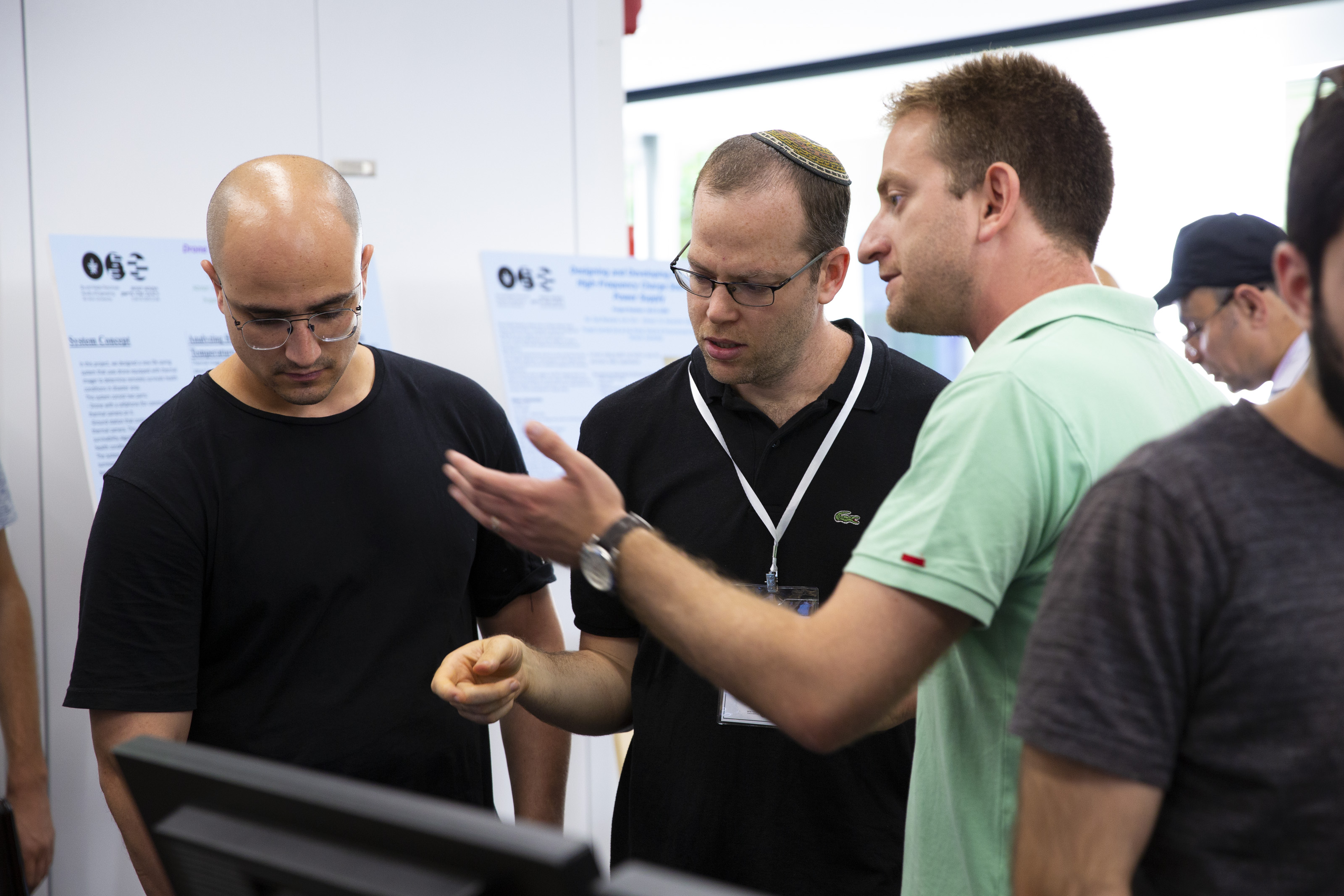
בתאריך ה 12.6 התכנסו הסטודנטים מבית הספר להנדסת חשמל להצגת פרוייקטי הגמר שלהם. הסטודנטים הביאו לידי ביטוי את היכולות ההנדסיות אשר רכשו במהלך לימודיהם בפקולטה להנדסה של אוניברסיטת תל-אביב. המוטיבציה לפרויקטים השונים נבעה מתוך ההבנה בצורך וחוסר אמיתי שקיים סביבם ותשוקה להבאת הפיתרון היצירתי ביותר.

בארוע נכחו פרופ' יוסי רוזנוקס, דיקאן הפקולטה להנדסה, פרופ' מרק שטייף, ראש ביה"ס להנדסת חשמל, ד"ר עפר עמרני, אחראי אקדמי על הפרויקטים בהנדסת חשמל, ויעקב פיינגלרנט, מהנדס ראשי ומארגן הארוע.  מר ינון ברכה, מנכ"ל PrimeSense לשעבר, העביר הרצאה מרתקת בנושא: "המהנדס/ת בעולם העתיד", מה בעצם מצפים ממהנדסים על מנת להצליח בעבודתם בעולם העתידי (שהוא למעשה כבר כאן) שבו קצב השינוי הולך וגדל. בסיום הארוע השופטים הכריזו על שלושת הפרוייקטים הזוכים:


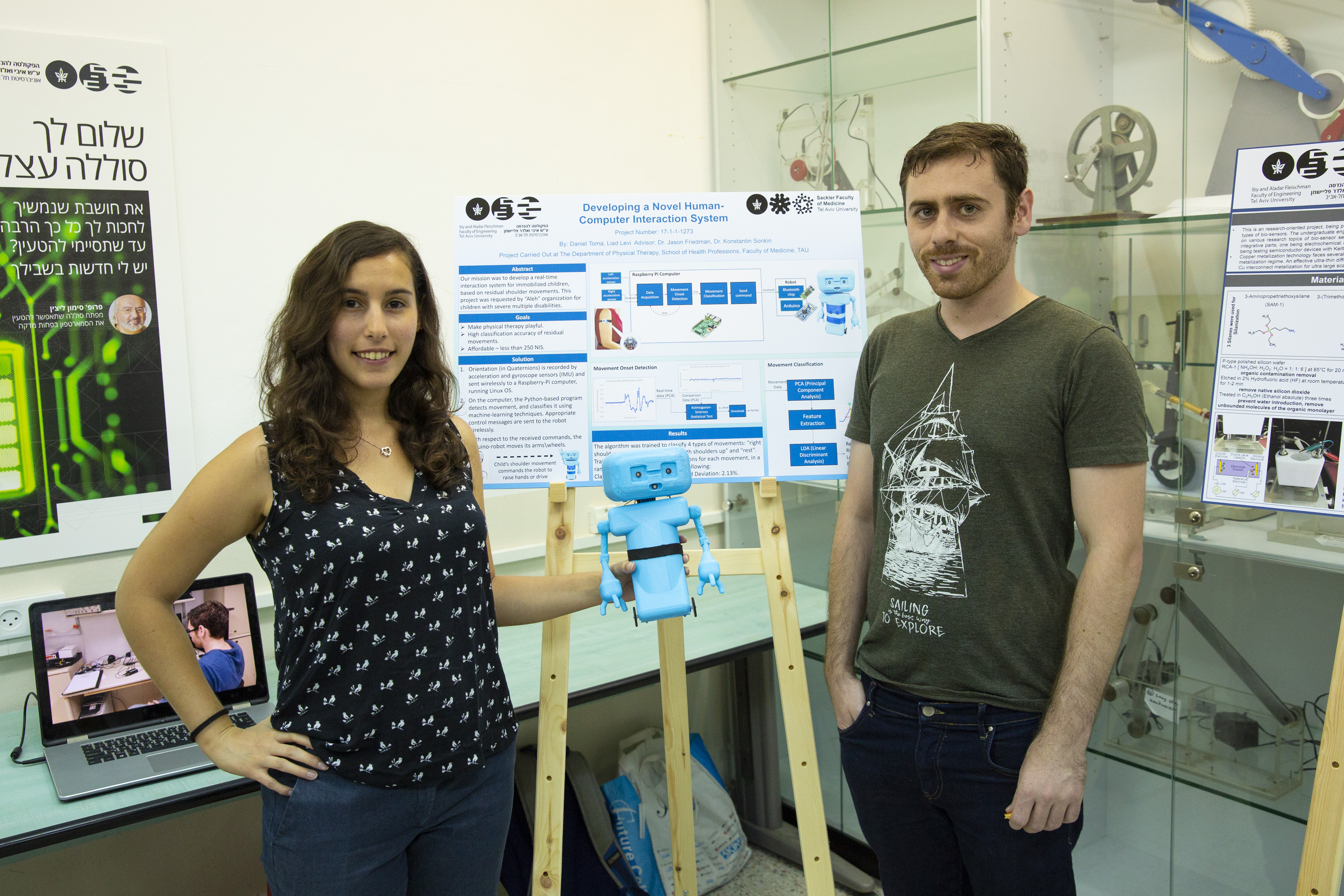
מקום ראשון - Develop a Novel Human-Computer Interaction System

ליעד לוי, דניאל טומה - הנדסת חשמל, שנה ד', בהנחיית ד"ר ג'ייסון פרידמן וד"ר קונסנטין סונקין

מטרת המוצר היא לשמש בשיקום ילדים עם לקויות מוטוריות ואנשים עם פציעה בעמוד השדרה העליון. בעיקרון הפציינט לובש חיישני תאוצה על כתפיו, המידע נשלח למחשב קטן שמעבד את המידע ומחליט איזו תנועה בוצעה, ולבסוף נשלחת פקודה לרובוט שיכול לנסוע (גם שמאלה או ימינה) ולהזיז את ידיו. כך ניתן לשלב משחק מהנה בתהליך השיקום. הפרוייקט בוצע בשיתוף עם Brainboost של בית הספר סגול למדעי המוח.

השראה: חיפשנו פרוייקט בתחום של עיבוד אותות ובחרנו בפרוייקט הזה כי ראינו שהוא יכול לעזור לאנשים. עניין אותנו השלב הבא בפיתוח המוצר – המוצר ישולב עם מדידת פעילות מוחית כך שיוכל לעזור גם לאנשים ללא שום יכולת תנועה.
 

מקום שני - Autonomous Nano-Drones Indoor Navigation System Based On Motion Capture Positioning Control 

יותם גני ואוראל בן ישי,  הנדסת חשמל ומדעי המחשב, שנה ד', בהנחיית יהונתן מנדל

המערכת שפותחה מאפשרת בקרת תנועה וניווט אוטונומיים בחלל סגור עבור קבוצה ("Swarm") של רחפנים זעירים, בהתבסס על מערכת עקיבת מיקום. המערכת מורכבת מרכיב תוכנה מרכזי שפותח ורץ בסביבת ROS (ר"ת Robotic Operating System), רחפנים זעירים (Nano-Drones) מסוג "CrazyFlie" שפותחו בסביבת Open-Source, ומערכת עקיבה סגורה מסוג "OptiTrack" המבוססת על 6 מצלמות IR ותוכנת עקיבה. בהיבט המחקרי, המערכת תהווה תשתית ופלטפורמה לפיתוח ומחקר בתחום אלגוריתמי תנועה מתקדמים לרחפנים, ובהיבט היישומי, מערכת שכזו יכולה לאפשר פתרונות רבים לצרכי ניווט אוטונומי במרחב סגור, כמו למשל, ביצוע ניהול מלאי אוטונומי במרכזים לוגיסטיים ומחסנים גדולים. תוצרי הפרויקט כללו טיסה אוטונומית ומדויקת של Swarm של רחפנים במרחב, כולל אפליקציות מתקדמות כמו עקיבת רחפן אחרי מטרה, מניעת התנגשויות ועקיבה אחר מסלול חלק. 
 

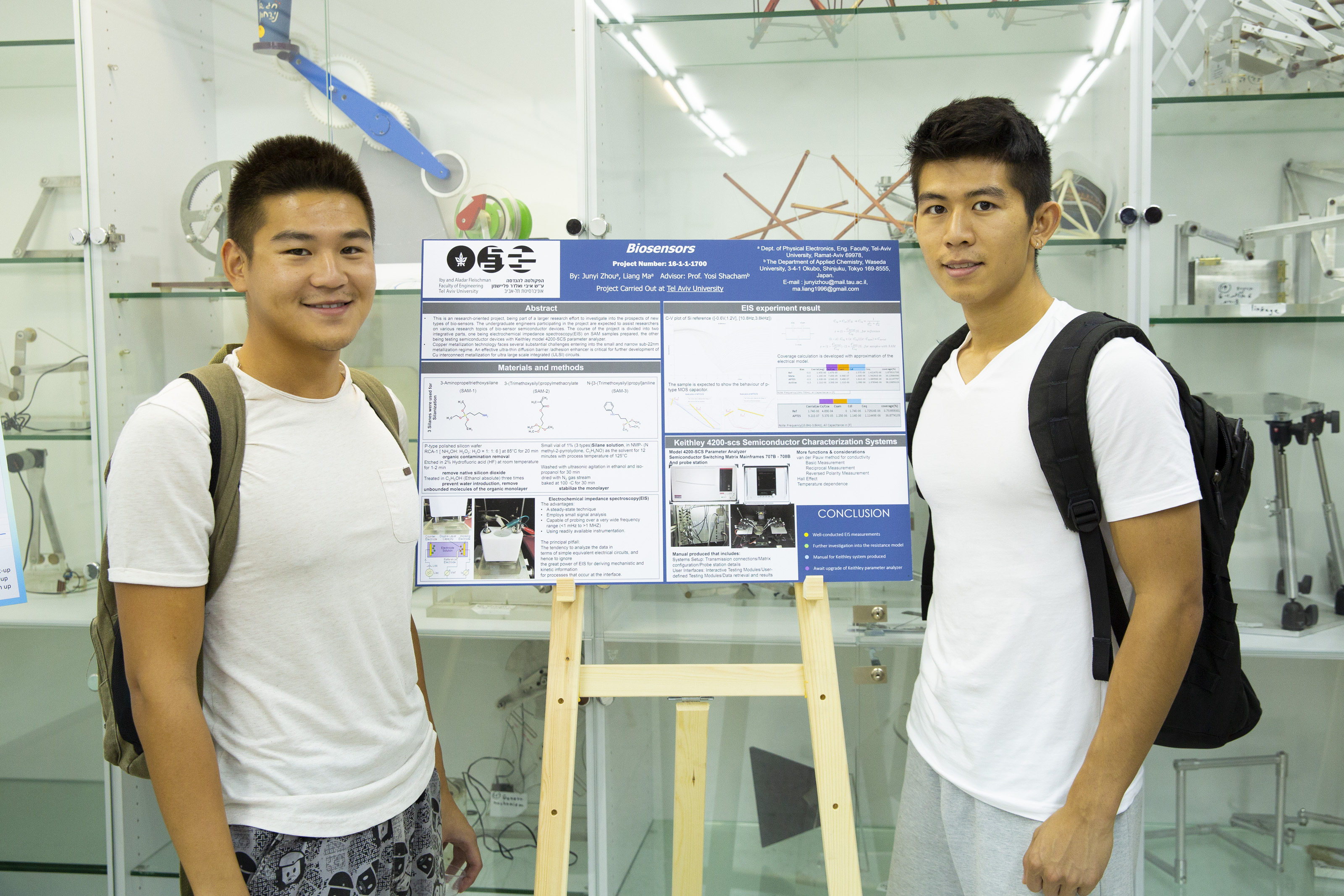
מקום שלישי - Biosensors

Junyi Zhou ו Liang Ma, הנדסת חשמל מהתכנית הבינלאומית, בהנחיית פרופ' יוסי שחם

זהו פרוייקט מחקרי, כחלק ממאמץ מחקרי גדול יותר לחקור את הסיכויים של סוגים חדשים של biosensors. מהנדסים לתואר ראשון המשתתפים בפרויקט התבקשו לסייע לחוקרים לחקור נושאים שונים של חומרים מובנים המוליכים למחצה התקנים כגון: מתכת / מבודדים / סיליקון. אמנם יש הרבה בדיקות קשורות, למשל זווית המגע, אליפסומטריה, מיקרוסקופ כוח אטומי, ספקטרוסקופית רנטגן פוטו-אלקטריקאית. מסלול זה מתמקד במבחני החשמל ומחולק לשני חלקים אינטגרטיביים, אחד מהם ספקטרוסקופית עכבה אלקטרוכימית (EIS) על הדגימות תצהיר מונולייר עצמי  / סיליקון מוכן, השני להיות בדיקות התקנים מוליכים למחצה עם מודל Keithley 4200-SCS Analyzer. 

השראה: ההשראה נובעת מהזיהוי של הצורך בפיתוח שיטת בדיקה לניטור תצהיר מונולייר עצמי (SAM) דרך יעילה וזולה יותר. לא רק למטרות מחקר, אלא גם עבור העולם התעשייתי.

  • 31יולי
  • 30יולי
  • 29יולי
  • 28יולי
  • 27יולי
  • 26יולי
  • 25יולי
  • 24יולי
  • 23יולי
  • 22יולי
  • 21יולי
  • 20יולי
  • 19יולי
  • 18יולי
  • 17יולי
  • 16יולי
  • 15יולי
  • 14יולי
  • 13יולי
  • 12יולי
  • 11יולי
  • 10יולי
  • 09יולי
  • 08יולי
  • 07יולי
  • 06יולי
  • 05יולי
  • 04יולי
  • 03יולי
  • 02יולי
  • 01יולי
  • 30יוני
  • 29יוני
  • 28יוני
  • 27יוני
  • 26יוני
  • 25יוני
  • 24יוני
  • 23יוני
  • 22יוני
  • 21יוני
  • 20יוני
  • 19יוני
  • 18יוני
  • 17יוני
  • 16יוני
  • 15יוני
  • 14יוני
  • 13יוני
  • 12יוני
  • 11יוני
  • 10יוני
  • 09יוני
  • 08יוני
  • 07יוני
  • 06יוני
  • 05יוני
  • 04יוני
  • 03יוני
  • 02יוני
  • 01יוני
  • 31מאי
  • 30מאי
  • 29מאי
  • 28מאי
  • 27מאי
  • 26מאי
  • 25מאי
  • 24מאי
  • 23מאי
  • 22מאי
  • 21מאי
  • 20מאי
  • 19מאי
  • 18מאי
  • 17מאי
  • 16מאי
  • 15מאי
  • 14מאי
  • 13מאי
  • 12מאי
  • 11מאי
  • 10מאי
  • 09מאי
  • 08מאי
  • 07מאי
  • 06מאי
  • 05מאי
  • 04מאי
  • 03מאי
  • 02מאי
  • 01מאי
  • 30אפריל
  • 29אפריל
  • 28אפריל
  • 27אפריל
  • 26אפריל
  • 25אפריל
  • 24אפריל
  • 23אפריל
  • 22אפריל
  • 21אפריל
  • 20אפריל
  • 19אפריל
  • 18אפריל
  • 17אפריל
  • 16אפריל
  • 15אפריל
  • 14אפריל
  • 13אפריל
  • 12אפריל
  • 11אפריל
  • 10אפריל
  • 09אפריל
  • 08אפריל
  • 07אפריל
  • 06אפריל
  • 05אפריל
  • 04אפריל
  • 03אפריל
  • 02אפריל
  • 01אפריל
  • 31מרץ
  • 30מרץ
  • 29מרץ
  • 28מרץ
  • 27מרץ
  • 26מרץ
  • 25מרץ
  • 24מרץ
  • 23מרץ
  • 22מרץ
  • 21מרץ
  • 20מרץ
  • 19מרץ
  • 18מרץ
  • 17מרץ
  • 16מרץ
  • 15מרץ
  • 14מרץ
  • 13מרץ
  • 12מרץ
  • 11מרץ
  • 10מרץ
  • 09מרץ
  • 08מרץ
  • 07מרץ
  • 06מרץ
  • 05מרץ
  • 04מרץ
  • 03מרץ
  • 02מרץ
  • 01מרץ
  • 28פברואר
  • 27פברואר
  • 26פברואר
  • 25פברואר
  • 24פברואר
  • 23פברואר
  • 22פברואר
  • 21פברואר
  • 20פברואר
  • 19פברואר
  • 18פברואר
  • 17פברואר
  • 16פברואר
  • 15פברואר
  • 14פברואר
  • 13פברואר
  • 12פברואר
  • 11פברואר
  • 10פברואר
  • 09פברואר
  • 08פברואר
  • 07פברואר
  • 06פברואר
  • 05פברואר
  • 04פברואר
  • 03פברואר
  • 02פברואר
  • 01פברואר
  • 31ינואר
  • 30ינואר
  • 29ינואר
  • 28ינואר
  • 27ינואר
  • 26ינואר
  • 25ינואר
  • 24ינואר
  • 23ינואר
  • 22ינואר
  • 21ינואר
  • 20ינואר
  • 19ינואר
  • 18ינואר
  • 17ינואר
  • 16ינואר
  • 15ינואר
  • 14ינואר
  • 13ינואר
  • 12ינואר
  • 11ינואר
  • 10ינואר
  • 09ינואר
  • 08ינואר
  • 07ינואר
  • 06ינואר
  • 05ינואר
  • 04ינואר
  • 03ינואר
  • 02ינואר
  • 01ינואר
  • 31דצמבר
  • 30דצמבר
  • 29דצמבר
  • 28דצמבר
  • 27דצמבר
  • 26דצמבר
  • 25דצמבר
  • 24דצמבר
  • 23דצמבר
  • 22דצמבר
  • 21דצמבר
  • 20דצמבר
  • 19דצמבר
  • 18דצמבר
  • 17דצמבר
  • 16דצמבר
  • 15דצמבר
  • 14דצמבר
  • 13דצמבר
  • 12דצמבר
  • 11דצמבר
  • 10דצמבר
  • 09דצמבר
  • 08דצמבר
  • 07דצמבר
  • 06דצמבר
  • 05דצמבר
  • 04דצמבר
  • 03דצמבר
  • 02דצמבר
  • 01דצמבר
  • 30נובמבר
  • 29נובמבר
  • 28נובמבר
  • 27נובמבר
  • 26נובמבר
  • 25נובמבר
  • 24נובמבר
  • 23נובמבר
  • 22נובמבר
  • 21נובמבר
  • 20נובמבר
  • 19נובמבר
  • 18נובמבר
  • 17נובמבר
  • 16נובמבר
  • 15נובמבר
  • 14נובמבר
  • 13נובמבר
  • 12נובמבר
  • 11נובמבר
  • 10נובמבר
  • 09נובמבר
  • 08נובמבר
  • 07נובמבר
  • 06נובמבר
  • 05נובמבר
  • 04נובמבר
  • 03נובמבר
  • 02נובמבר
  • 01נובמבר
  • 31אוקטובר
  • 30אוקטובר
  • 29אוקטובר
  • 28אוקטובר
  • 27אוקטובר
  • 26אוקטובר
  • 25אוקטובר
  • 24אוקטובר
  • 23אוקטובר
  • 22אוקטובר
  • 21אוקטובר
  • 20אוקטובר
  • 19אוקטובר
  • 18אוקטובר
  • 17אוקטובר
  • 16אוקטובר
  • 15אוקטובר
  • 14אוקטובר
  • 13אוקטובר
  • 12אוקטובר
  • 11אוקטובר
  • 10אוקטובר
  • 09אוקטובר
  • 08אוקטובר
  • 07אוקטובר
  • 06אוקטובר
  • 05אוקטובר
  • 04אוקטובר
  • 03אוקטובר
  • 02אוקטובר
  • 01אוקטובר
  • 30ספטמבר
  • 29ספטמבר
  • 28ספטמבר
  • 27ספטמבר
  • 26ספטמבר
  • 25ספטמבר
  • 24ספטמבר
  • 23ספטמבר
  • 22ספטמבר
  • 21ספטמבר
  • 20ספטמבר
  • 19ספטמבר
  • 18ספטמבר
  • 17ספטמבר
  • 16ספטמבר
  • 15ספטמבר
  • 14ספטמבר
  • 13ספטמבר
  • 12ספטמבר
  • 11ספטמבר
  • 10ספטמבר
  • 09ספטמבר
  • 08ספטמבר
  • 07ספטמבר
  • 06ספטמבר
  • 05ספטמבר
  • 04ספטמבר
  • 03ספטמבר
  • 02ספטמבר
  • 01ספטמבר
  • 31אוגוסט
  • 30אוגוסט
  • 29אוגוסט
  • 28אוגוסט
  • 27אוגוסט
  • 26אוגוסט
  • 25אוגוסט
  • 24אוגוסט
  • 23אוגוסט
  • 22אוגוסט
  • 21אוגוסט
  • 20אוגוסט
  • 19אוגוסט
  • 18אוגוסט
  • 17אוגוסט
  • 16אוגוסט
  • 15אוגוסט
  • 14אוגוסט
  • 13אוגוסט
  • 12אוגוסט
  • 11אוגוסט
  • 10אוגוסט
  • 09אוגוסט
  • 08אוגוסט
  • 07אוגוסט
  • 06אוגוסט
  • 05אוגוסט
  • 04אוגוסט
  • 03אוגוסט
  • 02אוגוסט
  • 01אוגוסט
הצג אירועים:
בתאריכים:
נקה סינון
22יוני
אירוע
  הפקולטה להנדסה נרגשת להזמין אתכם.ן לאירוע השנתי הגדול שלנו!

הציבור מוזמן

22/06/26
09:00
22יוני
סמינר

יום פקולטה להנדסה

22/06/26
18:00
-
09:00
05ינואר
סמינר

סמינר שמיעה לתלמידי תואר שני ושלישי

05/01/27
13:00

TAU-SERI- השקת מיזם למחקר בהנדסת מערכות

27 ביוני 2018, 18:30 - 20:45 
אולם רוזנבלט  
0
TAU-SERI- השקת מיזם למחקר בהנדסת מערכות

18:30-19:15

התכנסות                                                  

19:15-19:30

פרופ' יורם רייך – ראש המיזם, הצגת מיזם המחקר  להנדסת מערכות

19:30-19:35

פרופ' יוסי רוזנוקס – דקאן הפקולטה, ברכות

19:35-20:00

תא"ל רמי מלאכי – מפקד לוט"מ, אתגרים בתכנון ופיתוח מערכות מורכבות

20:00-20:45

עוזי אוריון, ממייסדי המיזם, מה בין מוסיקה קלסית להנדסת מערכות?

עמודים

אוניברסיטת תל אביב עושה כל מאמץ לכבד זכויות יוצרים. אם בבעלותך זכויות יוצרים בתכנים שנמצאים פה ו/או השימוש שנעשה בתכנים אלה לדעתך מפר זכויות
שנעשה בתכנים אלה לדעתך מפר זכויות נא לפנות בהקדם לכתובת שכאן >>