EE Seminar: Improving Prediction of Subroutine Return Branches

Speaker: Netanel Buhbut,

M.Sc. student under the supervision of Prof. Shlomo Weiss


Monday, February 13th, 2017 at 15:00

Room 011, Kitot Bldg., Faculty of Engineering


Improving Prediction of Subroutine Return Branches


Abstract


This work studies the return from subroutine in deeply pipelined VLIW DSP. Modern DSPs are designed to be deeply pipelined, some in order of 15 and up, to cope with high clock frequencies. Speculative instructions enter the processor's pipeline to avoid pipeline stalls and keep high throughput. This work proposes a fast and simple return from subroutine prediction using Return-Address Stack (RAS) and Return-Address Buffer (RAB). The proposed technique was measured using the output trace of a SimpleScalar simulator running a subset of Mediabench and Coremark benchmarks. While investigating the return from subroutine, we found a pairing mismatch in the benchmarks. In this work, the pairing mismatch is defined and a recovery mechanism, that helps the RAS recover from data corruption, is described. Finally, the design was synthesized for FPGA, in order to determine if it is a feasible solution for modern DSPs in terms of core frequency, power and area.

13 בפברואר 2017, 15:00 
חדר 011, בניין כיתות-חשמל  

התקיים ב- 25.12.2016

05 פברואר 2017
המפגש השנתי השני של המחלקה להנדסה ביו רפואית

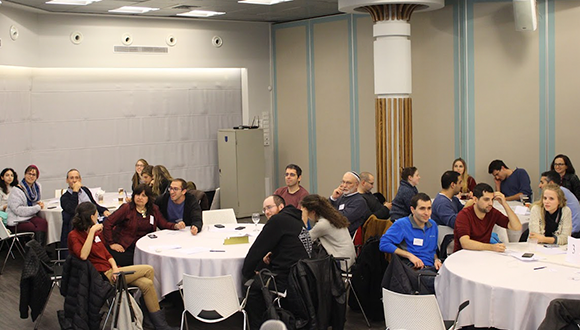
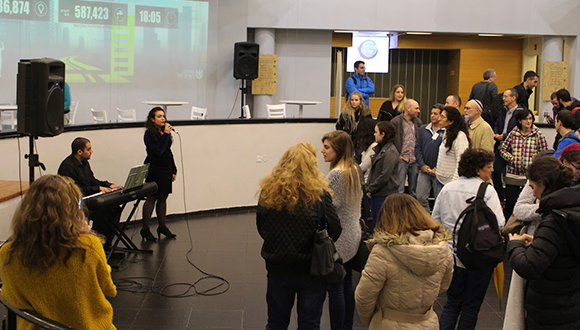
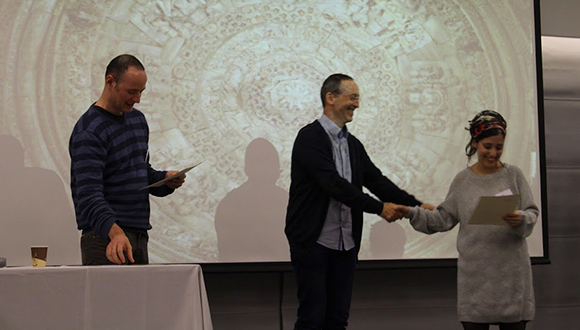
ב 25.12.2016 התקיים המפגש השנתי השני של המחלקה להנדסה ביו רפואית. במפגש השתתפו כל הסטודנטים למחקר וחברי הסגל מהמחלקה והוא כלל פעילויות מדעיות וחברתיות. בין השאר המפגש כלל הרצאות קצרות של כל הסטודנטים, מושב פוסטרים, ושעשועון מדעי. הסטודנטים: אבי בן כהן, מכל הקר ורולה עמאר זכו בתחרות הפוסטר המצטיין והסטודנטים רננה סבי, אריאל גרייזס, לורן וולברומסקי,

זכו בתחרות המצגת הקצרה המצטיינת. 

תודות לוועדה המארגנת: פרופ' מיקי שיינוביץ,פרופ' תמיר טולר, רננה סבי, אלון דיאמנט, יאנה פולדולסקי, מעין רוזנבוש, יואב נייגט וענת אוסקר.

School of Mechanical Engineering Yuval Yevnin

26 באפריל 2017, 14:00 - 15:00 
בניין וולפסון חדר 206  
ללא תשלום
School of Mechanical Engineering Yuval Yevnin


School of Mechanical Engineering Seminar
Monday, April 26, 2017 at 14:00
Wolfson Building of Mechanical Engineering, Room 206


A bottom reflection source term for wave forecasting models


Yuval Yevnin

MSc student under supervision of Dr. Yaron Toledo


The Wave Action conservation Equation (WAE) is a commonly used governing equation in numerical ocean wave models today. The WAE is based on the conservation of wave action flux – a frequency normalized wave energy, to generate a wave propagation forecast in these numerical models. During the derivation of the WAE, wave reflection from the sea bottom is neglected. The neglected wave reflection occurs when waves propagate in the nearshore environment over a sloping sea bottom and a part of the incident wave energy is transferred to a wave propagating in the opposite direction. Wave reflection can have a significant effect on the nearshore wave regime. It can alter the wave height in as much as 20% and generate waves that penetrate harbors or get trapped in the nearshore environment (edge waves). Nevertheless,   wave forecasting models use either a limited empirical source term for taking into account the bottom reflection, or neglect it entirely.

In the presented work, the mathematical basis for a new bottom reflection source term fitting for the entire spectral regime is described and discussed. The Mild-Slope Equation (MSE), a simplification of the Laplace equation with the assumptions of free-surface and impermeable mildly-sloping bottom boundary conditions, is written in form of two coupled terms – one for the incident wave, and the other for the reflected component. Assuming small reflection, a perturbation approach is applied resulting in the decoupling of the equations to two separate wave-action equations in the leading order. The solution of the second order equation results in a source term accounting for wave reflection. With this development, a fully analytical solution to the wave reflection of a sloping sea bottom is provided for use in numerical wave prediction models. The approximation shows good results in comparison to the MSE.


School of Mechanical Engineering Andrey Zavadsky

03 במאי 2017, 14:00 - 15:00 
בניין וולפסון חדר 206  
ללא תשלום
School of Mechanical Engineering Andrey Zavadsky


School of Mechanical Engineering Seminar
Wednesday, May 3, 2017 at 14:00
Wolfson Building of Mechanical Engineering, Room 206


Experimental Study of Water Waves Generated by Wind


Andrey Zavadsky

PhD. Student of Prof. Lev Shemer

School of Mechanical Engineering, Tel Aviv University, 69978 Tel Aviv, Israel


Only limited information is currently available on evolution of waves generated by wind that varies in time, and in particular on the initial stages of wind-waves growth from rest under suddenly applied wind forcing. The emerging wind-wave field varies in time as well as in space. Detailed knowledge of wave parameters distribution under those conditions contributes to better understanding of mechanisms of wind wave generation. Present research aims to advance our knowledge of the details of this fundamental phenomenon by performing a series of experiments in a small-scale wind-wave facility.

In order to accumulate reference data for the unsteady wave field, extensive experiments on waves under steady wind forcing were performed. Characteristic parameters of turbulent airflow as well as of the water surface were carefully studied. Prolonged measurements of wind-generated water waves using standard wave-gauge were carried out at a large number of locations along the test section and at numerous airflow rates. The evolution of the wind wave field was investigated using appropriate dimensionless parameters. When possible, quantitative comparison with the results accumulated in field measurements and in larger laboratory facilities was performed. In addition to using a conventional wave gauge to determine the temporal variation of the surface elevation at the sensor location, independent measuring techniques such as 3D reconstruction of stereo video images and 2D laser slope gauge (LSG) were applied in order to gain information on the three dimensional structure of the wind-wave field.

LSG enables direct measurements of two components of the instantaneous surface slope. Long sampling duration in a relatively small experimental facility allowed accumulating records of the measured parameters containing a large number of waves.

Frequency spectra of the surface elevation and of the instantaneous local slope variation measured under identical conditions are compared. Higher moments of the surface slope are presented. Information on the waves’ asymmetry is retrieved from the computed skewness of the surface slope components.

The results on the spatial and temporal coherence of the surface elevation variation, on the directional wave spectra, and on the probability distribution of the instantaneous surface slope directions obtained by processing of the reconstructed 3D surfaces demonstrate that the wind-wave


field, though generated in relatively narrow test section, is essentially three-dimensional and short-crested. The LSG-derived results corroborate these conclusions.

   Temporal variation of instantaneous main wave parameters in small scale facility under impulsive wind forcing were experimentally studied. Temporal variation of the wave field from the appearance of initial ripples, to emergence of quasi-steady wind-wave field was obtained. Distinct stages in the temporal and spatial wave evolution process were identified for waves excited by impulsive application of wind forcing. The experimental results during each stage of evolution were analyzed in view of the viscous instability theory by Kawai (1979) and the resonance model by Phillips (1957).

 

סמינר מחלקתי - אלקטרוניקה פיזיקאלית

02 בפברואר 2017, 15:00 
אוניברסיטת תל אביב, פקולטה להנדסה, בניין כיתות חדר 011  
סמינר מחלקתי - אלקטרוניקה פיזיקאלית

You are invited to attend a lecture

Macroscopic Manipulation and Control of High Harmonic Generation


By:

Lilya Lonachinsky

PhD student under the supervision of Alon Bahabad


Abstract

High harmonic generation (HHG) is an extreme nonlinear frequency up-conversion process during which extremely short duration optical pulses at very short wavelengths are emitted. A major concern of HHG is the small conversion efficiency at the single emitter level. Thus ensuring that the emission at different locations are emitted in phase is crucial. At high pump intensities it is impossible to phase match the radiation without reverting to ordered modulations of either the medium or the pump field itself, a technique known as Quasi-Phase-Matching (QPM). To date, demonstrated QPM techniques of HHG were usually complicated and/or lacked tunability. Here we demonstrate experimentally a relatively simple, highly and easily tunable QPM technique by using a structured pump beam made of the interference of different spatial optical modes. With this technique we demonstrate on-the-fly, tunable quasi-phase-matching of harmonic orders 25 to 39 with up to 30 fold enhancement of the emission.


On Thursday, February 02, 2017, 15:00

Room 011, Kitot Building

סמינר מחלקתי - אלקטרוניקה פיזיקאלית

31 בינואר 2017, 17:00 
אוניברסיטת תל אביב, פקולטה להנדסה, בניין כיתות, חדר 011  
סמינר מחלקתי - אלקטרוניקה פיזיקאלית

Advanced distributed and dynamic Fiber Optic Sensing for advance applications including shape sensing

:By

Michael Heflin and Alex Tongue

Sensuron, Inc, Austin, Tx

17:00-18:00

Abstract: Advanced sensing platforms are required to enable the creation of the FOG, a necessary intermediate layer between the Cloud and the Internet of things. Fiber Optic Sensing (FOS) has evolved from an enhanced discrete measurement tool into a sensing platforms capable of displacing a myriad of traditional technologies. Sensuron will present the three generations of FOS, how they are used to disrupt markets and demonstrate the most advanced technologies available today.

Room 011, Kitot Building (בנין כיתות )

סמינר מחלקתי - אלקטרוניקה פיזיקאלית

31 בינואר 2017, 16:00 
אוניברסיטת תל אביב, פקולטה להנדסה, ביניין כיתות חדר 011  
סמינר מחלקתי - אלקטרוניקה פיזיקאלית

FiberLab – a multi-sensing approach in a single optical fiber
 

:By

Prof. Wolfgang Schade

Clausthal University of Technology and Fraunhofer HHI

January 31, 2017, 16:00-17:00

Abstract: Femtosecond laser technology allows a new approach for direct writing of waveguides and periodic modulation of the index of refraction in optical transparent materials such as fibers. This technique can be used for processing Bragg grating structures in the core or in the cladding of an optical fiber but also in combination with chemical etching for processing well defined microstructures that offer interesting and up to now unknown possibilities for designing chemical fiber sensors. The combination of both approaches is the basis for the novel FiberLab concept that will find interesting application in fiber based 3D-shape sensing devices used in medicine as well as robotics. Both, the technology and various very recent applications will be discussed.


Tuesday, January 31, 2017

Room 011, Kitot Building (בנין כיתות )

EE Seminar: A Novel Approach to Exact Slow-Fast Decomposition of Linear Singularly Perturbed Systems with Small Delays


Speaker: Yuri Feigin

M.Sc. student under the supervision of Prof. Emilia Fridman


Sunday, February 5th, 2017 at 15:00

Room 011, Kitot Bldg., Faculty of Engineering


A Novel Approach to Exact Slow-Fast Decomposition of Linear Singularly Perturbed Systems with Small Delays


Singularly perturbed systems, being an adequate mathematical model of real-life two-time-scale systems, were studied extensively in the literature. An important type of such systems is a system with time delays of the order of a small parameter multiplying  part of derivatives in the system.


In this talk linear time-invariant singularly perturbed systems with small point-wise and distributed time delays are considered. A direct approach to exact slow-fast decomposition of such systems is presented. Unlike the existing method, this approach does not require the asymptotic stability of the fast subsystem.  Moreover, not requiring a complicated mathematical technique, this approach is much simpler for using  in various engineering applications. The efficiency of the results are illustrated by a model of a multi-link single-sink optical network.


05 בפברואר 2017, 15:00 
חדר 011, בניין כיתות-חשמל  

EE Seminar: Word-Spotting applications for historical documents

Speaker: Adi Silberpfennig

M.Sc. student under the supervision of Prof. Lior Wolf


Sunday, February 5th, 2017 at 15:30

Room 011, Kitot Bldg., Faculty of Engineering


Word-Spotting applications for historical documents


Historical documents have been undergoing large-scale digitization over the past years, bringing massive image collections available on-line. Optical character recognition (OCR) quality for historical manuscripts and for documents printed in old typefaces, is still lacking. As an alternative or in addition, one can perform an image-based search.

In this talk we will show a simple and efficient pipeline for word spotting in historical documents and how it is utilized for several applications;

An effective unsupervised pipeline for OCR betterment is proposed. It employs a baseline OCR engine as a black box plus a dataset of unlabeled document images. Given a new document to be analyzed, the black-box recognition engine is first applied. For each result, word spotting is carried out within the dataset and then a process for OCR improvement is applied using the spotting results.

We also present an image based approach for the retrieval of related articles in a newspaper. Given a dictionary, synthetic images are generated for every word in it, and each of these words is considered a query. Given a set of unlabeled documents they are first fed into the word spotting engine. Then, based on the spotting results, a normalized Tf-Idf vector representation is computed for every document and the articles retrieval is performed by a nearest-neighbor search.

Another utility shown here is an operational word spotting engine. We developed, in collaboration with the Friedberg Genizah Project, a real-time word spotting engine, incorporated in a large scale historical manuscripts collection – The Cairo Genizah.

05 בפברואר 2017, 15:30 
חדר 011, בניין כיתות-חשמל  

LMI Seminar

01 במרץ 2017, 13:00 
Auditorium 011, Engineering Class Room Building, Faculty of Engineering, Tel-Aviv University  
LMI Seminar

Prof. Adam Wax

Dept. of Biomedical Engineering, Duke University

Wednesday, March 1st , 2017

13:00-14:00

Light refreshments and drinks will be served starting 12:30

Auditorium 011, Engineering Class Room Building,

Faculty of Engineering, Tel-Aviv University

Abstract:

The mechanisms by which cells respond to mechanical stimuli are essential for cell function yet not well understood. Many rheological tools have been developed to characterize cellular viscoelastic properties but these typically require direct mechanical contact, limiting their throughput. We have developed a new approach for characterizing the organization of subcellular structures using a label free, noncontact, single-shot phase imaging method that correlates to measured cellular mechanical stiffness. The new analysis approach measures refractive index variance and relates it to disorder strength. These measurements are compared to cellular stiffness, measured using the same imaging tool to visualize nanoscale responses to flow shear stimulus. The utility of the technique is shown by comparing shear stiffness and phase disorder strength across five cellular populations with varying mechanical properties.  An inverse relationship between disorder strength and shear stiffness is shown, suggesting that cell mechanical properties can be assessed in a format amenable to high throughput studies using this novel, non-contact technique. Further studies will be presented which include examination of mechanical stiffness in early carcinogenic events and investigation of the role of specific cellular structural proteins in mechanotransduction.


עמודים

אוניברסיטת תל אביב עושה כל מאמץ לכבד זכויות יוצרים. אם בבעלותך זכויות יוצרים בתכנים שנמצאים פה ו/או השימוש שנעשה בתכנים אלה לדעתך מפר זכויות
שנעשה בתכנים אלה לדעתך מפר זכויות נא לפנות בהקדם לכתובת שכאן >>