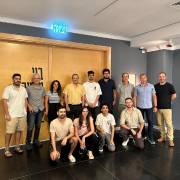
School of Mechanical Engineering Gilad Berg

03 בדצמבר 2018, 14:00 - 15:00 
בניין וולפסון חדר 206  
0
School of Mechanical Engineering Gilad Berg


School of Mechanical Engineering Seminar
Wednesday, December 03, 2018 at 14:00
Wolfson Building of Mechanical Engineering, Room 206


Simulating photothermal actuation in resonant micro bridges

 Gilad Goldenberg

 MSc Student of Dr. Yoav Linzon


This work comes from the application need of optimizing the photothermal actuation in micro bridges that change their resonance frequencies with changes in mass due to gas absorption. The micro bridges are activated using 405[nm] (blue) laser close to resonance frequency, the actual bridge frequencies are sensed with red probe laser.

The research in this work is performed using Comsol Multiphysics, modeling the polysilicon micro bridges of various lengths (20 um, 30 um and 35 um) and their oscillation using thermal actuation in periodic and aperiodic actuation.

The research main results are:

1.    The expected displacements in 1.5um wide, 0.14um thick and 20um, 30um and 35 um long polysilicon bridges in the time domain.

2.    The expected maximum displacements in 1.5um wide, 0.14um thick and 20um, 30um and 35 um long polysilicon bridges in the frequency domain.

3.    The Q factors derived from the frequency domain analysis.

4.    An analysis of the bridge heating duty cycle effect on the maximum displacement.

5.    An analysis of unsynchronized activation.


סמינר מחלקתי אלקטרוניקה פיזיקאלית : Itay Shomroni

15 בנובמבר 2018, 15:00 
 
סמינר מחלקתי אלקטרוניקה פיזיקאלית : Itay Shomroni

You are invited to attend a lecture


Quantum control with nanomechanical oscillators

:By

Itay Shomroni

Laboratoire de Photonique et de Mesure Quantique


Abstract

Quantum optomechanics, the study of mechanical motion in the quantum regime

using light, is an emerging field with applications ranging from sensing to

quantum information to exploring the classical-to-quantum transition. Although

its foundations had been laid in the 60s and 70s, quantum effects in macroscopic

mechanical motion, such as motional sideband asymmetry, radiation pressure shot

noise, and ponderomotive squeezing, have been observed only in the recent decade,

with advances in high-finesse microcavities. Mechanical oscillators based on

photonic crystals are one of the most promising systems for probing and

manipulating quantum motion, allowing efficient cooling to the motional ground

state using light as well as quantum-coherent operations. I will describe my

recent research with these systems, which includes the first demonstration of

backaction-evading measurement of mechanical motion in the optical domain. Such

measurement, originally proposed in the context of gravitational wave detection,

allows in principle arbitrary sensitivity by measuring only a single quadrature

of the motion, beating the quantum limit imposed by Heisenberg's uncertainty

relation. In addition, entering the regime of strongly-probed mechanical systems

close to their ground state has revealed novel phenomena such as interplay of

optomechanics and other Kerr-type effects, and new dynamics that can lead to

extraordinary instabilities. Quantum optomechanics is now entering a new era where full quantum control is feasible, and I will give my outlook and possible future

directions.


On Thursday, Nov 15, 2018, 15:00

Room 011, Kitot building

סמינר המחלקה להנדסה ביו רפואית הרצאת אורח של ד"ר דניאל טופגארד מאונ' לאנד בשוודיה

11 בנובמבר 2018, 14:00 
הבניין הרב תחומי, חדר 315  
ללא עלות
סמינר המחלקה להנדסה ביו רפואית הרצאת אורח של ד"ר דניאל טופגארד מאונ' לאנד בשוודיה

Multidimensional diffusion MRI

Author: D. Topgaard
Affiliation: Department of Chemistry, Lund University, Sweden
E-mail: daniel.topgaard@fkem1.lu.se

The use Diffusion MRI is an excellent method for detecting subtle microscopic changes of the living human brain, but often fails to assign the experimental observations to specific structural properties such as cell density, size, shape, or orientation. When attempting to solve this problem, we have chosen to disregard essentially all previous work in the field of diffusion MRI, and instead translate data acquisition and processing schemes from multidimensional solid-state NMR spectroscopy [1, 2]. Key elements of our approach are free gradient waveforms, q-vector trajectories, b-tensors, and correlations between isotropic and directional diffusion encoding. By approximating the water displacement probability as a sum of anisotropic Gaussians, the voxel composition can be reported as a diffusion tensor distribution where each component of the distribution corresponds to a distinct tissue environment. Our new methods yield estimates of the complete diffusion tensor distribution or well-defined statistical properties thereof, such as the mean and variance of isotropic diffusivities, mean-square anisotropy, and orientational order parameter, which derive from analogous parameters in solid-state NMR and can be related to the structural properties of the tissue. This presentation will give an overview of the new methods, including basic physical principles, pulse sequences, and data processing, as well as examples of applications in healthy and diseased brain.

[1] Schmidt-Rohr K, Spiess HW. Multidimensional solid-state NMR and polymers. San Diego: Academic Press; 1994.
[2] Topgaard D. Multidimensional diffusion MRI. J Magn Reson 2017;275:98-113. https://dx.doi.org/10.1016/j.jmr.2016.12.007


EE Seminar: Estimation in extreme noise levels with application to cryo-electron microscopy

12 בנובמבר 2018, 15:00 
חדר 011, בניין כיתות-חשמל  

(The talk will be given in English)


Speaker:     Dr. Tamir Bendory
                   Princeton University


Monday, November 12th, 2018
15:00 - 16:00

Room 011, Kitot Bldg., Faculty of Engineering


Estimation in extreme noise levels with application to cryo-electron microscopy
 

Abstract

Single-particle cryo-electron microscopy (cryo-EM) is an innovative technology for elucidating structures of biological molecules at atomic-scale resolution.In a cryo-EM experiment, tomographic projections of a molecule, taken at unknown viewing directions, are embedded in highly noisy images at unknown locations. The cryo-EM problem is to estimate the 3-D structure of a molecule from these noisy images. 

Inspired by cryo-EM, the talk will focus on two estimation problems: multi-reference alignment and blind deconvolution. These problems abstract away much of the intricacies of cryo-EM, while retaining some of its essential features. In multi-reference alignment, we aim to estimate a signal from its noisy, rotated observations. While the rotations and the signal are unknown, the goal is only to estimate the signal. In the blind deconvolution problem, the goal is to estimate a signal from its convolution with an unknown, sparse signal in the presence of noise. Focusing on the low SNR regime, I will propose the method of moments as a computationally efficient estimation framework for both problems and will introduce its properties. In particular, I will show that the method of moments allows estimating the sought signal accurately in any noise level, provided sufficiently many observations are collected, with only one pass over the data. I will then argue that the same principles carry through to cryo-EM, show examples, and draw potential implications.

EE Seminar: Beyond SGD: Data Adaptive Methods for Machine Learning

11 בנובמבר 2018, 15:00 
חדר 011, בניין כיתות-חשמל  

(The talk will be given in English)


Speaker:     Dr. Kfir Levy
                   Institute for Machine Learning at ETH Zurich


SUNDAY, November 11th, 2018
15:00 - 16:00

Room 011, Kitot Bldg., Faculty of Engineering


Beyond SGD: Data Adaptive Methods for Machine Learning 

Abstract

The tremendous success of the Machine Learning paradigm heavily relies on the development of powerful optimization methods. The canonical algorithm for training learning models is SGD (Stochastic Gradient Descent), yet this method has its limitations. It is often unable to exploit useful statistical/geometric structure, it might degrade upon encountering prevalent non-convex phenomena, and it is hard to parallelize. In this talk, I will discuss an ongoing line of research where we develop alternative methods that resolve some of SGD’s limitations. The methods that I describe are as efficient as SGD, and implicitly adapt to the underlying structure of the problem in a data-dependent manner.
In the first part of the talk, I will discuss a method that is able to take advantage of hard/easy training samples. In the second part, I will discuss a method that enables an efficient parallelization of SGD. Finally, I will briefly describe a method that implicitly adapts to the smoothness and noise properties of the learning objective.

Bio
Kfir Levy is a post-doctoral fellow in the Institute for Machine Learning at ETH Zurich, advised by Prof. Andreas Krause. Kfir’s research is focused on Machine Learning and Stochastic Optimization, with a special interest in designing universal methods that apply to a wide class of learning scenarios. He is a recipient of the ETH Zurich Postdoctoral fellowship, as well as the Irwin and Joan Jacobs fellowship for excellence in research. Kfir received his degrees from the Technion—Israel Institute of Technology. He was advised by Prof. Elad Hazan during his Ph.D. and by Prof. Nahum Shimkin during his Master’s.


יום זרקור עם חברת מלאנוקס

08 בנובמבר 2018, 11:00 
מחוץ לאולם רוזנבלט (הרחבה שבין תוכנה למעבדות).  
יום זרקור עם חברת מלאנוקס

ארגון עמיתי התעשיה של הפקולטה להנדסה אוניברסיטת תל-אביב שמח לארח את נציגי חברת Mellanox ליום זרקור.

סמינר מחלקתי אלקטרוניקה פיזיקאלית : . Shai Machnes

08 בנובמבר 2018, 15:00 
פקולטה להנדסה, ביניין כיתות, חדר 011  
סמינר מחלקתי אלקטרוניקה פיזיקאלית : . Shai Machnes

You are invited to attend a lecture


Merging Control Calibration and System Characterization for Scalable Quantum Computers

:By

Dr. Shai Machnes

Theoretical physics, Saarland University, Saarbrücken, Germany

Abstract


Quantum computing is a revolution in the making, but the field is facing difficulties scaling up from the current 20-30 qubits to larger scale devices. For Josephson junction quantum computers, manufacturing variabilities necessitate individual characterization of each qubit and each coupling, and calibration of each control sequence, totaling many thousands of measurements and calibrations for a 100 qubit chip, and many months of dedicated work by a large team. Further, control pulses are currently designed using highly simplified analytic models, resulting in initially poor fidelities. The controls are then calibrated in-situ, achieving high-fidelities, but without a corresponding model. We are therefore left with a ridiculous situation: a model we know is inaccurate, working controls for which we do not have a matching model, and a calibration process from which we learned nothing about the system. We propose a novel procedure to rectify the above problems, clearing a path to scalable quantum computation.

We begin with a quick review of the current state of quantum computing hardware. We then detail the new quantum optimal control technique, and how it may be utilized to merge control sequence design, calibration and system characterization into a single, scalable process. Finally, we'll present how a Computer Algebra System may be utilized to derive simplified system models, guiding automatic progressive characterization and calibration of large complex systems, and how generative-adversarial learning may be utilized to allow small quantum computers to boot-up larger ones.

We believe these new approaches will greatly improve both the accuracy of current quantum computers and our understanding of their dynamics - both critical components on the road to large scale quantum computation.

Main reference: Shai Machnes, Elie Assémat, David Tannor, and Frank K. Wilhelm - Phys. Rev. Lett. 120, 150401 (2018) - Tunable, Flexible, and Efficient Optimization of Control Pulses for Practical Qubits


On Thursday, Nov 08th, 2018, 15:00

Room 011, ‘Kitot’ building

שיתוף פעולה עם מדענים מובילים מהעולם במחלקה למדע והנדסה של חומרים

01 נובמבר 2018
ג'ואנה אייזנברג

פרופ' ג'ואנה אייזנברג מאוניברסיטת הרווארד היוקרתית התארחה בשבוע השני של אוקטובר במחלקה למדע והנדסה של חומרים ונפגשה עם חברי סגל וסטודנטים, והעבירה שני סמינרים מרתקים. אחד הסמינרים היה בנושא ציפויים מחליקים שמונעים הצמדות של בקטריות וסמינר שני בנושא חומרים עם מבנים דינמיים שמגיבים באופן הפיך לשינויים בסביבתם. 


ביקורה התאפשר תודות לתרומה של משפחת זיידמן מאזור שיקגו בארה"ב, עליה מופקד פרופ' נעם אליעז. תרומה זו מאפשרת למחלקה למדע והנדסה של חומרים לבנות שיתופי פעולה ארוכי טווח עם מדענים מובילים מצפון אמריקה ומאירופה. עוד בהמשך ביקורה נפגשה פרופ' אייזנברג אם נשיא האוניברסיטה, פרופ' יוסף קלפטר, על-מנת לבחון אפשרויות לשיתופי פעולה בין-מוסדיים חדשים. 


פרופ' אייזנברג היא פרופ' למדע חומרים, פרופ' לכימיה ולביולוגיה כימית, ודירקטורית מכון Kavli למדע וטכנולוגיה בתחום ביו-ננו באוניברסיטת הארוורד. היא חוקרת בעלת מוניטין עולמי במגוון תחומים כגון חיקוי מודלים מהטבע (biomimetics), ביו-מינרליזציה, חומרים חכמים, תופעות הרטבה, ממשקי ביו/ננו, ובנייה עצמית (self assembly). היא חברת האקדמיה האמריקאית למדעים ולאומנויות, האגודה הפילוסופית האמריקאית, האגודה האמריקאית לקידום המדע, ועמיתת האגודה האמריקאית הפיזיקלית, האגודה לחקר חומרים, וחברה חיצונית של אגודת מקס פלנק. היא זכתה בפרסים בינלאומיים רבים וחיברה למעלה מ- 220 מאמרים בכתבי עת, כולל Nature ו- Science היוקרתיים, ולמעלה מ-50 פטנטים שהתקבלו. היא הקימה מספר חברות. את הדוקטורט, בביולוגיה מבנית, ביצעה במכון וייצמן למדע.

קישור לסמינר: ציפויים מחליקים שמונעים הצמדות של בקטריות

עמודים

אוניברסיטת תל אביב עושה כל מאמץ לכבד זכויות יוצרים. אם בבעלותך זכויות יוצרים בתכנים שנמצאים פה ו/או השימוש שנעשה בתכנים אלה לדעתך מפר זכויות
שנעשה בתכנים אלה לדעתך מפר זכויות נא לפנות בהקדם לכתובת שכאן >>