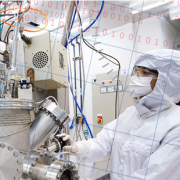
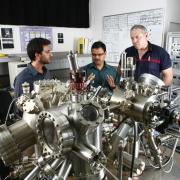
ארגון עמיתי התעשייה מקדם מחקרים ומוביל למצוינות בסיוע התעשייה  

המרכז לקשרי תעשייה פועל במרץ להרחיב את מפעלי התמיכות של התעשייה במגוון תחומים ביחידות האוניברססיטה השונות. 

מעת לעת מלגות מגוונות מוצעות על ידי התעשייה לתלמידינו ואנו מסייעים בהנגשת ההזדמנות לסטודנטים.ות, וכן בכל תהליכי המיון וההחלטה.

קולות קוראים מפורסמים באתר זה ואנו ממליצים לתלמידינו לעקוב אחר פרסומים אלו.


ערוץ נוסף שבו אנו משקיעים רבות הינו תמיכה במחקר ופיתוח. התעשייה תורמת ותומכת במעבדות מחקר שונות. ציוד מתקדם, מחקר ממומן והוצאות אחרות ממומנות לעיתים על ידי גורמי תעשייה, וזאת בכדי לסייע לפקולטה להדביק את ההתחדשות הטכנולוגית של מרחב המחקר שלה.


EE Seminar: Faster Guaranteed GAN-based recovery in Linear Inverse Problems

10 בפברואר 2020, 15:00 
room 011, Kitot Building  

(The talk will be given in English)


Speaker:     Prof. Yoram Bresler

Coordinated Science Laboratory and the Department of ECE, 

University of Illinois at Urbana-Champaign
 

Monday, February 10th, 2020
15:00 - 16:00

Room 011, Kitot Bldg., Faculty of Engineering


Faster Guaranteed GAN-based recovery in Linear Inverse Problems


Abstract

A Generative Adversarial Network (GAN) trained to model the prior of images has been shown to perform better than sparsity-based regularizers in ill-posed inverse problems. We describe an approach along these lines, with some modifications and refinements, with the following features: (1) on a given class of images, it addresses different linear inverse problems without re-training the neural network; (2) it accelerates the computation substantially as compared to previous GAN-based methods; and (3) it comes with a recovery guarantee. Experiments on several inverse problems demonstrate substantial speedup over earlier GAN-based recovery methods, along with better accuracy.
 

Short Bio

Yoram Bresler received the B.Sc. and M.Sc.  from the Technion–Israel Institute of Technology, and the Ph.D. from Stanford University all in electrical engineering. He is currently a Founder Professor of Engineering with the Departments of Electrical and Computer Engineering and Bioengineering, and the Coordinated Science Laboratory at the University of Illinois at Urbana–Champaign. He is also the founding President and the Chief Technology Officer at InstaRecon, Inc., commercializing breakthrough technology for tomographic reconstruction developed in his academic research. His research interests include machine learning and statistical signal processing and their applications to inverse problems in imaging, including compressed sensing, computed tomography, and magnetic resonance imaging.
Dr. Bresler was a Faculty Fellow at the National Center for Super Computing Applications in 2006. He is a recipient of the 1991 NSF Presidential Young Investigator Award, the Technion Fellowship in 1995, and the Xerox Senior Award for Faculty Research in 1998. He was named as the University of Illinois Scholar in 1999, and was appointed as an Associate at the Center for Advanced Study of the University in 2001. He has served on the editorial board of several journals, including the IEEE TSP, the IEEE JSTSP, Machine Vision and Applications, the SIAM Journal on Imaging Science, and on various committees of the IEEE.
Dr. Bresler is a fellow of the IEEE and the AIMBE. His papers have received 4 best journal paper awards, two of these with his students. In 2016, he was appointed IEEE SPS Distinguished Lecturer.

EE Seminar: Learning the Structure of Motion

03 בפברואר 2020, 15:00 
Room 011, Kitot Building  

Speaker: Kfir Aberman

Ph.D. student under the supervision of Prof. Daniel Cohen-Or and Prof. Shai Avidan


Monday, February 3rd, 2020 at 15:00
Room 206, Wolfson Mechanical Eng. Bldg., Faculty of Engineering

Learning the Structure of Motion


Abstract

Analysis and synthesis of human motion, which is an abstract, fundamental attribute, underlying actions, gestures, and behavior, has been a central research topic in computer vision and computer animation. However, understanding motion, and controlling or editing it in a high-level intuitive manner, have been hindered by lack of methods for effective disentanglement of the various motion attributes. As with many other areas of vision and graphics, motion analysis and synthesis have also benefited greatly from recent progress in machine learning and deep neural networks.


In this research, we propose various structures of neural networks that enable to decompose motion into different, disentangled, attributes and re-compose them into newly synthesized sequences. For example, separating the dynamic aspects of motions from the static ones, distinguishing between motion style and its content, and learn an abstract, character-agnosic motion representation, that can be transferred to characters with different body proportions.

This pipeline enables to mix attributes extracted from different inputs and to synthesize motion in an intuitive, exemplar-based, manner.


Our methodology is applied to 3D motion originated by animated characters as well as motion capture (MoCap) data. Furthermore, our research makes the utilization of ordinary videos, which account for the vast majority of the available depictions of human motion, for the purposes of motion capture and motion editing, paving the way for a multitude of applications in computer vision and computer graphics. In particular, we demonstrate state-of-the-art performances in various, fundamental, tasks in motion analysis and synthesis, including motion retargeting, motion style transfer, video performance cloning, and monocular motion reconstruction.

School of Mechanical Engineering: Michael Slavutin

23 במרץ 2020, 14:00 - 15:00 
וולפסון 206  
0
School of Mechanical Engineering: Michael Slavutin

~~

SCHOOL OF MECHANICAL ENGINEERING SEMINAR
Monday, March 23, 2020 at 14:00 
Wolfson Building of Mechanical Engineering, Room 206
Graph Theoretical and Geometrical Investigation of Kinematics and Singularity of 3D Parallel Mechanisms

Michael Slavutin
PhD Yoram Reich

This work presents geometrical and graph theoretical methods for analysis of mechanisms in three dimensions. In particular, the singularity analysis by geometric methods of parallel mechanisms is presented. The singularity of the most common three-dimensional mechanism, the 6/6 Stewart platform is fully analyzed. The Aronhold-Kennedy theorem is used for this analysis. This analysis is based on the properties of the reciprocal product of two screws, which depends only on the relative position of the two screws. First, the singularity criterion is developed assuming that there exist two lines that cross four of the six legs of the platform. The instantaneous screw axis and the forces in the legs are found. Next, the above assumption is relaxed and the singularity criterion is developed in a most general configuration. For this purpose, the two degrees-of-freedom mechanism obtained by removal of two legs of the platform is analyzed. The line that is a locus of all possible instantaneous screw axes of such mechanism is found. It is proved that the mechanism is singular if three loci of the instantaneous screw axes of three such sub-mechanisms share a common perpendicular. This criterion is expanded to a general parallel mechanism. Examples of analyzing complex mechanisms with this criterion are shown.
The analysis of singularity of a multi-platform parallel mechanism is performed by building an equivalent simpler mechanism using the reciprocality relation. The two-platform and single- and two-circuit three-platform mechanisms are reduced to a single-platform mechanism. It is shown that the three-circuit three-platform mechanisms are irreducible except for certain cases. This method is shown to be applicable to even more complex mechanisms.
The method used for analysis of the singularity of the multi-platform mechanisms is developed formally into a graph-theoretical duality that is used for kinematic and static investigation of a mechanical system. In this duality, a node of the dual graph that corresponds to a platform of a dual mechanism is placed in a face of a graph of the original mechanism. Edges of the dual graph that correspond to the constraints of the dual mechanism cross the edges of the primal graph and are built so that the dual edge is reciprocal to any primal edge crossed by it. The algorithms for determining the geometry of the dual edges are developed in the first part of this work. Since these graphs are multigraphs, there are various possibilities of building the dual graph. Therefore, the building of dual to a dual graph results in a graph that may be different from the original one. This allows simplification of the original mechanism by successful application of the dual operation, preserving the kinematic and static properties of the original systems.

"Turbulence modification in a rocket motor model particle-laden flow : Sabrina Kalenko

22 באפריל 2020, 14:00 - 15:00 
חדר 206 וולפסון  
0
"Turbulence modification in a rocket motor model particle-laden flow : Sabrina Kalenko

משרות ופרויקטים בתעשייה

מקורה של המילה "קריירה" הינו במונח הלטיני "כרכרת מסע". בימנו השימוש המקובל במילה מקורו במונח הצרפתי Char  – "זירה למרוץ מרכבות". אנו רואים בקריירה כמסלול מרוץ בדרך לתפקיד הנכסף, שיגדיר את עשייתנו מ"סתם עוד עבודה" ל"קריירה".


המונח הרווח בספרות המקצועית מגדיר את הקריירה כסדרה של פעילויות והתנסויות הכרוכות בתפקיד שאדם עובר במהלך חייו, כך למעשה יש קריירה כל עוד אנו נמצאים בעשייה הן בתפקידים שאנו מאיישים, במשימות שאנו ממלאים, בתגמולים שאנו מקבלים ועוד.


כדי להשלים את התמונה, נביט  גם על הפן הסובייקטיבי של המונח קריירה כרצף של התנסויות וחוויות השזורות בחייו המקצועיים של האדם - מסלול חיים מקצועי שלם הכולל הישגים, הצלחות, כישלונות, שינויים ומעברים" (פזי ובד"ט, 1994).


המרכז לקשרי תעשייה רואה חשיבות רבה בשילוב הסטודנטים.ות והבוגרים.ות בתעשייה. באתר תוכלו למצוא לוח משרות חמות בתעשייה, וכן מידע אודות פרוייקטי גמר (תואר ראשון/ תואר שני ללא תזה), שיהוו את הגשר בין העולם האקדמי לבין העולם התעסוקתי. הסטודנטים.ות והבוגרים.ות שלנו מכהנים כשגרירי האקדמיה במשק, וככאלו חשוב לנו ללוות אותם לאורך כל הדרך, במהלך הלימודים ובסיומם.

חלק מהותי משיתוף הפעולה של האקדמיה עם התעשייה הוא בנתיב המחקרי וסיוע בקידום המחקר והטכנולוגיה.


האוניברסיטה מורכבת מחוקרות וחוקרים מבטיחים שעוסקים במגוון עצום של תחומים כגון: סייבר, מקורות אנרגיה מתחדשים, ננוטכנולוגיה, ננו-רפואה, תקשורת, מיקרומכניקה ומיקרוזרימה, פיתוח חומרים חדשים ועוד.

אנו מזמינים את עמיתנו מהתעשייה לחבור אל החוקרות והחוקרים המובילים ולהשפיע על המחקר העתידי.

ציוד מתקדם, מחקר ממומן והוצאות אחרות ממומנות פעמים רבות על ידי גורמי תעשייה, וזאת בכדי לסייע לאקדמיה להדביק את ההתחדשות הטכנולוגית של מרחב המחקר שלה.


למידע נוסף מוזמנים לפנות אלינו.


למידע אודות מעבדות החדשנות

למידע אודות מכון זימין לעולם טוב יותר

למידע אודות המחקר והמעבדות בפקולטה 

למידע אודת המחקר בבית הספר למדעי המחשב

עמודים

אוניברסיטת תל אביב עושה כל מאמץ לכבד זכויות יוצרים. אם בבעלותך זכויות יוצרים בתכנים שנמצאים פה ו/או השימוש שנעשה בתכנים אלה לדעתך מפר זכויות
שנעשה בתכנים אלה לדעתך מפר זכויות נא לפנות בהקדם לכתובת שכאן >>