האנרגיה המתחדשת תאפשר לספק מים לכולם

28 דצמבר 2014

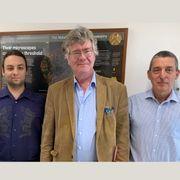
פרויקט ייחודי של האיחוד האירופי בתחום המשולב של האנרגיה המתחדשת ומים מיועד לפתח טכנולוגיה חדשה ומהפכנית לטיהור מים מזוהמים והפיכתם למים המיועדים לשתייה. אוניברסיטת תל-אביב היא אחד המרכזים שנבחרו לפרויקט

במעבדת המחקר של ד"ר הדס ממן, בשיתוף עם  ד"ר דרור אבישר והדוקטורנטית אינה הורוביץ, מפתחים במסגרת זו את הטכנולוגיה בעזרת ראקטור ממברנלי פוטוקטליטי, השואפת להיות זולה ויעילה, ללא צורך בכימיקלים.

כתבה ב- Ynet על מחקר של הדס ממן:

http://www.ynet.co.il/articles/0,7340,L-4606514,00.html


Seminar 31.12.14

31 בדצמבר 2014, 16:00 
וולפסון 206  
Seminar 31.12.14

Physical Electronics Dept.


***** Seminar *****


Gideon Segev


(PhD. student under the supervision of Prof. Yossi Rosenwaks and Prof. Abraham Kribus)

School of Electrical Engineering, Tel-Aviv University, Tel-Aviv 69978, Israel


Photon Enhanced Thermionic Emission for Solar Energy Conversion


To date, the vast majority of solar energy conversion research focused on two parallel paths: photovoltaics and solar thermal energy conversion. Attempts were made to combine photovoltaic and thermal conversion such as cogeneration and thermo-photonics. However, these attempts did not yield very high efficiencies, and these concepts were not widely implemented. As a result, researchers are still looking for a conversion path that exploits both the photonic nature of sunlight and the high temperatures that can be achieved by focusing it.

Photon Enhanced Thermionic Emission (PETE) was recently proposed as a novel concept in solar energy conversion. Similar to traditional thermionic emission devices, a PETE device consists of a high-temperature cathode emitting energetic electrons and a lower temperature anode absorbing the electrons. By using a semiconductor cathode, optically generated electrons increase the cathode’s conduction band charge population allowing high electron emission at temperatures lower than the common range for thermionic emitters. In this seminar, we will discuss the efficiency limits of PETE devices. The theoretical efficiency limits of PETE converters can theoretically rise above 40% at concentration of 1000 suns, exceeding the Shockley Queisser limit for an ideal single junction PV cell. When coupled to secondary thermal cycle the limits were shown to be exceptionally high reaching close to 70% for a flux concentration 1000. Furthermore, unlike traditional thermionic converters, PETE conversion is possible even under isothermal conditions. Next, the loss mechanisms of more realistic PETE devices will be surveyed through elaborated models. Negative space charge between the two electrodes and surface recombination at the cathode contact are shown to heavily restrict the conversion efficiency. Implementation of back surface field layers in the form of homo-junction or hetero-junction cathodes can reduce surface recombination and bring the efficiency closer to the ideal limits.


Wednesday, December 31, 2014, at 16:00

Room 206, Wolfson Mechanical Engineering Building


סמינר מחלקתי

30 בדצמבר 2014, 14:00 
חדר 206 בניין וולפסון  

ConSent: Context-Based Sentiment Analysis

Dr. Gilad Katz 

Abstract:

Sentiment analysis refers to the inference of people's views, positions and attitudes in their written or spoken texts. The applications of this field are numerous, ranging from the classification of hotel reviews to the analysis of public opinion on Twitter.

In this talk I will present ConSent, a context-based approach for the task of sentiment analysis. Our approach builds on techniques from the field of information retrieval to identify key terms indicative of the existence of sentiment. We model these terms and the contexts in which they appear and use them to generate features for supervised learning. The two major strengths of the proposed model are its robustness against noise and the easy addition of features from multiple sources to the feature set. In addition, I will present a set of domain-specific features, designed specifically for sentiment analysis in automatically transcribed text.


Bio:


Gilad Katz is a fourth-year PhD student in the Department of Information Systems Engineering, Ben Gurion University. His advisers are Prof. Yuval Elovici and Prof. Bracha Shapira. His research interest include text mining, machine learning and recommender systems. 


ההרצאה תתקיים ביום חמישי,30.12.14, בשעה 14:00 בחדר 206, בנין וולפסון הנדסה, הפקולטה להנדסה, אוניברסיטת תל-אביב.

30.12.14

30 בדצמבר 2014, 15:00 
KITOT 011  
30.12.14

You are invited to attend a lecture

By


Atef Shalabney

Institut de Science et d'Ingènierie Supramolèculaires, University of Strasbourg, Strasbourg, France

On the subject:


Light-matter strong coupling and potential for chemistry and biology

When matter is placed in the confined field of electromagnetic radiation, it can lead to modified and even new properties. This is of great interest from both the fundamental point of view as well as for many radiation engineering applications. For instance, the field confinement can lead to effects such as extraordinary optical transmission, enhanced absorption and emission of light, high-resolution spectroscopy and imaging. Under certain conditions, the light-matter interaction can become so strong that it enters the so-called strong coupling regime where new hybrid light-matter states are formed, offering a vast potential for chemistry and biology that has hardly been explored.

In this talk, I'll present the nature of enhanced optical phenomena using nanophotonics and plasmonic structures, emphasizing the applications of harnessing radiation fields into confined regions for bio-sensing and molecular detection. Then, a basic introduction to strong coupling of optically-active substances will be presented. Strong coupling of molecular vibrational transitions in the infra-red region will be particularly elaborated with new prospects to modify molecular and structural processes. New directions for exploiting strong light-matter interactions for bio-sensing and biomedical applications will be discussed.

Short biography:

Dr. Shalabney graduated from the Electrical Engineering Department of the Technion in 1997. He received his M.Sc. and Ph.D. degrees from the Electro-Optics Engineering Department at the Ben-Gurion University in the years 2010 and 2013 respectively. During his Ph.D., he worked within the group of Prof. Ibrahim Abdulhalim on developing plasmonic nanostructures to enhance the sensitivity of optical bio-sensors. In 2013, Dr. Shalabney joined the group of Prof. Thomas  Ebbesen at the University of Strasbourg, where his work has been focused on light-matter strong coupling with applications in biology and chemistry.

30 December 2014, at 15:00,

Room 011, Engineering Kitot Building


הכנס השנתי של המרכז לתקשורת מתקדמת


תוכנית ופרטים להרשמה: 

http://www.eng.tau.ac.il/research/acc/


18 בפברואר 2015, 8:30 
אודיטוריום רוזנבלט, בניין הנדסת תוכנה, הפקולטה להנדסה  

EE Seminar: Gilad Poker

~~
Gilad Poker, 
M.Sc. student under the supervision of Prof. Michael Margaliot

Wednesday, January 7, 2015 at 15:00
Room 011, Kitot Bldg., Faculty of Engineering

Maximizing Protein Translation Rate in the Ribosome Flow Model

Abstract

Translation is an important stage in gene expression. During this stage, macro-molecules called ribosomes, travel along the mRNA strand linking amino-acids together in a specific order to create a functioning protein.
An important question, related to many biomedical disciplines, is how to maximize protein production.
 Indeed, translation is known to be one of the most energy consuming processes in the cell, and it is natural to assume that evolution shaped this process so that it maximizes the protein production rate. If this is indeed so then one can estimate various parameters of the translation machinery by solving an appropriate mathematical optimization problem.
 The same problem also arises in the context of synthetic biology, namely, re-engineer heterologous genes in order to maximize their translation rate in a host organism.
We consider the problem of maximizing the protein production rate using a computational model for translation-elongation called the ribosome flow model (RFM). This model describes the flow of the ribosomes along an mRNA chain of length n using a set of n first-order nonlinear ordinary differential equations.
We show that the steady-state translation rate in the RFM is a strictly concave function of its parameters.
 This means that the problem of maximizing the translation rate under a suitable  constraint  always admits a unique solution, and that this solution can be determined  using highly-efficient algorithms for solving convex optimization problems.
  Furthermore, our analysis shows that the optimal translation rate can be computed based only on the optimal initiation rate and the elongation rate of the codons near the beginning of the ORF.
 

07 בינואר 2015, 15:00 
חדר 011, בניין כיתות חשמל  

ברכות לחוקרים על מענקי מחקר ופרסומים

24 דצמבר 2014
  • Congratulations to Prof. Amit Gefen who was just elected to be a Fellow of the International Academy of Medical and Biological Engineering.

"The International Academy of Medical and Biological Engineering (IAMBE) is made up of fellows who are recognized for their outstanding contributions to the profession of medical and biological engineering. Election to the Academy is initiated by nominations which are screened by the membership committee of the Academy. The election is conducted by a vote of all Fellows of the Academy."

ברכות ל:

  • אבישי אייל, אלון באב"ד+ערן סוחר, אילן גולדפרב+אריה רוזין+שחר ריכטר, מיכאל מרגליות+תמיר טולר, וגבור קושה +חדוה שפיצר

שזכו במענקי מחקר של הקרן הלאומית למחקר מדעי יישומי והנדסי (מי"ה)


  • ברכות לנתן שקד, סלבה קרילוב ודוד מנדלוביץ שזכו במענקי קרן מומנטום של רמות .

Label-free quantitative analysis of sperm cells by interferometric microscopy by Dr. Natan Shaked

A novel phase interferometric technique will allow measuring live sperm cells, without any staining and in a fully quantitative manner. This device will allow the embryologist to select the most suitable sperm cell for in-vitro fertilization (IVF), and is anticipated to substantially increase the success rate of IVF, which stands today on about 30% for woman under 35 years old.


Hyperspectral MEMS (“HSM”) Filter by Prof. D. Mendlovic and Prof. S. Krylov

HSM enables fast and reliable scanning of wavelengths for various sensing, detection and imaging applications. It aims to improve image quality and to equip any standard camera with hyperspectral imaging capabilities. It is a highly accurate, MEMS based, tunable spectral filter with closed loop feedback mechanism. HSM is especially suited for mobile cameras as well as other cameras, spectrometers, medical and industrial cameras, etc. Some of its unique advantages include small form factor, adding hyperspectral functionality to all camera types, wide wavelength range (UV, VIS, NIR, IR), flexible transmission spectra, power efficiency, and low cost.

  • מאמר של בוריס מלמד התפרסם ב-   Nature Physics


  • Congratulations to Leslie Banks-Sills who was elected for a second, four year term as President of the European Structural Integrity Society (ESIS) http://www.structuralintegrity.eu/   The Society has over 500 members from over 20 countries in Europe.  The aims of ESIS include development and extension of knowledge in all aspects of structural integrity, as well as dissemination of that knowledge world-wide with the objectives of improving the safety and performance of engineering equipment, individual components and structures.  She is also President of the local organization: Israel Structural Integrity Group (ISIG).​

סמינר מחלקתי

25 בדצמבר 2014, 12:00 
חדר 206 בניין וולפסון  
סמינר מחלקתי


Using models to inform public health policy

Dr. Dan Yamin

Center for Infectious Disease Modeling, School of Public Health, Yale University


Abstract:

The healthcare industry is one of world’s largest and fastest growing industries, with over 7.5% of gross domestic products in most developed countries, including Israel. Using multiple tools from operations research I seek to design and apply theoretical and practical models that capture the interaction among individuals, pharmaceutical companies, and decision makers in dynamic environments. I will present the following three applications and their contribution in shaping health policy: 1) a theoretical epidemiological game model to find the optimal incentive for influenza vaccination, 2) a contact network based model to design a practical vaccination policy to identify the super-spreaders of influenza and prioritizes them for vaccination, and 3) a stochastic transmission model that integrates epidemiological data and data on contacts of patients with Ebola from the current outbreak to evaluate the effect of Ebola progression on transmission and control.


EE Seminar: Prof. Jason L. Speyer

~~(The talk will be given in English)

Prof. Jason L. Speyer
Mechanical and Airspace Engineering Department, University of California, Los Angeles
Thursday, December 25, 2014
11:00 - 12:00
Room 011, Kitot Bldg., Faculty of Engineering

A System Theoretic Approach to the Feedback Control of Channel Flow
Abstract
A framework for determining feedback controllers for the stabilization of three-dimensional channel flow with wall pumping-and-suction control and wall shear measurements is developed using a control theoretic approach.  The elements of this approach are the determination of the finite-dimensional model based on the Navier- Stokes equations and the controller development based on the inherent decomposition of the system state and measurement model. Using balanced realization, the model reduction of the nonnormal Orr-Sommerfield system shows the sensitivity of the transfer function and the effect of the pseudo-spectrum due to the balanced model truncation. Finally, it is shown that an upstream travelling wave reduces friction drag, but induces secondary instabilities.  It is shown that the dynamics of the steady-state flow induced by a traveling wave must be linearized and decomposed in a frame of reference moving with the traveling wave. The resulting linear time-invariant equations are appropriate for system theoretic feedback control synthesis. A linear controller based on these equations is shown to suppress the secondary instabilities in direct numerical simulations. Although our ultimate goal of driving a turbulent boundary layer to a laminar boundary layer has not yet been achieved, these various steps appear to be bringing us closer to this goal.


25 בדצמבר 2014, 11:00 
חדר 011, בניין כיתות-חשמל  

Stem Cell Therapies for Skeletal Injuries


סמינר מחלקתי


סמינר מחלקתי


Stem Cell Therapies for Skeletal Injuries

Dan Gazit PhD, DMD

Skeletal Biotech Laboratory, The Hebrew University–Hadassah Faculty of Dental Medicine, Ein Kerem, Jerusalem, Israel


As the population grows older, our skeleton is subjected to increasing incidents of trauma, cancer and various disorders such as osteoporosis. Vertebral compression fractures are the most common fractures associated with osteoporosis. Approximately 700,000 osteoporosis-related vertebral compression fractures (OVCFs) occur each year in the USA. Multiple publications have shown that mortality risk is increased up to nine-fold following such fractures. It is estimated that about 100,000 cases of severe bone loss in the craniofacial bones and a million non-union fractures in long bones are treated each year. Most of the critical-size bone defects are treated with bone grafts, while OVCFs are often treated with bed rest and pain medication due to lack of effective therapeutic options. Current bone grafts suffer from several disadvantages: autografts have limited availability and often cause prolonged pain and comorbidity. Allografts, on the other hand, are more available but tend to fail due to poor integration. We hypothesized that mesenchymal stem cells (MSCs) could be utilized either to generate a new potent bone graft or to optimize the use of currently available allografts. Our studies included the use of exogenous or endogenous MSCs for the treatment of vertebral fractures and critical size defects in calvaria and long bones. Specifically, we treated osteopenic rats with multiple vertebral fractures by i.v. injections of human MSCs and intermittent administration of recombinant PTH, as an adjuvant to enhance cell homing and differentiation. We also used PTH to enhance the integration of calvaria bone allografts in mice, showing a local effect on osteoprogenitors around the graft. Finally, we used collagen scaffolds to recruit endogenous MSCs to radius bone defects in mice and then delivered a BMP gene to the cells using sonoporation. Our results showed accelerated bone repair and graft integration in all three-injury sites. Furthermore, pilot studies in pig models yielded promising results utilizing the same therapeutic approaches. In summary, we believe that by the right manipulation of either exogenous of endogenous MSCs it is possible to bring novel therapeutic options for unmet clinical needs in orthopedic medicine.


28 בדצמבר 2014, 14:15 
הנדסה ביו רפואית  

סמינר המחלקה להנדסה ביו רפואית יתקיים ביום ראשון  ה 28.12.14 בשעה 14:15

בחדר 315 ,הבניין הרב תחומי ,אוניברסיטת תל אביב

עמודים

אוניברסיטת תל אביב עושה כל מאמץ לכבד זכויות יוצרים. אם בבעלותך זכויות יוצרים בתכנים שנמצאים פה ו/או השימוש שנעשה בתכנים אלה לדעתך מפר זכויות
שנעשה בתכנים אלה לדעתך מפר זכויות נא לפנות בהקדם לכתובת שכאן >>