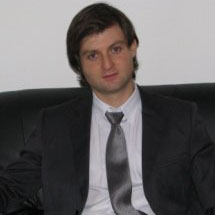
Seminar 8.1.15


Yoav Livneh

M.Sc. student under supervision of Prof. Yossi Rosenwaks, Dr. Philip Klipstein

School of Electrical Engineering, Tel-Aviv University, Tel-Aviv 69978, Israel

On the subject:

Band Structure Calculation and Analysis

of Antimonide Based Type-II Superlattices

08 בינואר 2015, 9:30 
Room 101, Software Eng. Build.  
Seminar 8.1.15

  Physical Electronics Dept.


You are invited to attend a lecture

By


Yoav Livneh

(M.Sc. student under supervision of Prof. Yossi Rosenwaks, Dr. Philip Klipstein,

School of Electrical Engineering, Tel-Aviv University, Tel-Aviv 69978, Israel)


On the subject:


Band Structure Calculation and Analysis

of Antimonide Based Type-II Superlattices


Superlattices are a kind of quantum structure, made up of alternating thin layers of two materials. By changing the layer widths of the individual materials in the superlattice, we can control the optical and electrical properties of the material (bandgap engineering). In recent years, InAs/GaSb type-II superlattices (T2SLs) have become a very attractive potential sensing material in photonic devices used for infrared sensing and imaging.

This work presents a new and effective model for the prediction of T2SL band structure and absorption spectra, based on the k.p method, including a novel approach to the effect of the interfaces between the two individual materials. The main difference between this method and other k.p based methods is in the operator ordering, and in the use of delta-function like interface potentials. The model has reduced the number of fitting parameters to only six, all of which can be deduced empirically.

Calculation results show very good agreement with measurements on over 30 samples grown by Molecular Beam Epitaxy, both in the band gaps and the absorption spectra.


Thursday, 8 January 2015 at 09:30

Room 101, Software Eng. Build.


Special Seminar

Collagen-based nano-biocomposite materials and their potential
applications as tissue scaffolds

Prof. Rina Tannenbaum

Stony Brook University

31 בדצמבר 2014, 16:00 
בניין כיתות, חדר 101  

7.1.15

07 בינואר 2015, 11:00 
Wolfson 206  
7.1.15


יועצים אקדמיים

שם

מגמה/שנת לימוד

תחום התמחות

דוא"ל

פרופ' אבישי אייל

חשמל / א' ו-ב'

אלקטרואופטיקה, ביו-אלקטרוניקה

avishay@eng.tau.ac.il

פרופ' עופר עמרני

חשמל / ג' ו-ד' וכן חשמל-אביב / ג' ו-ד'

תקשורת, עיבוד אותות

ofera@eng.tau.ac.il

פרופ' דורון שמילוביץ

חשמל-אביב / א' ו-ב'

אנרגיה והספק

shmilo@post.tau.ac.il

ד"ר אמיר נתן

חשמל-פיזיקה / א'-ד'

התקנים, חומרים

amirnatan@post.tau.ac.il

פרופ' אריה רוזין

חשמל-פיזיקה / א'-ד'

התקנים

ruzin@tauex.tau.ac.il

פרופ' יצחק תמו

חשמל-מדמ"ח / א'-ד'

מחשבים

tamo@post.tau.ac.il

ד"ר יקיר חדד


אלקטרומגנטיות

hadady@eng.tau.ac.il

פרופ' ג'ורג וייס


בקרה

gweiss@eng.tau.ac.il


האנרגיה המתחדשת תאפשר לספק מים לכולם

28 דצמבר 2014

פרויקט ייחודי של האיחוד האירופי בתחום המשולב של האנרגיה המתחדשת ומים מיועד לפתח טכנולוגיה חדשה ומהפכנית לטיהור מים מזוהמים והפיכתם למים המיועדים לשתייה. אוניברסיטת תל-אביב היא אחד המרכזים שנבחרו לפרויקט

במעבדת המחקר של ד"ר הדס ממן, בשיתוף עם  ד"ר דרור אבישר והדוקטורנטית אינה הורוביץ, מפתחים במסגרת זו את הטכנולוגיה בעזרת ראקטור ממברנלי פוטוקטליטי, השואפת להיות זולה ויעילה, ללא צורך בכימיקלים.

כתבה ב- Ynet על מחקר של הדס ממן:

http://www.ynet.co.il/articles/0,7340,L-4606514,00.html


Seminar 31.12.14

31 בדצמבר 2014, 16:00 
וולפסון 206  
Seminar 31.12.14

Physical Electronics Dept.


***** Seminar *****


Gideon Segev


(PhD. student under the supervision of Prof. Yossi Rosenwaks and Prof. Abraham Kribus)

School of Electrical Engineering, Tel-Aviv University, Tel-Aviv 69978, Israel


Photon Enhanced Thermionic Emission for Solar Energy Conversion


To date, the vast majority of solar energy conversion research focused on two parallel paths: photovoltaics and solar thermal energy conversion. Attempts were made to combine photovoltaic and thermal conversion such as cogeneration and thermo-photonics. However, these attempts did not yield very high efficiencies, and these concepts were not widely implemented. As a result, researchers are still looking for a conversion path that exploits both the photonic nature of sunlight and the high temperatures that can be achieved by focusing it.

Photon Enhanced Thermionic Emission (PETE) was recently proposed as a novel concept in solar energy conversion. Similar to traditional thermionic emission devices, a PETE device consists of a high-temperature cathode emitting energetic electrons and a lower temperature anode absorbing the electrons. By using a semiconductor cathode, optically generated electrons increase the cathode’s conduction band charge population allowing high electron emission at temperatures lower than the common range for thermionic emitters. In this seminar, we will discuss the efficiency limits of PETE devices. The theoretical efficiency limits of PETE converters can theoretically rise above 40% at concentration of 1000 suns, exceeding the Shockley Queisser limit for an ideal single junction PV cell. When coupled to secondary thermal cycle the limits were shown to be exceptionally high reaching close to 70% for a flux concentration 1000. Furthermore, unlike traditional thermionic converters, PETE conversion is possible even under isothermal conditions. Next, the loss mechanisms of more realistic PETE devices will be surveyed through elaborated models. Negative space charge between the two electrodes and surface recombination at the cathode contact are shown to heavily restrict the conversion efficiency. Implementation of back surface field layers in the form of homo-junction or hetero-junction cathodes can reduce surface recombination and bring the efficiency closer to the ideal limits.


Wednesday, December 31, 2014, at 16:00

Room 206, Wolfson Mechanical Engineering Building


סמינר מחלקתי

30 בדצמבר 2014, 14:00 
חדר 206 בניין וולפסון  

ConSent: Context-Based Sentiment Analysis

Dr. Gilad Katz 

Abstract:

Sentiment analysis refers to the inference of people's views, positions and attitudes in their written or spoken texts. The applications of this field are numerous, ranging from the classification of hotel reviews to the analysis of public opinion on Twitter.

In this talk I will present ConSent, a context-based approach for the task of sentiment analysis. Our approach builds on techniques from the field of information retrieval to identify key terms indicative of the existence of sentiment. We model these terms and the contexts in which they appear and use them to generate features for supervised learning. The two major strengths of the proposed model are its robustness against noise and the easy addition of features from multiple sources to the feature set. In addition, I will present a set of domain-specific features, designed specifically for sentiment analysis in automatically transcribed text.


Bio:


Gilad Katz is a fourth-year PhD student in the Department of Information Systems Engineering, Ben Gurion University. His advisers are Prof. Yuval Elovici and Prof. Bracha Shapira. His research interest include text mining, machine learning and recommender systems. 


ההרצאה תתקיים ביום חמישי,30.12.14, בשעה 14:00 בחדר 206, בנין וולפסון הנדסה, הפקולטה להנדסה, אוניברסיטת תל-אביב.

30.12.14

30 בדצמבר 2014, 15:00 
KITOT 011  
30.12.14

You are invited to attend a lecture

By


Atef Shalabney

Institut de Science et d'Ingènierie Supramolèculaires, University of Strasbourg, Strasbourg, France

On the subject:


Light-matter strong coupling and potential for chemistry and biology

When matter is placed in the confined field of electromagnetic radiation, it can lead to modified and even new properties. This is of great interest from both the fundamental point of view as well as for many radiation engineering applications. For instance, the field confinement can lead to effects such as extraordinary optical transmission, enhanced absorption and emission of light, high-resolution spectroscopy and imaging. Under certain conditions, the light-matter interaction can become so strong that it enters the so-called strong coupling regime where new hybrid light-matter states are formed, offering a vast potential for chemistry and biology that has hardly been explored.

In this talk, I'll present the nature of enhanced optical phenomena using nanophotonics and plasmonic structures, emphasizing the applications of harnessing radiation fields into confined regions for bio-sensing and molecular detection. Then, a basic introduction to strong coupling of optically-active substances will be presented. Strong coupling of molecular vibrational transitions in the infra-red region will be particularly elaborated with new prospects to modify molecular and structural processes. New directions for exploiting strong light-matter interactions for bio-sensing and biomedical applications will be discussed.

Short biography:

Dr. Shalabney graduated from the Electrical Engineering Department of the Technion in 1997. He received his M.Sc. and Ph.D. degrees from the Electro-Optics Engineering Department at the Ben-Gurion University in the years 2010 and 2013 respectively. During his Ph.D., he worked within the group of Prof. Ibrahim Abdulhalim on developing plasmonic nanostructures to enhance the sensitivity of optical bio-sensors. In 2013, Dr. Shalabney joined the group of Prof. Thomas  Ebbesen at the University of Strasbourg, where his work has been focused on light-matter strong coupling with applications in biology and chemistry.

30 December 2014, at 15:00,

Room 011, Engineering Kitot Building


הכנס השנתי של המרכז לתקשורת מתקדמת


תוכנית ופרטים להרשמה: 

http://www.eng.tau.ac.il/research/acc/


18 בפברואר 2015, 8:30 
אודיטוריום רוזנבלט, בניין הנדסת תוכנה, הפקולטה להנדסה  

EE Seminar: Gilad Poker

~~
Gilad Poker, 
M.Sc. student under the supervision of Prof. Michael Margaliot

Wednesday, January 7, 2015 at 15:00
Room 011, Kitot Bldg., Faculty of Engineering

Maximizing Protein Translation Rate in the Ribosome Flow Model

Abstract

Translation is an important stage in gene expression. During this stage, macro-molecules called ribosomes, travel along the mRNA strand linking amino-acids together in a specific order to create a functioning protein.
An important question, related to many biomedical disciplines, is how to maximize protein production.
 Indeed, translation is known to be one of the most energy consuming processes in the cell, and it is natural to assume that evolution shaped this process so that it maximizes the protein production rate. If this is indeed so then one can estimate various parameters of the translation machinery by solving an appropriate mathematical optimization problem.
 The same problem also arises in the context of synthetic biology, namely, re-engineer heterologous genes in order to maximize their translation rate in a host organism.
We consider the problem of maximizing the protein production rate using a computational model for translation-elongation called the ribosome flow model (RFM). This model describes the flow of the ribosomes along an mRNA chain of length n using a set of n first-order nonlinear ordinary differential equations.
We show that the steady-state translation rate in the RFM is a strictly concave function of its parameters.
 This means that the problem of maximizing the translation rate under a suitable  constraint  always admits a unique solution, and that this solution can be determined  using highly-efficient algorithms for solving convex optimization problems.
  Furthermore, our analysis shows that the optimal translation rate can be computed based only on the optimal initiation rate and the elongation rate of the codons near the beginning of the ORF.
 

07 בינואר 2015, 15:00 
חדר 011, בניין כיתות חשמל  

עמודים

אוניברסיטת תל אביב עושה כל מאמץ לכבד זכויות יוצרים. אם בבעלותך זכויות יוצרים בתכנים שנמצאים פה ו/או השימוש שנעשה בתכנים אלה לדעתך מפר זכויות
שנעשה בתכנים אלה לדעתך מפר זכויות נא לפנות בהקדם לכתובת שכאן >>