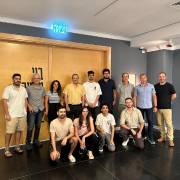
School of Mechanical Engineering: Bar Mizrahi

01 בינואר 2020, 14:00 - 15:00 
בניין וולפסון 206  
0
School of Mechanical Engineering: Bar Mizrahi

~~

SCHOOL OF MECHANICAL ENGINEERING SEMINAR
Wednesday, January 1, 2020 at 14:00
Wolfson Building of Mechanical Engineering, Room 206

Development, Characterization and Implementation of Oscillatory Suction Actuator for Boundary Layer Control
Bar Mizrahi
M.Sc. student of Prof. Avraham ‘Avi’ Seifert

An experimental study of a new innovative fluidic device aimed at creating oscillatory suction and oscillatory blowing (OSOB) with no moving parts was conducted, to be used as an actuator for active flow control applications.
Following the previous generation highly successful SaOB (Steady Suction and Oscillatory Blowing) actuator, a new device was developed, with the aim to create both oscillatory suction (compared to steady suction in the SaOB) and oscillatory blowing. The use of unsteady suction has been shown both experimentally (by Morgulis) and theoretically (by Seifert) to be more efficient than its steady counterpart. The new actuator concept is based on the principle of pulsing a pair of ejectors by a single fluidic oscillator.
The study was conducted in three steps. The first step included benchtop characterization of the new actuator in still-air, with the focus on the oscillatory quality of the suction (also termed ‘switching quality’), and a wide range of suction velocities and frequencies. The second step included an investigation of the actuation – transitional boundary layer interaction over a flat-plate with zero-pressure-gradient, in a small-scale, low–speed wind tunnel. In this stage, four configurations were tested, including base flow (unexcited), steady suction, oscillatory suction, and oscillatory suction combined with oscillatory blowing. Two types of hot-wire surveys were conducted– surface mapping at a constant height above the plate and vertical velocity scan for boundary layer characterization. The third step included a comparison between steady to unsteady suction, both combined with oscillatory-blowing (SaOB and OSOB actuators), on a special-designed airfoil performance, which was tested in the Knapp-Meadow wind tunnel, with both a load-cell and pressure-taps.
The benchtop results show the actuator is capable of creating mean suction velocities of more than 30m/s, with fluctuations to mean ratio of up to 0.7, and wide-range, controllable frequency response. The actuation – boundary layer interaction results show a clear impact of the oscillatory suction on the flow field, expressed in dominant frequency maps and phase-lag maps. Integral parameters of the boundary layer present a shape-factor in the range 2≤H≤1.6 for the base flow, which points on a transitional boundary layer. Both the displacement and the momentum thickness decreased by applying steady and unsteady suction, with certain advantages to unsteady suction, especially at low suction magnitudes. The results of the comparison between the two actuators on the airfoil performance show an increase in the actuation efficiency of the oscillatory suction in comparison to steady suction, resulting from a lower energy consumption that leads to the same desired airfoil performance.

סמינר זיידמן

אורחת כבוד פרופ' ג'וליה גריר 

29 באוקטובר 2019, 11:00 
אולם רוזנבלט  
prof. Julia Greer Seminar

Materials by Design:

Three-Dimensional (3D) Nano-Architected Meta-Materials. Part II


Julia R. Greer

Departments of Materials Science, Mechanics, and Medical Engineering

California Institute of Technology, Pasadena, CA

http://www.jrgreer.caltech.edu


Creation of extremely strong and simultaneously ultra lightweight materials can be achieved by incorporating architecture into material design. In our research, we design and fabricate three-dimensional (3D) nano-architected materials that can exhibit superior and often tunable thermal, photonic, electrochemical, and ­mechanical pro­­­per­­ties at ex­tre­me­ly low mass densities (lighter than aerogels), which renders them useful, and often enabling, in many scientific pursuits and tech­no­lo­gi­cal applications. Dominant properties of such meta-materials are driven by their multi-scale nature: from characteristic material microstructure (atoms) to individual constituents (nanometers) to structural components (microns) to overall architectures (millimeters and above). 

To harness the beneficial properties of 3D nano-architected meta-materials, it is critical to assess their properties at each relevant scale while capturing over­all structural complexity. Our research is focused on fabrication and synthesis of such architected materials using 3D lithography, nanofabrication, and additive manufacturing (AM) techniques, as well as on investigating their mechanical, biochemical, electrochemical, electromechanical, and thermal properties as a function of architecture, constituent materials, and microstructural detail. We strive to uncover the synergy between the internal atomic-level microstructure and the nano-sized external dimensionality, where competing material- and structure-induced size effects drive overall response and govern these properties.

In Part II of the Seidman Lectures, I will shift focus towards additive manufacturing via function-containing resin synthesis, i.e. metals, metal oxides, shape memory polymers, etc., as well as demonstrate their potential in some real-use applications.


Some relevant publications:

  1. D. Yee, M. Lifson, J.R. Greer, Additive manufacturing of 3D architected multifunctional metal oxides, Adv. Mater. (2019) in press, DOI: 10.1002/adma.201901345.
  2. X. Zhang et al, Lightweight, flaw-tolerant, and ultrastrong nanoarchitected carbon. PNAS, 116(14) (2019) 6665-72.
  3. X. Xia et al., Electrochemically reconfigurable architected materials, Nature, 573 (2019) 205-13.
  4. A.J. Mateos et al., Discrete‐continuum duality of architected materials: Failure, flaws, and fracture, Adv. Funct Mater., 29 (2019) article 1806772.
  5. L.A. Shaw et al., Computationally efficient design of directionally compliant metamaterials, Nature Commun., 10 (2019) article 291.
  6. A. Vyatskikh et al., Additive manufacturing of 3D nano-architected metals, Nature Commun., 9 (2018) article 593.
  7. V. Chernow et al., Polymer nanolattices as mechanically tunable 3-dimensional photonic crystals, Appl. Phys. Lett., 107 (2015) article 101905.
  8. L.R. Meza, S. Das, J.R. Greer, Strong, lightweight and recoverable three-dimensional ceramic nanolattices, Science,  345 (2014) 1322-6.

סמינר זיידמן

אורחת כבוד פרופ' ג'וליה גריר 

28 באוקטובר 2019, 16:00 
אולם רוזנבלט  
prof. Julia Greer Seminar

Materials by Design:

Three-Dimensional (3D) Nano-Architected Meta-Materials. Part I


Julia R. Greer

Departments of Materials Science, Mechanics, and Medical Engineering

California Institute of Technology, Pasadena, CA

http://www.jrgreer.caltech.edu


Creation of extremely strong and simultaneously ultra lightweight materials can be achieved by incorporating architecture into material design. In our research, we design and fabricate three-dimensional (3D) nano-architected materials that can exhibit superior and often tunable thermal, photonic, electrochemical, and ­mechanical pro­­­per­­ties at ex­tre­me­ly low mass densities (lighter than aerogels), which renders them useful, and often enabling, in many scientific pursuits and tech­no­lo­gi­cal applications. Dominant properties of such meta-materials are driven by their multi-scale nature: from characteristic material microstructure (atoms) to individual constituents (nanometers) to structural components (microns) to overall architectures (millimeters and above). 

To harness the beneficial properties of 3D nano-architected meta-materials, it is critical to assess their properties at each relevant scale while capturing over­all structural complexity. Our research is focused on fabrication and synthesis of such architected materials using 3D lithography, nanofabrication, and additive manufacturing (AM) techniques, as well as on investigating their mechanical, biochemical, electrochemical, electromechanical, and thermal properties as a function of architecture, constituent materials, and microstructural detail. We strive to uncover the synergy between the internal atomic-level microstructure and the nano-sized external dimensionality, where competing material- and structure-induced size effects drive overall response and govern these properties.

In Part I of the Seidman Lectures, I will focus on the mechanics of 3D nano-architected materials, which include compression, tension, and fracture experiments and simulations, as well as quasi-static vs. dynamic loading for a broad range of materials. I will describe an example where unusual mechanical properties of these nano-architected materials enable creating stimulus-responsive reconfigurable materials through electrochemistry.


Some relevant publications:

  1. D. Yee, M. Lifson, J.R. Greer, Additive manufacturing of 3D architected multifunctional metal oxides, Adv. Mater. (2019) in press, DOI: 10.1002/adma.201901345.
  2. X. Zhang et al, Lightweight, flaw-tolerant, and ultrastrong nanoarchitected carbon. PNAS, 116(14) (2019) 6665-72.
  3. X. Xia et al., Electrochemically reconfigurable architected materials, Nature, 573 (2019) 205-13.
  4. A.J. Mateos et al., Discrete‐continuum duality of architected materials: Failure, flaws, and fracture, Adv. Funct Mater., 29 (2019) article 1806772.
  5. L.A. Shaw et al., Computationally efficient design of directionally compliant metamaterials, Nature Commun., 10 (2019) article 291.
  6. A. Vyatskikh et al., Additive manufacturing of 3D nano-architected metals, Nature Commun., 9 (2018) article 593.
  7. V. Chernow et al., Polymer nanolattices as mechanically tunable 3-dimensional photonic crystals, Appl. Phys. Lett., 107 (2015) article 101905.
  8. L.R. Meza, S. Das, J.R. Greer, Strong, lightweight and recoverable three-dimensional ceramic nanolattices, Science,  345 (2014) 1322-6.

חבר סגל חדש: מדעים להייטק

03 נובמבר 2019
ד"ר יונתן יגאל אוסטרומצקי

נעים מאוד, ד"ר יונתן אוסטרומצקי...אני חבר סגל חדש בבמדעים להייטק והגעתי לפקולטה להנדסה אוניברסיטת תל אביב כבר בשנת 2005, כאשר התחלתי את לימודי התואר הראשון בהנדסת חשמל. מהר מאוד נמשכתי למחקר, והצטרפתי אל המסלול הישיר לתואר שני, ומיד לאחריו לדוקטורט. עם סיום לימודי הדוקטורט אצלנו בבית הספר להנדסת חשמל, יצאתי לפוסט-דוקטורט באוניברסיטת קולומביה בניו יורק. עכשיו, לאחר שנתיים בפוסט, אני משלים את המעגל וחוזר אלינו לפקולטה.


אם הייתי צריך לספר על המחקר שלי בכמה מילים, הייתי אומר...שהמחקר שלי משלב פיתוח תיאורטי של כלים ויכולות לצורך שערוך וזיהוי תופעות ממידע חלקי, ביחד עם מימוש היכולות הללו באפליקציות מרתקות: שיפור הדיוק של ניטור מזג אוויר ע״י שימוש במידע מזדמן מרשתות סלולריות, או זיהוי התקפות סייבר על תשתיות קריטיות (כמו רשת החשמל) והתרעה מבעוד מועד.


הישגים שאני גאה בהם....אני גאה בכלים המחקריים התיאורטיים שפיתחתי - הכלים הללו, שכבר נבדקו בשטח, תורמים לשיפור היכולת והדיוק של מדידות האקלים, וגם לשיפור וייעול התשתית של רשתות תקשורת אלחוטיות עתידיות. במהלך הדוקטורט הוזמנתי להרצות במספר כנסים כדי להציג את המחקר, ואף זכיתי במלגת סטודנט מארגון ה IEEE לצורך נסיעה לסין והצגת המחקר. בנוסף - אני מאוד גאה בהצלחה לשלב את המחקר עם הוראה. כבר במהלך הדוקטורט שימשתי כמרצה אצלנו בפקולטה, וזכיתי במספר רב של פרסי הצטיינות. בהמשך, במהלך פוסט-הדוקטורט, פעלתי רבות בפעילויות שונות של הנגשת מדע-הנדסה-טכנולוגיה-ומתמטיקה למורים ולתלמידים בבתי ספר מקומיים בניו יורק. רק לאחרונה זכינו במענק של 100,000 דולרים מחברת ווריזון לצורך פיתוח תשתית לימוד וירטואלית לתלמידי תיכון על גבי רשת דור 5 העתידית.


המטרות למעבדה החדשה שלי...לפתח שיטות חדשניות לייעול התשתיות העתידיות של תקשורת אלחוטית (לדוגמא בערים חכמות) - הן לצרכי תקשורת יעילה, והן לצרכים אופורטוניסטיים כמו ניטור האקלים. בנוסף – אני מתכנן להשתמש בכלים ובידע שצברתי בתקופת פוסט-הדוקטורט כדי לנסות וליצור תשתית לשדרוג חוויית ההוראה האקדמית.


כשאני לא באוניברסיטה...אני משחק טניס, מבשל, ומשחק עם הכלב.


אם לא היית חוקר הייתי...כנראה רופא


ליצירת קשר איתי

jonatano@post.tau.ac.il

בסך 5,000ש״ח

03 נובמבר 2019
פרסי הצטיינות של חברת Apple לסטודנטים להנדסת חשמל

חברת Apple מזמינה אתכם/ן, סטודנטיות וסטודנטים מצטיינים להנדסת חשמל, להגיש את מועמדותכם/ן לפרסי הצטיינות בסך 5,000 ש״ח. הענקת הפרסים תערך במסגרת אירוע של חברת Apple אשר פרטיו יפורסמו בהמשך.


מועד אחרון להגשת מועמדות

21/11/2019


תנאי סף לזכאות

• סטודנטיות וסטודנטים רשומים ופעילים לתואר ראשון בבית הספר להנדסת חשמל בכל מסלולי הלימוד

• צבירה של 40 נקודות זכות (לפחות)

• בעלי ממוצע ציונים של +90

• יתרון לסטודנטיות וסטודנטים שהיו או הינם פעילים חברתית


אופן הגשת מועמדות

סטודנטיות וסטודנטים העומדים בתנאי הסף ומעוניינים להגיש מועמדות, מתבקשים להיכנס ללינק מטה, למלא פרטיהם ולצרף את המסמכים הבאים:

• קורות חיים

• תדפיס ציונים עדכני

• התייחסות למעורבות החברתית (במידה ויש)


להרשמה
https://applecorp.avature.net/AppleExcellenceAward2020TAU 

***מספר המלגות מוגבל וחברת אפל ישראל איננה מתחייבת להעניק מלגה לכל מועמדת/ת התואם לתנאי הקבלה


לשאלות

לשאלות ניתן לפנות לחני רפאלוביץ׳ crefaelovich@apple.com 


בהצלחה!

חבר סגל חדש: בית הספר להנדסת חשמל

03 נובמבר 2019
 ד"ר גדעון צבי שגב

נעים מאוד שמי ד"ר גדעון צבי שגב. אני חבר סגל חדש במחלקה לאלקטרוניקה פיסיקלית בבית הספר להנדסת חשמל הפקולטה להנדסה אוניברסיטת תל אביב.


הגעתי לאוניברסיטת תל אביב מ...המעבדות הלאומיות על שם לורנס, ברקלי, ארה"ב


אם הייתי צריך לספר על המחקר שלי בכמה מילים, הייתי אומר...המחקר שלי עוסק בפיתוח התקנים אלקטרונים לשימושים שקשורים בסביבה כמו המרת אנרגיית שמש, התפלת מים וטיהור מים. אנחנו מפתחים שיטות לזיהוי פגמים בתאי שמש. שיטות אלו יכולות לזרז את תהליך האופטימיזציה של תאי שמש וכן לזהות במהירות חומרים חדשים שמתאימים לתאי שמש.

בפרויקט אחר אנחנו מפתחים תאי שמש מיוחדים שמסוגלים לייצר חשמל, מימן (שהוא סוג של דלק) ולטהר מים בעת ובעונה אחת. המטרה היא שמערכת כזאת תוכל לעמוד במרכז של כפר אי שם ולספק לכפר את כל הצרכים הבסיסיים שלו.

פרויקט אחרון עוסק בהתפלת מים. אנחנו מפתחים התקן חדשני שמסוגל לשאוב מלח מתוך מי ים ועל ידי כך להתפיל מים לשתייה וחקלאות. אנחנו מאמינים שהתקן כזה יכול לעבוד בצורה יעילה בהרבה המערכות הקיימות להתפלת מים.


הישגים שאני גאה בהם...הצלחנו למצוא פתרונות יצירתיים לבעיות שהרבה חוקרים נתקלו בהן. זה כיף גדול כשמגיע אליך חוקר ומספר שהוא קרא עבודה שלך שהוא מאוד אוהב את הפתרון שלך לבעיה.


החלום למעבדה החדשה שלי...שהעבודה שלנו תביא לפריצת הדרך המיוחלת בתחומים עליהם אנחנו עובדים. העולם משווע לטכנולוגיות חדשות בתחום האנרגיה והמים, כולי תקווה שנוכל לעזור לקדם מעבר לאנרגיה נקייה יותר ולספק גישה למי שתייה בכל מקום.


כשאני לא באוניברסיטה אני...מטייל. משתדל גם לרוץ מדי פעם.


אם לא היית חוקר הייתי...מורה בתיכון


פרטי ההתקשרות שלי...

חדר:238

0733804217

gideons1@tauex.tau.ac.il

School of Mechanical Engineering:Erella Eisenstadt-Matalon

20 בנובמבר 2019, 14:00 - 15:00 
בניין וולפסון 206  
0

~~

SCHOOL OF MECHANICAL ENGINEERING SEMINAR
Wednesday, November 20, 2019 at 14:00
Wolfson Building of Mechanical Engineering, Room 206

Co-evolving rationalizable strategies in multi-objective games

Erella Eisenstadt-Matalon
PhD student of Ami Moshaiov

The vast majority of game-theoretic studies are on Single Objective Games (SOG), also known as single payoff games. The area of Multi-Objective Games (MOGs), which are also termed as multi payoff, multi criteria or vector payoff games, has received lesser attention. Yet, in many practical problems, in economics and engineering, the players must cope with multiple objectives or payoffs.
The considered MOGs are static, non-cooperative, two-persons, zero-sum games with pure strategies, in which each player has self-conflicting objectives and none of the players has a-priori objective preferences. Yet, each player knows all the available strategies of the opponent and all the payoff vectors that result from all possible interactions between the player's strategies and those of the opponent. Here, common knowledge of rationality is assumed. Namely, it is assumed that each player is rational, and that each player knows it, and so on.
The common approach to deal with MOGs is to assume that the objective preferences of the players are known a-priori. In such a case a utility function is employed which transforms the MOG into a surrogate SOG (usually by a weighted-sum approach). However, players may have doubts when trying to a-priori make a rational decision on their objective preferences. Moreover, existing solution techniques, such as by equilibrium or by a MiniMax approach, suffer from not considering the performance trade-offs. In contrast, here it is assumed that in general, decision-makers should take into account performance trade-offs when making a decision. In view of this assertion and of the state-of-the-art, a novel solution concept to MOGs is suggested, which is based on the idea of rationalizability.
The proposed mutual-rationalizability solution concept for solving MOGs involves two-stages. In the first stage, a Set of Rationalizable Strategies (SRS) and their associated payoff vectors are sought for each of the players. This is done using Pareto-based best replies of the opponent, under the assumptions of common knowledge of rationality and undecided objective preferences by the players. The proposed approach results with trade-off information at the end of the first stage. In the second stage, Multi-Criteria Decision Analysis (MCDA) techniques are used to select a strategy out of the obtained SRSs based on the trade-off information that is revealed in the first stage. To realize the proposed two-stage solution approach, a multi-objective co-evolutionary algorithm is devised, which co-evolve the players’ strategies and finds approximated SRS for each of them.
To demonstrate the proposed approach, a novel MOG version of the Traveling Salesperson Problem (TSP) is suggested. It amalgamates two known versions of the TSP including the competing TSP and the selective TSP. The demonstration shows the capabilities of the proposed search algorithm and the significance of the proposed solution approach.


סמינר מחלקה אלקטרוניקה פיזיקאלית: Sergei Koniakhin

14 בנובמבר 2019, 15:00 
הפקולטה הנדסה, בניין כיתות, חדר 011  
סמינר מחלקה אלקטרוניקה פיזיקאלית:  Sergei Koniakhin

סרגיי סמינר

You are invited to attend a lecture
Stationary quantum vortex street in a driven-dissipative quantum fluid of exciton-polaritons

By:
Sergei Koniakhin

Researcher, Université Clermont Auvergne, Institut Pascal, Photon-N2, France
Senior Researcher, Zhores Alferov St. Petersburg Academic University, Russia

Abstract

We investigate the formation of a new class of density-phase defects in a resonantly driven 2D quantum fluid of light. The system bistability allows the formation of low density regions containing density-phase singularities confined between high density regions. We show that in 1D channels, an odd (1-3) or even (2-4) number of dark solitons form parallel to the channel axis in order to accommodate the phase constraint induced by the pumps in the barriers. These soliton molecules are typically unstable and evolve toward stationary symmetric or anti-symmetric arrays of vortex streets straightforwardly observable in \emph{cw} experiments. The flexibility of this photonic platform allows implementing more complicated potentials such as maze-like channels, with the vortex streets connecting the entrances and thus solving the maze.


On Tuesday, Nov 14, 2019, 15:00
Room 011, Kitot building


סמינר מחלקה אלקטרוניקה פיזיקאלית: Sergei Koniakhin

12 בנובמבר 2019, 15:00 
פקולטה להנדסה, בניין כיתות, חדר 011  
סמינר מחלקה אלקטרוניקה פיזיקאלית: Sergei Koniakhin

סרגיי סמינר

You are invited to attend a lecture
Evidence of absorption dominating over scattering in light attenuation by nanodiamonds
By:
Sergei Koniakhin

Researcher, Université Clermont Auvergne, Institut Pascal, Photon-N2, France
Senior Researcher, Zhores Alferov St. Petersburg Academic University, Russia

Abstract
We show an experimental evidence of the domination of absorption over scattering in absorbance spectra of detonation nanodiamonds. We perform the absorbance measurements on the UV-Vis spectrophotometer equipped with integrating sphere and compare them with conventional absorbance spectra. Additionally, we measure the scattering light intensity at the cuvette side wall (scattering at 90 degrees angle). The obtained experimental data were interpreted using the simulations of photon random walk in turbid media and Kubelka-Munk approach. The scattering cross sections and indicatrices were obtained by Mie theory.
 We discover that despite being very close to -4 power law (like Rayleigh scattering) the light extinction by the primary 4 nm diamond crystallites is due to absorption only and scattering can be neglected. That is the reason why previously absorption and scattering contributions were confused. The scattering is governed only by the agglomerates of 100 nm and larger in size remaining in the hydrosols and their fraction can be effectively controlled by centrifugation. Only Mie theory reproduces correctly the close to -2 scattering by the agglomerates accounting for the weird interplay between their size, fractal dimension, and dielectric properties. Finally, using the obtained absorbance spectra we estimate the fraction of non diamond phase in nanodiamonds and their agglomerates.

On Tuesday, Nov 12, 2019, 15:00
Room 011, Kitot building

עמודים

אוניברסיטת תל אביב עושה כל מאמץ לכבד זכויות יוצרים. אם בבעלותך זכויות יוצרים בתכנים שנמצאים פה ו/או השימוש שנעשה בתכנים אלה לדעתך מפר זכויות
שנעשה בתכנים אלה לדעתך מפר זכויות נא לפנות בהקדם לכתובת שכאן >>