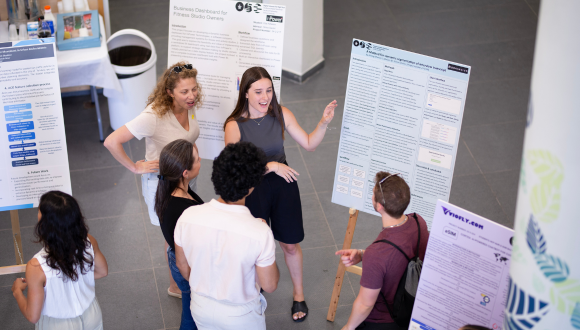
יום עיון מחקרי

לסטודנטים וסטודנטיות לתארים מתקדמים תשפ"ה

07 בינואר 2025, 9:00 
בנייון כיתות, אולם 011  
יום עיון  מחקרי לסטודנטים לתארים מתקדמים

9:00 - 9:10 - התכנסות, ודברי פתיחה

9:10 - 10:00 - מושב א׳

אילן אסטרוגו - בהנחיית פרופ' טל רביב ופרופ' יוסי בוקצ'ין
Grid-based sorting: Centralized online algorithm
נועם שינה – בהנחיית פרופ' ערן טוך
Detecting Deceptive Design Patterns in Mobile Apps
גל נריה - בהנחיית פרופ' מיכל צור
The Dynamic Two-Stage Order Fulfillment Problem

10:00 - 10:15 - הפסקה

10:15 - 11:05 - מושב ב׳

טל בוחניק - בהנחיית פרופ' עירד בן-גל
Identifying Coordinated Groups in Social Networks via Frequency Analysis
יניב לויכטר- בהנחיית פרופ' נטע רבין וד"ר מור כספי
Simulation-Based Optimization for Enhancing Preparedness of the Israel Fire Department
שי מתוק – בהנחיית פרופ' עירד בן-גל
Identifying Social Media Bots and inauthentic users

11:05 - 11:20 - הפסקה

11:20 - 12:10 - מושב ג׳

נעם פרינץ - בהנחיית ד"ר רעות נחם
Multi-Session Appointment Scheduling Using Reinforcement Learning

מאיה ריינר - בהנחיית פרופ' ארז שמואלי
Multi-Layer Stress Assessment Using Smartwatches and Smartphones

יניר צדיקריו - בהנחיית ד"ר מור כספי
Optimizing Recharging Depot Location in a Robotic Delivery Service Extended by Public Transportation

12:10 - 12:45 - הפסקה

12:45 - 13:00 - הסברים כלליים על המסלול הישיר לתואר שני
מיועד למועמדים למסלול ישיר וכן לסטודנטים לתואר שני שעוד לא בחרו נושא לעבודת גמר

13:00 - 14:00 - מפגש עם סטודנטים ותיקים
קומה 4, מעבדה 424 בניין וולפסון

למידע נוסף אודות יום עיון


EE Seminar: Aligning Machine Learning with Society

06 בינואר 2025, 12:00 
אולם 011, בניין כיתות חשמל  
EE Seminar: Aligning Machine Learning with Society

(The talk will be given in English)


Speaker:     Dr. Lee Cohen

                    Stanford

011 hall, Electrical Engineering-Kitot Building‏

Monday, January 6th, 2025

12:00 - 13:00


Aligning Machine Learning with Society


Abstract


Machine Learning (ML) systems are increasingly integrated into society, but challenges arise when human incentives and expectations are overlooked. In this talk, I will present frameworks for aligning ML with society, focusing on strategic classification and personalization in decision making.
Strategic classification models scenarios where individuals, aware of the deployed classifier, manipulate their observable attributes to achieve favorable outcomes. For example, individuals might apply for additional credit cards to boost their credit score just so they can qualify for a loan, even though it doesn’t impact their ability to repay the loan. I will survey extensions to strategic classification, including sequential classifiers, partial knowledge about the deployed classifier, the problem in the context of large language models, and whether classic learnability implies strategic learnability.
In addition, I will discuss multi-objective Markov Decision Processes (MDPs), which involve multiple, potentially conflicting objectives. In classic reinforcement learning and MDPs, policies are evaluated with scalar reward functions, implying that every optimal policy is optimal for all users. However, real-world scenarios involve multiple, sometimes conflicting objectives, necessitating personalized solutions. I will present an MDP framework that accommodates different user preferences over objectives, where preferences are learned via policy comparisons, and the goal is to efficiently compute a near-optimal policy for a given user.
Short Bio

Lee Cohen is a postdoctoral fellow at Stanford. Her research focuses on the intersection of learning theory and societal challenges. She develops methodologies to address fairness, incentive awareness, personalization, and explainability in machine learning and decision-making. Before that, Lee was a Research Assistant Professor at the Toyota Technological Institute at Chicago. She completed her Ph.D. in Computer Science at Tel Aviv University, where she was advised by Yishay Mansour. Lee is a recipient of the Simons Collaboration on the Foundations of Fairness Postdoctoral Fellowship, the Eric and Wendy Schmidt Postdoctoral Award, and the Ariane de Rothschild Ph.D. Fellowship.


השתתפות בסמינר תיתן קרדיט שמיעה לתלמידי תואר שני ושלישי = עפ"י רישום שם מלא + מספר ת.ז. בטופס הנוכחות שיועבר באולם במהלך הסמינר


Our Vision:

The Faculty of Engineering at Tel Aviv University aims to build and support a diverse international portfolio based on excellence in the forms of research collaborations and exchange programs at all levels of study.


Our mission:

The Faculty of Engineering at Tel Aviv University develops and oversees international research collaborations, co-ops, student exchange programs, multi-institutional international workshops, and international fellowships.

For incoming visitors, we strive to enrich their experience at Tel Aviv University by acting as their administrative point-of-contact so that they can focus on their academic goals and enjoy the rich culture of Israel.


What we do:

  • Work together with the Lowy International School to provide logistical services for incoming visitors and outgoing students
  • Develop and manage innovative student exchange programs for outgoing and incoming students for full degree programs, summer research, short-term visits, and condensed-courses given by world-renowned international faculty members
  • Foster new Faculty- and University-level relationships with leading academic institutes around the world 
  • Provide resources for the TAU community to enable hosting international scholars and students

EE Seminar: Securing Modern Systems is More Challenging Than Ever (and Requires New Dedicated Guardrails)

30 בדצמבר 2024, 12:00 
אולם 011, בניין כיתות חשמל  
EE Seminar: Securing Modern Systems is More Challenging Than Ever (and Requires New Dedicated Guardrails)

(The talk will be given in English)


Speaker:     Dr. Ben Nassi

                           Research fellow in the Faculty of Electrical and Computer Engineering (ECE) at the Technion and a Board Member at Black Hat


011 hall, Electrical Engineering-Kitot Building‏

Monday, December 30th, 2024

12:00 - 13:00


Securing Modern Systems is More Challenging Than Ever (and Requires New Dedicated Guardrails)


Abstract

Over the past decade, an increasing number of systems and devices have gained Internet connectivity and been enhanced with sensing capabilities and AI. While these advancements have created a world of smarter, more automated, and highly connected devices, they have also introduced significant security and privacy challenges that cannot be effectively addressed with traditional countermeasures.

In the first part of this talk, we will explore the security and privacy concerns of cyber-physical systems. Specifically, we will examine new threats that have emerged with the deployment of technologies like drones and Teslas in real-world environments. Our discussion will highlight methods for detecting intrusive drone filming and securing Teslas against time-domain adversarial attacks.

The second part of the talk focuses on the challenges posed by the coexistence of functional devices with limited computational power (that do not adhere to Moore’s law) alongside sensors with ever-increasing sampling rates. We will explore how threats such as cryptanalysis and speech eavesdropping—previously accessible only to well-resourced adversaries—can now be executed by ordinary attackers using readily available hardware like photodiodes and video cameras. These attacks leverage optical traces or video footage from a device’s power LED to extract sensitive information.

Finally, in the last part of the talk, we will address the emerging need to secure GenAI-powered applications against a new category of threats we call Promptware. This threat highlights the evolving landscape of vulnerabilities introduced by generative AI systems.

Short Bio

Bio. Dr. Ben Nassi is a research fellow in the Faculty of Electrical and Computer Engineering (ECE) at the Technion and a Board Member at Black Hat.

Ben investigates the security and privacy of systems and devices. He has introduced innovative side-channel attacks to recover speech from light emitted by light bulbs and to extract cryptographic keys from a device’s power LED using video footage. In the realm of cyber-physical systems, he developed techniques to secure Tesla vehicles against time-domain adversarial attacks and to detect intrusive video filming conducted by drones. Recently, his research has expanded to AI security, where he proposed methods to protect GenAI-powered applications from AI worms and to safeguard autonomous vehicle perception against emergency vehicle lighting attacks.

His work has been published in leading academic venues such as USENIX Security, IEEE S&P, and CCS, as well as prestigious industrial conferences, including Black Hat, DEFCON, and the RSA Conference. His research has garnered significant media attention, with features in Forbes, Fox News, Wired, Ars Technica and other major outlets.

Ben earned his PhD from Ben-Gurion University, focusing on “Security and Privacy in the IoT Era,” and completed his postdoctoral fellowship at Cornell Tech. His accomplishments include winning the 2023 Pwnie Award for Best Cryptographic Attack and the Dean’s Award for Excellence in PhD Studies.


השתתפות בסמינר תיתן קרדיט שמיעה לתלמידי תואר שני ושלישי = עפ"י רישום שם מלא + מספר ת.ז. בטופס הנוכחות שיועבר באולם במהלך הסמינר


ד"ר אנז'ליקה אלקן

ד"ר אנז'ליקה אלקן

סיימה דוקטורט בחומרים ומדע מולקולרי במכון ויצמן

סיימה פוסט דוקטורט מדע והנדסה כימית וביו מולקולרית באוניברסיטת יוסטון

ופיזיקה של מערכות מורכבות במכון ויצמן

Physical Electronics Seminar :Management of electromagnetic scattering with spatially and temporally modulated structured environment

סמינר שמיעה לתלמידי תואר שני ושלישי

24 בדצמבר 2024, 15:00 
Room 512 Tochna Building  
Physical Electronics Seminar :Management of electromagnetic scattering with spatially and temporally modulated structured environment


  -סמינר זה יחשב כסמינר שמיעה לתלמידי תואר שני ושלישי-  This Seminar Is Considered A Hearing Seminar For Msc/Phd Students


EE Seminar: Cardio Spectrum: Comprehensive Myocardium Motion Analysis with 3D Deep Learning and Geometric Insights

25 בדצמבר 2024, 15:00 
אולם 011, בניין כיתות-חשמל  
EE Seminar: Cardio Spectrum: Comprehensive Myocardium Motion Analysis with 3D Deep Learning and Geometric Insights

Electrical Engineering Systems Seminar


Speaker: Shahar Zuler

M.Sc. student under the supervision of Dr. Dan Raviv


Wednesday, 25th December 2024, at 15:00

Room 011, Kitot Building, Faculty of Engineering


Cardio Spectrum: Comprehensive Myocardium Motion Analysis with 3D Deep Learning and Geometric Insights


Abstract

The ability to map left ventricle (LV) myocardial motion using computed tomography angiography (CTA) is essential to diagnosing cardiovascular conditions and guiding interventional procedures. Due to their inherent locality, conventional neural networks typically have difficulty predicting subtle tangential movements, which considerably lessens the level of precision at which myocardium three-dimensional (3D) mapping can be performed. Using 3D optical flow techniques and Functional Maps (FMs), we present a comprehensive approach to address this problem. FMs are known for their capacity to capture global geometric features, thus providing a fuller understanding of 3D geometry. As an alternative to traditional segmentation-based priors, we employ surface-based two-dimensional (2D) constraints derived from spectral correspondence methods. Our 3D deep learning architecture, based on the ARFlow model, is optimized to handle complex 3D motion analysis tasks. By incorporating FMs, we can capture the subtle tangential movements of the myocardium surface precisely, hence significantly improving the accuracy of 3D mapping of the myocardium. The experimental results confirm the effectiveness of this method in enhancing myocardium motion analysis. This approach can contribute to improving cardiovascular diagnosis and treatment.

Our code and additional resources are available at: https://shaharzuler.github.io/CardioSpectrumPage


השתתפות בסמינר תיתן קרדיט שמיעה = עפ"י רישום שם מלא + מספר ת.ז. בדף הנוכחות שיועבר באולם במהלך הסמינר


LMI Special Seminar: Quantum measurement through parametric amplification

31 בדצמבר 2024, 15:30 
הפקולטה להנדסה אוניברסיטת תל אביב, בנין כיתות ,אולם 011  
LMI Special Seminar: Quantum measurement through parametric amplification


EE Seminar: Making Neural Networks Linear Again: Projection and Beyond

סמינר שמיעה לתלמידי תואר שני ושלישי

23 בדצמבר 2024, 12:00 
אולם 011, בניין כיתות חשמל  
EE Seminar: Making Neural Networks Linear Again: Projection and Beyond

(The talk will be given in English)


Speaker:     Dr. Assaf Shocher

                              NVIDIA


011 hall, Electrical Engineering-Kitot Building‏

Monday, December 23rd, 2024

12:00 - 13:00


Making Neural Networks Linear Again: Projection and Beyond


Abstract

Every day, somewhere, a researcher mutters, “If only neural networks were linear, this problem would be solved”. Linear operations offer powerful tools: projection onto subspaces, eigen decomposition, and more. This talk explores their equivalents in the non-linear world of neural networks, with a special focus on projection, generalized by idempotent operators- operators that satisfy f(f(x)) = f(x).

Idempotent Generative Network (IGN) is a generative model that is trained by enforcing two main objectives: (1) target distribution data map to themselves f(x) = x, defining the target manifold, and (2) latents project onto this manifold via the idempotence condition f(f(z)) = f(z). IGN generates data in a single step, but can iteratively refine, and projects corrupted data back onto the distribution.

This projection ability gives rise to Idempotent Test-Time Training (IT³), a method to adapt models at test time using only current out-of-distribution (OOD) input. During training, the model f receives an input x along with either the ground truth label y or a neutral "don't know" signal . At test-time, given corrupted/OOD input x, a brief training session minimizes ||f(x, f(x, )) - f(x, )||, making f(x,) idempotent. IT³ works across architectures and tasks, demonstrated for MLPs, CNNs, and GNNs on corrupted images, tabular data, OOD facial age prediction, and aerodynamic predictions.

Finally, I'll ask: "Who says neural networks are non-linear?" They're only non-linear with respect to the standard vector spaces! In an ongoing work, we construct vector spaces X, Y with their own addition, negation, and scalar multiplication, where f: X → Y becomes truly linear. This enables novel applications including spectral decomposition, zero-shot solutions to non-linear inverse problems via Pseudo-Inverse, and architecture-enforced idempotence.

Short Bio

I am a postdoctoral researcher at NVIDIA. Prior to that I was a postdoctoral fellow at UC Berkeley, working with Alyosha Efros, and a visiting researcher at Google. I received my PhD from the Weizmann Institute of Science, where I was advised by Michal Irani. I have bachelor's degrees in Physics and EE from Ben-Gurion University. My prizes and honors include the Rothschild postdoctoral fellowship, the Fulbright postdoctoral fellowship, John F. Kennedy award for outstanding Ph.D. at the Weizmann Institute, and the Blavatnik award for CS Ph.D. graduates.


השתתפות בסמינר תיתן קרדיט שמיעה = עפ"י רישום שם מלא + מספר ת.ז. בטופס הנוכחות שיועבר באולם במהלך הסמינר


עמודים

אוניברסיטת תל אביב עושה כל מאמץ לכבד זכויות יוצרים. אם בבעלותך זכויות יוצרים בתכנים שנמצאים פה ו/או השימוש שנעשה בתכנים אלה לדעתך מפר זכויות
שנעשה בתכנים אלה לדעתך מפר זכויות נא לפנות בהקדם לכתובת שכאן >>