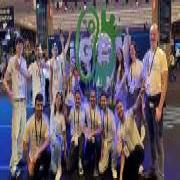
יום זרקור של חברת Apple

09 בדצמבר 2024, 12:30 - 14:30 
בניין כיתות  
יום זרקור של חברת Apple

מהרו להירשם- המקומום מוגבלים

סטודנטים.ות לחשמל ומדעי המחשב-חברת Apple מגיעה לפגוש אתכם.ן בקמפוס!


חברת אפל באה לפגוש אתכם.ן ביום זרקור מרתק ביום שני הקרוב, ה- 9 בדצמבר, 2024 בשעות 12:30 – 14:30 בלובי בניין כיתות.

במסגרת יום הזרקור תתקיים הרצאה בשעה 13:30 בחדר 011 בנושא:

"How custom silicon made Apple Vision Pro Possible"

ההרצאה תועבר ע"י אסף מנחם, מנהל קבוצת ארכיטקטורה בחברת אפל, ישראל.

מתי? 09.12.2024 בשעה 12:30
איפה? לובי בניין כיתות


יש להירשם באמצעות הברקוד


מצפים לראותכם.ן.


Physical Electronics Seminar :Exploring the Frontier of Free-Space Quantum Key Distribution with Spatial Modes of Light

סמינר שמיעה לתלמידי תואר שני ושלישי

23 בדצמבר 2024, 15:00 
Room 512 Tochna Building  
Physical Electronics Seminar :Exploring the Frontier of Free-Space Quantum Key Distribution with Spatial Modes of Light


  -סמינר זה יחשב כסמינר שמיעה לתלמידי תואר שני ושלישי-  This Seminar Is Considered A Hearing Seminar For Msc/Phd Students


Physical Electronics Seminar :Superscatterers for Labeling Miniature Lightweight Airborne Targets

סמינר שמיעה לתלמידי תואר שני ושלישי

14 בינואר 2025, 15:00 
Room 011 Kitot Building  
 Physical Electronics Seminar :Superscatterers for Labeling Miniature Lightweight Airborne Targets


  -סמינר זה יחשב כסמינר שמיעה לתלמידי תואר שני ושלישי-  This Seminar Is Considered A Hearing Seminar For Msc/Phd Students


Physical Electronics Seminar :Quantum optomechanical control of long-lived bulk acoustic phonons

סמינר שמיעה לתלמידי תואר שני ושלישי

12 בדצמבר 2024, 11:00 
Room 011 Kitot Building  
  Physical Electronics Seminar :Quantum optomechanical control of long-lived bulk acoustic phonons


  -סמינר זה יחשב כסמינר שמיעה לתלמידי תואר שני ושלישי-  This Seminar Is Considered A Hearing Seminar For Msc/Phd Students


כנס בפקולטה למדעי החיים באוניברסיטת תל אביב קידם שיתופי פעולה פוריים

כשהאקדמיה והתעשייה נפגשות

ב-25 בנובמבר 2024 התקיים כנס השקה מרשים באנו - מוזיאון העם היהודי שבקמפוס אוניברסיטת תל אביב, אשר עסק בקשרי אקדמיה ותעשייה בתחום מדעי החיים.

האירוע, בהובלת ד"ר יריב ויין ובשיתוף המרכז לקשרי תעשייה של אוניברסיטת תל אביב, איגד אנשי אקדמיה ותעשייה לחשיפת מחקרים חדשניים ולשיח מעמיק על בניית שיתופי פעולה עתידיים.

בכנס השתתפו בכירים מהאקדמייה ומהתעשייה, וביניהם פרופ' אריאל פורת נשיא אוניברסיטת תל אביב, פרופ' עבדאלסלאם עאזם דקאן הפקולטה למדעי החיים, ונציגי חברות מובילות.


לכתבה המלאה ולתמונות נוספות מהאירוע


EE Seminar: Can We Bypass the Curse of Dimensionality in Private Data Analysis

22 בדצמבר 2024, 15:00 
אולם 011, בניין כיתות חשמל  
EE Seminar: Can We Bypass the Curse of Dimensionality in Private Data Analysis

(The talk will be given in English)


Speaker:     Dr. Eliad Tsfadia

                              Department of Computer Science at Georgetown University


011 hall, Electrical Engineering-Kitot Building‏

Sunday, December 22nd, 2024

15:00 - 16:00


Can We Bypass the Curse of Dimensionality in Private Data Analysis?


Abstract


Differentially private (DP) algorithms typically exhibit a significant dependence on the dimensionality of their input, as their error or sample complexity tends to grow polynomially with the dimension. This cost of dimensionality is inherent in many problems, as Bun, Ullman, and Vadhan (STOC 2014) showed that any method that achieves lower error rates is vulnerable to tracing attacks (also known as membership inference attacks). Unfortunately, such costs are often too high in many real-world scenarios, such as training large neural networks, where the number of parameters (the ambient dimension) is very high.
On the positive side, the lower bounds do not rule out the possibility of reducing error rates for "easy" inputs. But what constitutes "easy" inputs? And how likely is it to encounter such inputs in real-world scenarios?
In this talk, I will present a few ways to quantify "input easiness" for the fundamental task of private averaging and support them with upper and lower bounds. In particular, I will show types of properties that are both sufficient and necessary for eliminating the polynomial dependency on the dimension.

I will conclude by outlining future research directions and providing a broader perspective on my work.


The talk is mainly based on the following three papers:
(1) FriendlyCore https://arxiv.org/abs/2110.10132 (joint with Edith Cohen, Haim Kaplan, Yishay Mansour, and Uri Stemmer, ICML 2022),


(2) https://arxiv.org/abs/2307.07604 (joint with Naty Peter and Jonathan Ullman, COLT 2024),

Short Bio

Eliad Tsfadia is a postdoctoral researcher in the Department of Computer Science at Georgetown University, hosted by Prof. Kobbi Nissim. He completed his Ph.D. in the Department of Computer Science at Tel Aviv University under the supervision of Prof. Iftach Haitner. In addition, Eliad was a research intern at Google Research - Israel (2019-2022), a part-time security researcher at IBM Research - Haifa (2017-2019), and a full-time software engineer, team leader, and officer (Major) in the technological unit of the Intelligence Corps at IDF (2008-2017). Eliad's primary research interests lie in Data Privacy, particularly at the intersections with Cryptography and Machine Learning.


השתתפות בסמינר תיתן קרדיט שמיעה = עפ"י רישום שם מלא + מספר ת.ז. בטופס הנוכחות שיועבר באולם במהלך הסמינר


EE Seminar: Polynomial Time Cryptanalytic Extraction of Neural Network Models

09 בדצמבר 2024, 12:00 
אולם 011, בניין כיתות-חשמל  
EE Seminar: Polynomial Time Cryptanalytic Extraction of Neural Network Models

(The talk will be given in English)


Speaker:     Prof. Adi Shamir

                                Computer Science and Applied Mathematics,Weizmann Institute of Science


011 hall, Electrical Engineering-Kitot Building‏

Monday, December 9th, 2024

12:00 - 13:00


Polynomial Time Cryptanalytic Extraction of Neural Network Models


Abstract

Abstract. Billions of dollars and countless GPU hours are currently spent on training Deep Neural Networks (DNNs) for a variety of tasks. Thus, it is essential to determine the difficulty of extracting all the parameters of such neural networks when given access to their black-box implementations. Many versions of this problem have been studied over the last 30 years, and the best previous attack on ReLU-based deep neural networks was presented at Crypto’20 by Carlini, Jagielski, and Mironov. It resembled a differential chosen plaintext attack on a cryptosystem, which has a secret key embedded in its black-box implementation and required a polynomial number of queries but an exponential amount of time (as a function of the number of neurons).

In this talk, I will improve this attack by developing several new techniques that make it possible to extract with arbitrarily high precision all the real-valued parameters of a ReLU-based DNN using a polynomial number of queries AND a polynomial amount of time. We demonstrated its practical efficiency by applying it to a full-sized neural network for classifying the CIFAR10 dataset, which has 3072 inputs, 8 hidden layers with 256 neurons each, and about 1.2 million neuronal parameters. An attack following the approach by Carlini et al. requires an exhaustive search over 2^256 possibilities, whereas our attack requires only 30 minutes on a 256-core computer. In the last part of the talk I will show a recent extension of the attack which can extract in polynomial time all the parameters of the network even when the attacker receives only the label (e.g., a “cat” or a “dog”) of any given input, rather than the numeric values of its logits.


השתתפות בסמינר תיתן קרדיט שמיעה = עפ"י רישום שם מלא + מספר ת.ז. בטופס הנוכחות שיועבר באולם במהלך הסמינר


ברכות חמות לפרופ' ראמי חג'-עלי על זכייתו במענק המשותף MOONSHOT-MED של אוניברסיטת תל אביב ושירותי בריאות כללית

ראמי, מחקר שתורם משמעותית לקידום הידע בתחום ומוביל לתוצאות פורצות דרך.

הצלחה רבה בהמשך דרכו

TAUSAT1

TAUSAT2

TAUSAT3
Tevel1


Tevel2

Optical communications 
 
Hyperspectral remote sensing

עמודים

אוניברסיטת תל אביב עושה כל מאמץ לכבד זכויות יוצרים. אם בבעלותך זכויות יוצרים בתכנים שנמצאים פה ו/או השימוש שנעשה בתכנים אלה לדעתך מפר זכויות
שנעשה בתכנים אלה לדעתך מפר זכויות נא לפנות בהקדם לכתובת שכאן >>