EE Seminar: Single Sensor Trajectory Optimization for Best Emitter Localization

04 במרץ 2019, 15:00 
חדר 011, בניין כיתות-חשמל  

Speaker: Elad Tzoreff

Ph.D. student under the supervision of Prof. Anthony J. Weiss


Monday, March 4th, 2019 at 15:00

Room 011, Kitot Bldg., Faculty of Engineering


Single Sensor Trajectory Optimization for Best Emitter Localization


Abstract


Passive emitter localization has many civilian, commercial and military applications. The rapidly increasing utilization of smartphones and, therefore mobile applications, has created a high demand for location based services, both in commercial applications and social networking, for multiple and varied uses. Location based services are also critical to many businesses and government organizations to derive real insight from data tied to specific locations where activities take place. The spatial patterns that location-related data and services can provide is one of the most powerful and useful aspects when location is a common denominator in all of these activities and can be leveraged to better understand patterns and relationships. Accordingly, precise, and personalized localization solutions become a fundamental requirement of any commercial/social service.

In this presentation I will address the problem of a single platform trajectory optimization, aims to provide a targeted localization solution for a given emitter based on TOA measurements (i.e., minimizing the localization error of the emitter). The problem of trajectory optimization is a constraint non-convex optimization problem. Constraints arise due to physical limitation of the platforms, and geographical constrains such as restricted areas and safety zones in which the receiver is not allowed to travel. I will discuss two use-cases, a pre-mission design in which the entire trajectory is optimized based on prior knowledge on the emitter location. The second use-case is a real-time path design, in which the receiver begins with a coarse estimation of the emitter location, and searches for the next best way-point to travel to. In this case, the uncertainty in the estimation is incorporated into the optimization problem, in order to avoid over-optimistic steps in preliminary stages of the process. For both use-cases, we propose convex relaxation solutions based on Semi-definite relaxation methods and demonstrate their impressive results in terms of performance and robustness. Next, I will discuss the trajectory optimization of a pair of sensors which cooperate to localize an emitter based on TDOA observations. The presence of more than a single sensor imposes additional constraints on the pairwise distances between the sensors. We derive a solution based on the alternating direction of multipliers (ADMM) with intermediate steps carried out using the majorization minimization (MM) and SDR methods. The algorithm is demonstrated to outperform global optimizers such as genetic and the basin-hoping algorithms, both in terms of performance (better localization error) and speed of convergence.

As a final step, in order to provide an algorithmic solution that is capable of operating in real time environments, we introduce a differential dynamic programming (DDP) solution that is demonstrated to converge quadratically to good local optima, exploiting the desired properties of Newton method.


EE Seminar: Live Semantic Face Editing in Video using Deep Adversarial Autoencoders

27 בפברואר 2019, 15:30 
חדר 011, בניין כיתות-חשמל  

Speaker: Oran Gafni

M.Sc. student under the supervision of Prof. Lior Wolf


Wednesday, February 27th 2019 at 15:30

Room 011, Kitot Bldg., Faculty of Engineering


Live Semantic Face Editing in Video using Deep Adversarial Autoencoders


Abstract


We propose a method for face editing in video that enables live face effects at high frame rates. Two applications are considered (i) replacing the face with a similar face that is not recognizable as the same identity, and (ii) modifying parts of the face. These applications require maintaining the pose, the apparent illumination, and the expression of the face in the input frames while making natural-looking modifications according to the desired task.

We achieve this by a novel feed forward encoder-decoder architecture that is conditioned on the target high-level features of a single image. The network is global, in the sense that it does not need to be retrained for a given video or based on the desired outcome, and it creates naturally looking sequences with little distortions.

EE Seminar: On the Role of Geometry in Geo-Localization

27 בפברואר 2019, 15:00 
חדר 011, בניין כיתות-חשמל  

Speaker:  Moti Kadosh

M.Sc. student under the supervision of Prof. Ariel Shamir and Prof. Daniel Cohen Or


Wednesday, February 27th, 2019 at 15:00

Room 011, Kitot Bldg., Faculty of Engineering

On the Role of Geometry in Geo-Localization

Abstract


            Humans can build a mental map of a geographical area to find their way and recognize places. The basic task we consider is finding the pose (position & orientation) of a camera in a large 3D scene from a single image. Our goal is to examine whether such a capability can be learned by a neural network. In particular, we aim to explore the role of geometry alone in geo-localization using CNNs, while ignoring the often available texture of the scene. We therefore deliberately avoid using texture or rich geometric details and use images projected from a simple 3D model of a city, which we term lean images. Lean images contain mostly information that relates to the geometry of the area viewed (edges, faces, or relative depth). We find that the network is capable of estimating the camera pose from the lean images, not by memorization but by some measure of geometric learning of the geographical area. The main contributions of this thesis are: (i) demonstrating the power of CNNs for recovering camera pose using lean images; and (ii) providing insight into the role of geometry in the CNN learning process.

EE Seminar: PointWise: An Unsupervised Point-wise Feature Learning Neural Network

25 בפברואר 2019, 15:30 
חדר 011, בניין כיתות-חשמל  

Speaker: Matan Shoef

M.Sc. student under the supervision of Prof. Daniel Cohen-Or


Monday, February 25th 2019 at 15:30

Room 011, Kitot Bldg., Faculty of Engineering


PointWise: An Unsupervised Point-wise Feature Learning Neural Network


Abstract


We present a novel approach to learning a point-wise, meaningful embedding for point-clouds in an unsupervised manner, through the use of neural-networks.

The domain of point-cloud processing via neural-networks is rapidly evolving, with novel architectures and applications frequently emerging. Within this field of research, the availability and plethora of unlabeled point-clouds as well as their possible applications make finding ways of characterizing this type of data appealing. Though significant advancement was achieved in the realm of unsupervised learning, its adaptation to the point-cloud representation is not trivial.

Previous research focuses on the embedding of entire point-clouds representing an object in a meaningful manner. We present a deep learning framework to learn point-wise description from a set of shapes without supervision.

Our approach leverages self-supervision to define a relevant loss function to learn rich per-point features. We train a neural-network with objectives based on context derived directly from the raw data, with no added annotation. We use local structures of point-clouds to incorporate geometric information into each point's latent representation. In addition to using local geometric information, we encourage adjacent points to have similar representations and vice-versa, creating a smoother, more descriptive representation.

We demonstrate the ability of our method to capture meaningful point-wise features through three applications. By clustering the learned embedding space, we perform unsupervised part-segmentation on point clouds. By calculating Euclidean distance in the latent space we derive semantic point-analogies. Finally, by retrieving nearest-neighbors in our learned latent space we present meaningful point-correspondence within and among point-clouds.

סמינר מחלקה אלקטרוניקה פיזיקאלית: Yoav Shoshani

28 בפברואר 2019, 11:00 
פקולטה להנדסה, ביניין וולפסון, חדר 234  
סמינר מחלקה אלקטרוניקה פיזיקאלית: Yoav Shoshani

סמינר יואב

You are invited to attend a lecture

Localized microwave-heating of basalts –
Melting, lava-like eruption, and dusty-plasma ejection
By
Yoav Shoshani
MSc student under the supervision of Prof. Eli Jerby

Abstract
Localized microwave-heating (LMH) and the consequent formation of hotspots by thermal-runaway instability may cause local melting, and even plasma ejection by various materials. The LMH phenomenon, generated by the microwave-material interaction, enables a rapid heating within a localized zone (a hotspot, much smaller than the microwave wavelength). This local heating process evolves up to the occurrence of a phase transition of the solid material into liquid, gas or plasma. In this study, LMH phenomena of basalt melting, lava-like eruptions and dusty-plasma ejection are presented. This study includes experimental and numerical investigations of the LMH interactions of basalts with microwaves, characterization of the dusty plasma and its nano-particle products by various diagnostic means (in- and ex-situ). Additionally, these experimental results are considered in various scientific and practical aspects, namely their potential relevance to natural ball-lightning and volcanic effects, as well as their significance for several applications, such as construction, mining, powder generation, microwave-induced breakdown spectroscopy (MIBS), and mineral extraction.


On Thursday, February 28, 2019, 11:00
Room 234, Wolfson Building
 

שיח פתוח בין חוקרות לדקאן

21 פברואר 2019

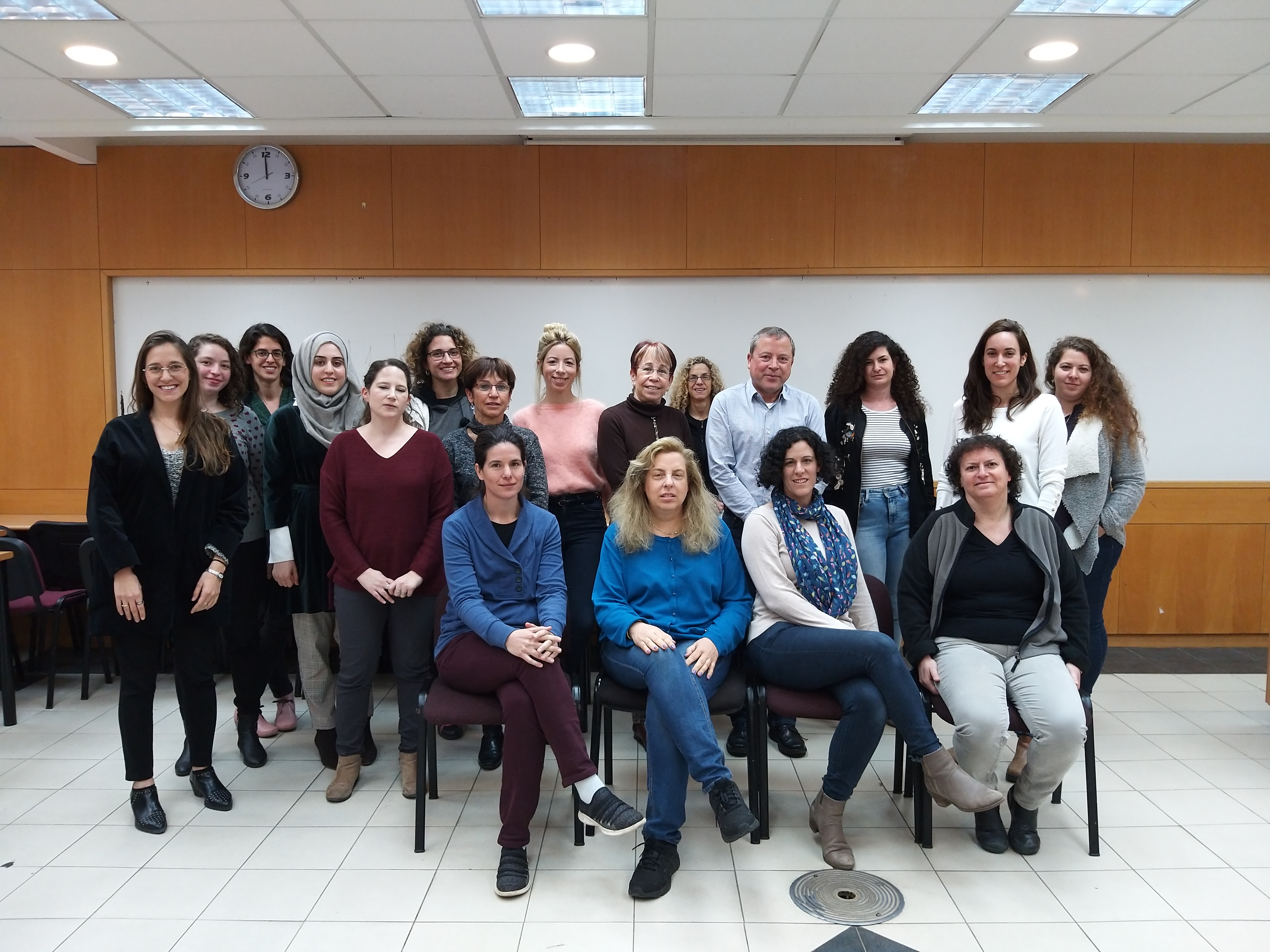
כמידי שנה, לקראת יום האשה הבינלאומי, נפגש דקאן הפקולטה להנדסה פרופ' יוסי רוזנוקס עם הדוקטורנטיות הלומדות בפקולטה להנדסה באוניברסיטת תל אביב.


פרופ' רוזנוקס הציג במפגש שהתקיים ביום רביעי ה 20.2.2019, את חזון הפקולטה: להעלות את מספר הנשים הלומדות בפקולטה להנדסה, החל מהתואר הראשון ועד התואר השלישי. כמו כן ציין הדקאן את המאמצים שעושה הפקולטה בשנים האחרונות לגייס לשורותיה כל שנה מספר חברות סגל חדשות. במפגש נכחו גם חברות הוועדה להוגנות מגדרית בפקולטה וחלקו עם הסטודנטיות את נסיונן.


הדוקטורנטיות במפגש ציינו את הקשיים שהן מתמודדות איתם כחוקרות צעירות, כאשר חלקן הן גם אמהות לילדים קטנים. את ההחלטות שעליהן לקבל בנושא יציאה לפוסט-דוקטורט בחו"ל והמשמעות של בחירה בקריירה אקדמית בתחום כה תובעני.


הדקאן ציין את התמיכה שאוניברסיטת תל אביב והפקולטה בפרט נותנות לדוקטורנטיות בעזרת מלגות ייעודיות:

  • מלגות הנשיא לדוקטורנטיות מצטיינות היוצאות לפוסט-דוקטורט
  • תמיכה כספית לאימהות לתינוקות היוצאות לכנסים
  • מלגות של הרקטור ושל הפקולטה לדוקטורנטיות היולדות במהלך לימודיהן.

מימין לשמאל(עומדות): לילה וולצינסקי, לירון דוד, הדר טרויגוט, פרופ' רוזנוקס, פרופ' רון, פנינה אפרתי, קארין לבון, זיוה ליפובצקי, מור פלג, הדר כהן דוויק, כיאן קעדאן, ליהי שילה, טליה עדן , טלי דותן

מימין לשמאל(יושבות): פרופ' צור, דר' לכמן, פרופ' זילברמן, ד"ר לסמן

EE Seminar: DEVELOPMENT OF A NEW DYNAMIC ALGORITHM FOR EXERCISE MONITORING AND PROGRAMING

25 בפברואר 2019, 15:00 
חדר 011, בניין כיתות-חשמל  

Speaker: Nir Minerbi

M.Sc. student under the supervision of Prof. Mickey Scheinowitz


Monday, February 25th, 2019 at 15:00

Room 011, Kitot Bldg., Faculty of Engineering


DEVELOPMENT OF A NEW DYNAMIC ALGORITHM FOR EXERCISE MONITORING AND PROGRAMING


Abstract

Background- Many studies have found that sedentary lifestyle is associated with an increased risk of diabetes, obesity, heart disease, cancer and premature death. These studies show that maintaining high physical fitness level does not prevent the damage caused by prolonged sitting [1]. Despite having a large variety of sport technologies, very few provide real-time feedback and neither were clinically proven on cardiac patients.

Goal- To create a dynamic algorithm for monitoring and recommending effective exercise recommendations, both as part of the training program and as part of leisure time physical activity.

Methods- Unlike most of applications on market today, whom handle daily activity and training program separately, this algorithm aims to analyze both activity types and to make bi-directional adjustments for serving the main goal: user’s fitness improvement and health outcome. For maximizing the efficiency of the application, the algorithm will adapt to the capabilities and needs of the user and will feed him back according to his progress. The purpose of the current thesis was therefore to develop a virtual personal trainer, which helps the user to enhance physical fitness, and reduce as much as possible the damage associated with physical inactivity during daily routine. In order to test the efficiency of the newly developed algorithm, it was tested under a clinical experimental setting in the cardiac rehabilitation institute, Sheba Medical Centre.

Results- the results show that the algorithm achieved much better results comparing the control group. In addition, statistical comparison to meta-analysis of 31 similar researches showed that the developed algorithm showed up to 65% higher fitness improvement results among the patients participated in the experiment than other rehabilitation processes. Conclusions- The newly developed algorithm was proven to be as good as human guidance and can potentially replace human accompaniment in the cardiac rehabilitation setting, in the future.

School of Mechanical Engineering Barak Kashi

06 במרץ 2019, 14:00 - 15:00 
בניין וולפסון חדר 206  
0
School of Mechanical Engineering Barak Kashi


School of Mechanical Engineering Seminar
Thursday, March 6, 2019 at 14:00
Wolfson Building of Mechanical Engineering, Room 206


Finding the Limits of Submerged Jet Heat Transfer


Barak Kashi

PhD student of Herman Haustein


Impinging jets offer much higher transport rates than other canonical flows and therefore have many industrial applications. Specifically, for cooling of electronic components they are often employed in arrays of micro-jets for improved uniformity. Examination of the literature shows that prior to dealing with arrays, key understandings of single jet heat transfer are still lacking. Within this study, these gaps are filled by new relations which are developed and validated against numerical simulations over a wide range of working conditions.

While traditional macro-scale heat transfer (HT) correlations predict continuous increase in HT during down-scaling, it is here found that this trend reverses at the micro-scale due to viscous dissipation even under low-viscosity laminar flow conditions. Thus, a maximum exists for effective cooling, beyond which any further down-scaling decreases the cooling rate. Furthermore, It is shown that when dissipation becomes significant, the effective HT is no longer independent of the imposed heat flux and the heating-cooling symmetry is broken.

Next, dependencies of HT on geometrical parameters such as nozzle length and nozzle-to-wall distance are resolved,  showing that the velocity profile arriving at the wall uniquely determines the stagnation-point HT. First examining short-nozzle flow reveals three distinct flow regimes, associated with flow separation at the inlet and its reattachment. The corresponding non-monotonous dependence of HT on nozzle length is then correlated for short nozzle-to-wall distances. Larger nozzle-to-wall distances are here dealt with by deriving an approximate solution to the axial momentum equation, which gives a good description of the jet core for a wide range of flight distances and for all issuing profile. This approximate solution, not only revealed the true form of the jet’s potential core, but also led to the identification of a new concept – the “boundary core” delimiting the jet’s interaction with its surroundings.

Finally, a mechanistic model is developed which provides the HT distribution under the jet and its relation to the arriving jet profile. Therein, apparent contradiction in observed stagnation-point HT trends is resolved, while the non-monotonous radial distribution under quasi-uniform jets is explained.

The contribution of the present work is two-fold: i) identifying and quantifying the inherent lower bound of beneficial down-scaling of jet impingement systems­ – thus curbing the on-going trend of jet-array miniaturization; ii) the relations developed here significantly extend jet impingement theory and enable finding the optimal HT regardless of scale.

 

פרופ' בת אל שני פנחסיק

ד"ר בת אל שני פנחסיק


פרופ' גילי חנה ביסקר רביב

עמודים

אוניברסיטת תל אביב עושה כל מאמץ לכבד זכויות יוצרים. אם בבעלותך זכויות יוצרים בתכנים שנמצאים פה ו/או השימוש שנעשה בתכנים אלה לדעתך מפר זכויות
שנעשה בתכנים אלה לדעתך מפר זכויות נא לפנות בהקדם לכתובת שכאן >>