קבלת רובוטים ב"מעבדת סקרנות"

17 בנובמבר 2015, 10:00 
בניין וולפסון מעבדת CIM  

09:50               התכנסות


10:00-10:10    ברכות:

פרופ' יוסי רוזנווקס, דיקאן הפקולטה להנדסה ע"ש אייבי ואלדר פליישמן


10:10-11:30    דוברים:

·         הגב' טל שרייבר, נציגת Spin Master בישראל

·         מר אסף ברזילאי, מנכ"ל אקסטרים ריאליטי בישראל

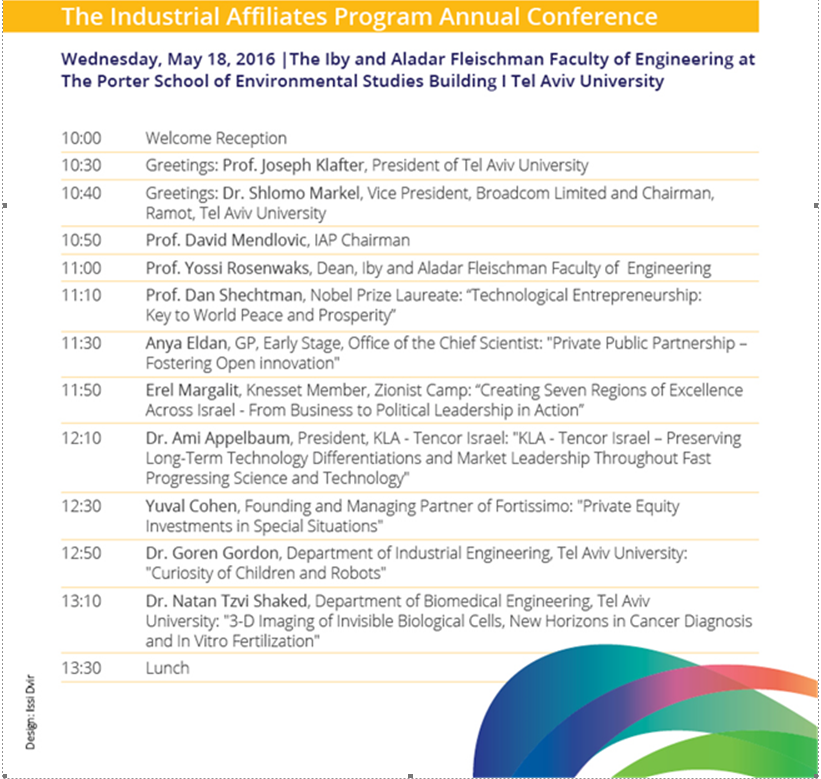
·         דר' גורן גורדון, מחלקה להנדסת תעשייה, הפקולטה להנדסה ע"ש אייבי ואלדר פליישמן, אוניברסיטת ת"א

A Curious Mind in a Versatile Body""  ("מוח סקרן בגוף משתנה")


o        הצגת הרובוטים

Model-Based Design

15 בנובמבר 2015, 10:00 
Wolfson Building for Mechanical Engineering, room 206  
Model-Based Design


The IAP of the Engineering Faculty

Invites the faculty students and staff to attend the lecture on:


Model-Based Design

(the lecture is in English)


Sunday, 15 November, 10:00-12:00

Wolfson Building for Mechanical Engineering, room 206


The lecture:

The Lecture will deal with Model-Based Design – here is the entry in the Wikipedia:

https://en.wikipedia.org/wiki/Model-based_design


A brief video about the method:

http://www.mathworks.com/videos/model-based-design-with-matlab-and-simulink-69040.html?type=shadow&shadow_version=lightbox


The speaker:

Dr. Jon Friedman is a senior manager at MathWorks in Industry Marketing.  Dr. Friedman’s thesis work focused on the application of robust system identification and control theory.  After completing the PhD program at University of Michigan, Jon held research and product development positions in the commercial and defense sectors of the automotive and aerospace industries.  In addition experience deploying Model-Based Design and code generation at a Fortune 50 company, he has also been a program manager on multiple vehicle programs and led lean engineering and manufacturing projects.  At MathWorks, Jon leads a team of industry experts focused on helping leading companies in the AeroDef and Auto industries adopt Model-Based Design though sharing of best practices.  Dr. Friedman has authored over 50 papers and articles on modeling and Model-Based Design and also holds an MBA from the University of Michigan.


The IAP promotes the dialogue between the Faculty and the Industry, by providing the platform on which both can engage in areas such as R&D, students’ internship and recruitment, activation of knowledge transfer processes by Ramot and more.

EE Seminar: Sub-Nyquist Sampling: Bounds, Algorithms and Hardware

~~(The talk will be given in English)

Speaker:  Prof. Yonina Eldar
                      EE, Technion

Monday, November 16th, 2015
15:00 - 16:00
Room 011, Kitot Bldg., Faculty of Engineering
Sub-Nyquist Sampling: Bounds, Algorithms and Hardware
Abstract
The famous Shannon-Nyquist theorem has become a landmark in the development of digital signal processing. However, in many modern applications, the signal bandwidths have increased tremendously, while the acquisition capabilities have not scaled sufficiently fast. Consequently, conversion to digital has become a serious bottleneck. Furthermore, the resulting high rate digital data requires storage, communication and processing at very high rates which is computationally expensive and requires large amounts of power.

In this talk, we present a framework for sampling and processing a wide class of wideband analog signals at rates far below Nyquist. We refer to this methodology as Xampling: A combination of compression and sampling, performed simultaneously. Using the Cramer-Rao bound we develop a generic low-rate sampling architecture that is optimal in a mean-squared error sense, and can be applied to a wide variety of wideband inputs. The resulting system can be readily implemented in hardware, and is easily modified to incorporate correlations between signals. We consider application of these ideas to a variety of problems including low rate ultrasound imaging, radar detection, ultra wideband communication, and cognitive radio, and show several demos of real-time sub-Nyquist prototypes.


16 בנובמבר 2015, 15:00 
חדר 011, בניין כיתות-חשמל  

סמינר מחלקתי Avishai Sintov

04 בינואר 2016, 15:00 
וולפסון 206  
0
סמינר מחלקתי Avishai Sintov


School of Mechanical Engineering Seminar
Monday, january 4, 2016 at 15:00
Wolfson Building of Mechanical Engineering, Room 206


Common Grasping and Dynamic Regrasping


Avishai Sintov

Ben-Gurion University of the Negev


In today’s manufacturing plants, robots are the foundational element of high volume automation and are used extensively in various operations. Today’s manufacturing plants have to juggle two critical and often conflicting requirements: the greater demand and the higher quality. This requires manufacturing high quality products while meeting a very high production rate. The robots interact with the objects by using an arm and an end-effector that is a key interface between the robot and the component or product that needs to be handled. The robot arms are built for multi-purpose tasks. While many end-effectors look similar to one another; they are designed, built, and optimized for a specific task and specific part geometry. This makes them very inflexible in handling variations in component shape or the task. Thus, a typical end-effector consumes a considerable amount of engineering time and adds extra cost to the final product. 

In this talk I will address this problem with two distinguish approaches. The first is a novel search algorithm for common grasping of a set of objects. The algorithm searches for a simple end-effector design able to feasibly grasp all of the objects. The second approach is known as Dynamic Regrasping to alternate grasp configurations of the object with respect to the task to be done. I would talk about two types of dynamic regrasping manipulations using a robotic arm and a simple non-dexterous gripper. Thus, the same arm can grasp multiple parts and perform multiple operations on the same part, and by that decrease the number of robotic arms in the plant.


11/5/15 - Dr. Jeffrey Pawlan

Dr. Jeffrey Pawlan

Pawlan Communications, San Jose CA, USA

An Introduction to Software Defined Radio


05 בנובמבר 2015, 16:00 
011 כיתות  
11/5/15 - Dr. Jeffrey Pawlan

Dr. Jeffrey Pawlan


Pawlan Communications, San Jose CA, USA


An Introduction to Software Defined Radio


Abstract

This lecture will begin with the definition, history and evolution of Software Defined Radio (SDR). RF/microwave engineers will find it clear and understandable because analogies will be made to conventional classic radio systems and components. The lecture will then introduce the concepts of oversampling and undersampling as it applies to SDR. There will be an introduction to the details of correctly driving and implementing an A/D converter as this is one of the important areas that the RF/microwave engineer will be asked to do. There will be an introduction and explanation of the firmware and software portions of SDR and a comparison with state-of-the art conventional analog circuitry will be shown. A live demonstration of SDR will be presented. Software Defined Radio (SDR) is the culmination of advances on several fronts and probably the most significant area of development in radio systems today. The entire worldwide cellular system uses SDR. NASA and the US military communications are now almost exclusively using SDR. Some new automobile radios use SDR to accommodate multiple modulation formats. The role of the RF/microwave engineer in this new technology will be shown so that the audience can adapt and feel that their skills are needed in the evolving field of radio communications

Bio

Dr. Jeffrey Pawlan has been a consultant as owner of Pawlan Communications for 25 years. Prior to that, he had worked for many companies in California in very diverse areas of analog, RF, and microwave design and has been an engineer for 45 years. Some of his work was for NASA projects including the very successful design of the SARSAT/COSPAS search and rescue satellite ground stations. He also taught engineering part-time. Born and raised in the Los Angeles area, he attended UCLA and several other universities. He enjoyed learning many different fields and has 13 years of higher education including a Doctorate degree. He has worked on projects for consumer, industrial, and military applications covering a wide range of the spectrum from LF to 50GHz. In addition to his primary involvement with the MTT society, he is also a member of the UFFC (frequency control) concentrating on low phase noise oscillators and phase noise measurements, a member of the AP-S, and also the Communications Society. He has published several papers and has two patents. He is serving as a member on the IEEE SCV Section ExCom and also is on the Opcom of Region 6. He is a member of two MTT technical committees, MTT-9 and MTT-20. He has been designing RF and microwave hardware for Software Defined Radio uses within instrumentation and military satellite communications since 1984. He has presented talks in many MTT workshops and more than 58 lectures world-wide.


Thursday, November 5, 2015, at 16:00

Room 011, Kitot building


The Department of Systems, School of Electrical Engineering at Tel Aviv University is recruiting excellent candidates

04 נובמבר 2015

The Department of Systems, School of Electrical Engineering at Tel Aviv University is recruiting  excellent candidates with outstanding academic credentials for tenure-track positions at all levels.


Faculty members in the department specialize in systems and control theory, information theory, signal processing, networking, computer vision, machine learning, power electronics, systems biology, communications, cryptography, the theory of algorithms, and more.


Evaluation of candidates will be based primarily on originality, the potential for performing ground-breaking research, and high commitment for teaching.  Nominees must have or be entitled to a  Israeli Citizenship.  


For more information, please contact the Dept. Chair: Prof. Michael Margaliot, Email: michaelm@eng.tau.ac.il


סמינר מחלקתי

Fare Prediction Websites and Transaction Prices: Empirical Evidence from the Airline Industry

Dr. Eran Rubin - Faculty of Technology Management at the Holon Institute of Technology (HIT)


Abstract:

. The operations discipline has increasingly accounted for the presence of strategic consumer behavior. Theory suggests that such behavior exists when consumers are able to consider future distribution of prices, and that this behavior exposes firms to intertemporal competition which results with a downwards pressure on prices. However, deriving future distribution of prices is not a trivial task. Online decision support tools that provide consumers with information about future distributions of prices can facilitate strategic consumer behavior. This research studies whether the availability of such information affects transacted prices by conducting an empirical analysis in the context of the airline industry. Studying the effect at the route level, we find significant price reduction effects as such information becomes available for a route, both in fixed-effects and difference-in-differences estimation models. This effect is consistent across the different fare percentiles and amounts to a reduction of approximately 4-6% in transactions’ prices. Our results lend ample support to the notion that price prediction decision tools make a statistically significant economic impact. Presumably, consumers are able to exploit the information available online and exhibit strategic behavior.


Bio :

Dr. Eran Rubin is currently a lecturer at the Faculty of Technology Management at the Holon Institute of Technology (HIT). He received his Ph.D. in Management Information Systems from the University of British Columbia, and B.Sc. with High Honor in Computer Science from the Technion - Israel Institute of Technology. His research interests include financial impacts of information systems, decision support systems and systems analysis and design. Dr. Rubin has published in various journals including Marketing Science, Information & Management, Journal of Business Finance and Accounting, and Requirements Engineering.


ההרצאה תתקיים ביום שלישי 10.11.15, בשעה 14:00 בחדר 206, בנין וולפסון הנדסה, הפקולטה להנדסה, אוניברסיטת תל-אביב.

10 בנובמבר 2015, 14:00 
חדר 206 בניין וולפסון  

סמינר מחלקתי


סמינר מחלקתי Prof. Bernhard Mehlig

16 בנובמבר 2015, 15:00 
 
0
סמינר מחלקתי Prof. Bernhard Mehlig


School of Mechanical Engineering Seminar
Monday, November 16, 2015 at 15:00
Wolfson Building of Mechanical Engineering, Room 206


THE EFFECT OF PARTICLE AND FLUID INERTIA ON THE DYNAMICS OF PARTICLES IN FLOWS


Prof. Bernhard Mehlig

Department of Physics

University of Gothenburg

Sweden


The dynamics of a very small particle suspended in a fluid flow is simple: the centre-of-mass is advected by the fluid velocity, and the orientational dynamics is determined by the sequence of fluid-velocity gradients that the particle experiences. For larger particles inertial effects may become important. Particle inertia is relatively straightforward to treat and there has recently been substantial progress in understanding its effect upon the dynamics of particles in flows. The effect of fluid inertia, by contrast, is more difficult to describe. In this talk I will review what is known about the effect of fluid inertia upon the translational and orientational motion of particles in flows.


סמינר מחלקתי Avinoam Rabinovich

07 בדצמבר 2015, 15:00 
וולפסון 206  
0
סמינר מחלקתי Avinoam Rabinovich


School of Mechanical Engineering Seminar
Monday, December 7, 2015 at 15:00
Wolfson Building of Mechanical Engineering, Room 206


Petroleum Reservoir Modeling: Upscaling Flow

with Capillary Heterogeneity Effects


Dr. Avinoam Rabinovich

Department of Energy Resources Engineering Stanford University, Stanford, CA, USA


Reservoir modeling is an area of petroleum engineering focused on characterizing reservoirs and simulating flow associated with injection and production of oil and natural gas. In this talk I will begin with a short overview on reservoir modeling with emphasis on upscaling. Modeling multi-phase flows in reservoirs consists of solving complex non-linear equations. Typically, reservoir scale flow on the order of hundreds of meters are simulated on grids of about a meter in size and computation is therefore very expensive. Furthermore, reservoir properties are spatially variable and subject to uncertainty so that often many different realizations of the geological model are considered. This adds to the computational cost resulting in many cases in unrealistic simulation times. Upscaling is a means of reducing the computational cost by transitioning to larger grid blocks assigned with equivalent properties. A new method for upscaling two-phase flow with strong capillary heterogeneity effects will be presented. This method was tested on a synthetic two-dimensional reservoir model simulating an aquifer injected with CO2, for possible use in CO2 sequestration applications.


Another aspect of reservoir modeling is estimation of subsurface properties, e.g., permeability. Recently, interest has grown in characterization using oscillatory pumping tests. New field test results will be presented, in which a periodic pressure signal is generated by pumping and injecting water into an aquifer consecutively and the pressure response is recorded at many points around the source. Hydraulic equivalent properties are then estimated by matching measurements to an analytical solution and values are shown to be in agreement with previous estimates conducted at this site.


עמודים

אוניברסיטת תל אביב עושה כל מאמץ לכבד זכויות יוצרים. אם בבעלותך זכויות יוצרים בתכנים שנמצאים פה ו/או השימוש שנעשה בתכנים אלה לדעתך מפר זכויות
שנעשה בתכנים אלה לדעתך מפר זכויות נא לפנות בהקדם לכתובת שכאן >>