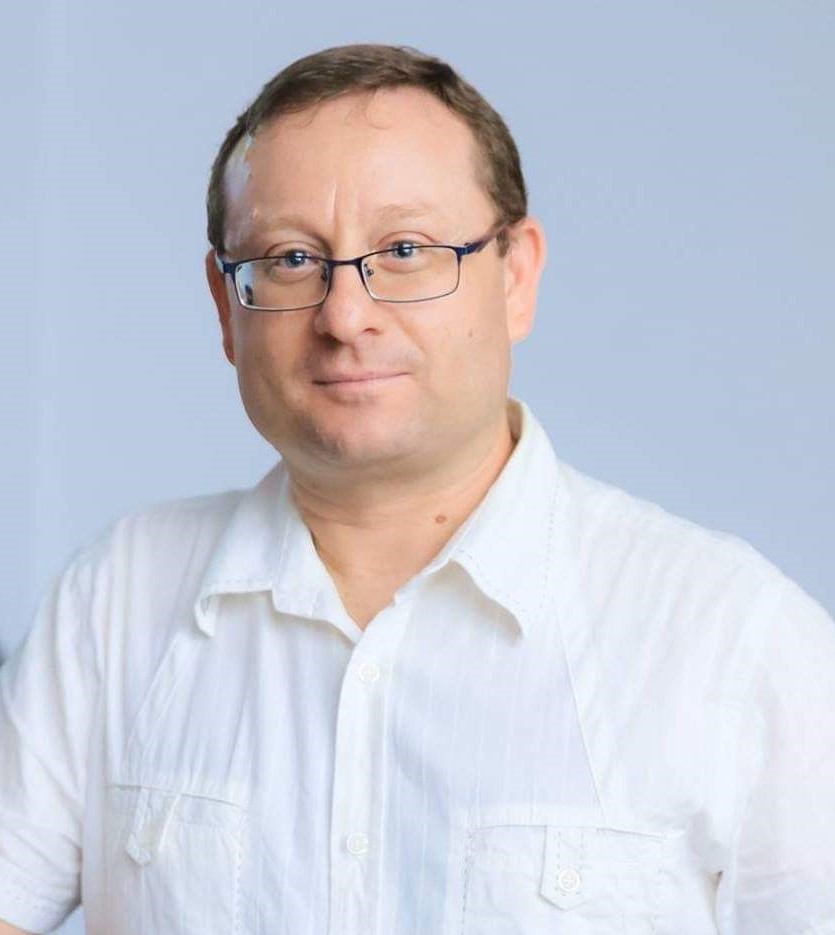
מיכאל עוז שמואלוב

סגן ראשת מנהל לתקציב ורכש

shmuelov@tauex.tau.ac.il

מיכאל עוז שמואלוב

וולפסון הנדסה

חדר 305

03-6408136

גילי בן אליהו-זלצר

תקציבנית

gilib@tauex.tau.ac.il

גילה בן אליהו-זלצר

וולפסון הנדסה

חדר 305

03-6408078

שמרית פרקש

תקציבנית

chshimr168@tauex.tau.ac.il

וולפסון הנדסה

חדר 305


03-6406421

טלי קול

תקציבנית

talyk@tauex.tau.ac.il

וולפסון הנדסה

חדר 305


03-6405390

אולג קגנוביץ'

רכז משק

olegkagan@tauex.tau.ac.il

אולג קגנוביץ'

וולפסון הנדסה

חדר 315א

03-6408175

סיון כזום 

קניינית פקולטית

sivanka@tauex.tau.ac.il

וולפסון הנדסה

חדר 313

03-6407297

לילך שבתאי ורובלבסקי 

קניינית פקולטית
lilachwro@tauex.tau.ac.il

וולפסון הנדסה

חדר 315

03-6409426

איתן מרדכי רוזין

אחראי אינוונטר ושכפול

eitanrozin@tauex.tau.ac.il

איתן מרדכי רוזין

וולפסון הנדסה

חדר 101

03-6407133

גדי מליש

רכז מחסן פקולטי
gadim@tauex.tau.ac.il

וולפסון הנדסה

חדר 102

03-6408175


הקמת פרויקטי תשתית תוך יצירת דו שיח סביבתי

12 ביוני 2019, 18:30 
אולם 011 בניין כיתות הפקולטה להנדסה אוניברסיטת תל אביב  
הקמת פרויקטי תשתית תוך יצירת דו שיח סביבתי

הקמת פרויקטי תשתית תוך יצירת דו שיח סביבתי

הקמת פרויקטי תשתית תוך יצירת דו שיח סביבתי

מקרה בוחן: הולכת הגז הטבעי בישראל

יום רביעי 12.06.19 התכנסות:  18:30-19:15 הרצאה: 19:15-20:30

בפקולטה להנדסה אוניברסיטת תל אביב

מרצה: רחל לוטן מנהלת המחלקה לתכנון סטטוטורי, הסדרת מקרקעין ופיתוח בר קיימא ב"נתיבי הגז הטבעי לישראל בע"מ". 

לפרטים נוספים ולהרשמה לחצו כאן 


במסגרת תכנית המצטיינים הפקולטית

16 מאי 2019
מלגות הצטיינות
ברכות לסטודנטים מהפקולטה להנדסה על שזכו במלגות הצטיינות במסגרת תכנית המצטיינים הפקולטית:
קלי כץ - שנה שלישית מהמחלקה להנדסת חומרים
אלכס סטיליק - שנה שלישית מבית הספר להנדסה מכנית
לי איתן - שנה שלישית מהמחלקה להנדסה תעשייה וניהול

המלגות נתנו באדיבותה של משפחת נגר שהגיעו לביקור מהונג קונג אצלנו בפקולטה.


School of Mechanical Engineering victor troshin

03 ביוני 2019, 14:00 - 15:00 
בניין וולפסון חדר 206  
School of Mechanical Engineering victor troshin


School of Mechanical Engineering Seminar
Monday, June 3, 2019 at 14:00
Wolfson Building of Mechanical Engineering, Room 206


Data-Driven Modeling of Pitching and Plunging Wings in Single and Tandem Configurations in Hovering Flight


Victor Troshin

Academic Advisor:

Prof. Avi Seifert


The presented work addresses the challenges related to the low order dynamic modeling of the fluid domain with immersed moving solid bodies in it. In this work mathematical tools were developed and tested on numerical and experimental data. The ultimate goal of this work was to develop a methodology which enables a real-time flow field estimation based on a small number of sensors. As an example of such a problem, modeling of pitching and plunging wings in single and tandem configurations was chosen. In order to achieve the defined goal, the presented research was carried out in the three following stages:

In the first stage of the research, a proper orthogonal decomposition (POD) methodology for a flow field in a domain with moving boundaries was developed. In the standard POD approach, the properties of the region of the domain which alternatingly occupied by fluid and solid are not defined. Thus, here, prior to the decomposition, the domain with moving or deforming boundaries was mapped to a stationary domain using volume preserving mapping. This mapping was created by combining a transfinite interpolation and volume adjustment algorithm. The algorithm is based on an iterative solution of the Laplace equation with respect to the displacement potential of the grid points. At this stage of the research, the method was validated on CFD simulation of pitching and plunging ellipse in a still fluid.

The main goal of the second stage of the research was to develop a low order model of a heaving airfoil in a still fluid using experimental measurements. This was achieved by modifying and applying the tools developed in the first stage of the study.  The modified POD approach together with a time delay neural network (TDNN) was used to model and predict the flow field evolution using only a couple of low profile load sensors. The neural network estimated the amplitudes of the most energetic modes using four sensory inputs. The modes were calculated using the proper orthogonal decomposition of the flow field data obtained experimentally by time-resolved, phase-locked particle imaging velocimetry (TRPIV). The model showed good estimation quality.

In the final stage of this study, a modeling methodology was implemented on measured flow field data of pitching and plunging wings in a tandem configuration. Here, the velocity field associated with the wings’ flapping motion was mapped and modeled using the previously developed POD approach. The flow field dynamics was approximated by a linear model based on only four POD modes. Since the state of the low order model (i.e. the amplitudes of the modes) is physically impossible to measure, a Kalman filter was implemented. The Kalman filter used the signals from two low-profile strain gauge sensors located at the root of the hindwing to evaluate the reduced-order state of the system. Then, the full state of the system was estimated using the POD approximation. Therefore, by using only two strain sensors’ signals, the complex vortex dynamics associated with the tandem wings motion was successfully modeled.




החל משנת הלמודים הקרובה (תש"פ).

15 מאי 2019
המחלקה להנדסה ביו-רפואה מתרעננת עם תכניות לימוד חדשות עכשוויות

אנו שמחים להציג בפניכם את תוכנית הלימודים החדשה של המחלקה להנדסה ביו-רפואית אשר אושרה להוראה החל משנת הלמודים הקרובה (תש"פ).

בין השינויים בתוכנית החדשה:

  • עיבוי קורסים חובה בתחומי המחשבים ובתחומי מדעי הנתונים כגון: קורס במבנה נתונים, קורס חובה בגנומיקה חישובית וקורס חובה חדש נוסף מבוא למדעי המידע.  
  • הוספת מסלול קורסי בחירה מידע ולמידה ברפואה שיאפשר העמקה בתחומי מדעי הנתונים ולמידת מכונה machine learning ושימושיהם במידע רפואי.


EE Seminar: Deep Radar Detector

19 ביוני 2019, 15:30 
חדר 011, בניין כיתות-חשמל  

Speaker: Daniel Brodeski

M.Sc. student under the supervision of Dr. Raja Giryes


Wednesday, June 19th, 2019 at 15:30

Room 011, Kitot Bldg., Faculty of Engineering


Deep Radar Detector


Abstract

While camera and LiDAR processing have been revolutionized since the introduction of deep learning, radar processing still relies on classical tools. In this work, we introduce a deep learning approach for radar processing, working directly with the radar complex data. To overcome the lack of radar labeled data, we rely in training only on the radar calibration data and introduce new radar augmentation techniques. We evaluate our method on the radar 4D detection task and demonstrate superior performance compared to the classical approaches while keeping real-time performance. Applying deep learning on radar data has several advantages such as eliminating the need for an expensive radar calibration process each time and enabling classification of the detected objects with almost zero-overhead.


EE Seminar: Zero-Shot Linear and Nonlinear Channel Equalization and Decoding using Variational Autoencoders

15 במאי 2019, 15:30 
חדר 011, בניין כיתות-חשמל  


Speaker: Avi Caciularu

M.Sc. student under the supervision of Prof. David Burshtein


Wednesday, May 15th, 2019 at 15:30

Room 011, Kitot Bldg., Faculty of Engineering


Zero-Shot Linear and Nonlinear Channel Equalization and Decoding using Variational Autoencoders


Abstract

A new maximum likelihood estimation approach for zero-shot unsupervised blind channel equalization and decoding, using variational autoencoders (VAEs), is introduced. We first consider the reconstruction of uncoded data symbols transmitted over a noisy intersymbol interference (ISI) channel. Significant and consistent improvements in the error rate of the reconstructed symbols, compared to existing blind equalization methods such as constant modulus equalization, are demonstrated. In fact, for the channels that were examined, the performance of the new VAE equalizer that does not require a pilot signal, was close to the performance of a non-blind adaptive linear minimum mean square error equalizer that requires a pilot signal. The new equalization method enables a significantly lower latency channel acquisition compared to other algorithms. The VAE equalizer uses a convolutional neural network with two layers and a very small number of free parameters. Although the computational complexity of the VAE equalizer is higher compared to CMA, it is still reasonable, and the number of free parameters to estimate is small. The results have also been extended to unsupervised equalization over non-linear channels, and to coded communication using low-density parity-check (LDPC) codes, with substantial improvements compared to baseline methods, e.g. expectation maximization (EM) using Turbo equalization.


EE Seminar: A Framework for Collective Behavior in Plant-Inspired Growth-Driven Systems

20 במאי 2019, 15:00 
חדר 011, בניין כיתות-חשמל  

(The talk will be given in English)


Speaker:     Dr. Yasmine Meroz
                     School of Plant Sciences and Food Security, Tel Aviv University


Monday, May 20th, 2019
15:00 - 16:00

Room 011, Kitot Bldg., Faculty of Engineering


A Framework for Collective Behavior in Plant-Inspired Growth-Driven Systems

Abstract

A variety of biological systems are not motile, but sessile in nature, relying on growth as the main driver of their movement. Groups of such growing organisms can form complex structures, such as the functional architecture of growing axons, or the adaptive structure of plant root systems. These processes are not yet understood, however the decentralized growth dynamics bear similarities to the collective behavior observed in groups of motile organisms, such as flocks of birds or schools of fish. Equivalent growth mechanisms make these systems amenable to a theoretical framework inspired by tropic responses of plants, where growth is considered implicitly as the driver of the observed bending towards a stimulus. We introduce two new concepts related to plant tropisms: point tropism, the response of a plant to a nearby point signal source, and allotropism, the growth-driven response of plant organs to neighboring plants. We first analytically and numerically investigate the 2D dynamics of single organs responding to point signals fixed in space. Building on this we study pairs of organs interacting via allotropism, i.e. each organ senses signals emitted at the tip of their neighbor and responds accordingly. In the case of local sensing we find a rich phase space. This work sets the stage towards a theoretical framework for the investigation and understanding of systems of interacting growth-driven individuals.

https://www.biorxiv.org/content/10.1101/566364v1


סמינר מחלקה אלקטרוניקה פיזיקאלית: Artem Volosniev

28 במאי 2019, 11:00 
פקולטה להנדסה, בניין כיתות, חדר 011  
סמינר מחלקה אלקטרוניקה פיזיקאלית: Artem Volosniev

ארטם סמינר

You are invited to attend a department seminar

Impurity atoms in one-dimensional Bose gases
By:
Artem Volosniev
TU Darmstadt (Germany)

Abstract

 The subject of this study are impurity atoms immersed in an environment. The purpose is to understand/calculate properties of these atoms. Particularly interesting are their self-energies and masses, the latter are usually larger than masses of bare atoms due to the “dress” of low-energy excitations of the environment. Another question of the study is the impurity-impurity interaction. Impurities in the environment often attract one another stronger than in free space, which may drastically change properties of the system.
 In the talk, I will present a polaron-like effective description of an atom in a Bose gas,  and address the possibility of testing this description in experiments with cold atoms. Furthermore, I will discuss properties of two impurity atoms. The impurities attract each other, because their energy is lowered when they share the same distortion of the Bose gas. Therefore, even if atoms do not interact in free space they form a bound state when immersed in a Bose gas [any attractive interaction in one spatial dimension leads to a bound state, which, however, can be very shallow]. This can potentially be used in the future as an experimental signature of the induced attraction mediated by the Bose gas.


On Thursday, May 23, 2019, 15:00

Room 011, EE-Class Building

סמינר מחלקה אלקטרוניקה פיזיקאלית: Sergey Kolen

28 במאי 2019, 15:00 
פקולטה להנדסה, בניין כיתות, חדר 011  
סמינר מחלקה אלקטרוניקה פיזיקאלית: Sergey Kolen

סרגיי סמינר

You are invited to attend a department seminar

VOLUMETRIC 3D-PRINTED ANTENNAS, MANUFACTURED VIA SELECTIVE POLYMER METTALIZATION

By:

Sergey Kolen
MSc student under the supervision of Prof. Pavel Ginzburg

Abstract

Additive manufacturing paves new ways to the efficient exploration of the third space dimension, providing advantages over conventional planar architectures. In particular, volumetric electromagnetic antennas can demonstrate superior characteristics, outperforming their planar counterparts. Here a new approach to the fabrication of electromagnetic devices is developed and applied to antennas, implemented on curved surfaces. Highly directive and broadband antennas are 3D‐printed on hemispherical supports. The antenna skeleton and the support are simultaneously printed with different polymer materials – PLA mixed with graphene flakes and pure PLA, respectively. Weakly DC‐conductive graphene PLA‐based skeleton is post‐processed and high‐quality conductive copper layer is selectively electrochemically deposited on it. The antenna devices are found to demonstrate radiation performance, similar to that achievable with conventional fabrication approaches. However, additive manufacturing of RF antennas provides superior capabilities of constructing tailor‐made devices with properties, pre‐defined by non‐standardized end users.

On Tuesday, May 28, 2019, 15:00
Room 011, EE-Class Building

עמודים

אוניברסיטת תל אביב עושה כל מאמץ לכבד זכויות יוצרים. אם בבעלותך זכויות יוצרים בתכנים שנמצאים פה ו/או השימוש שנעשה בתכנים אלה לדעתך מפר זכויות
שנעשה בתכנים אלה לדעתך מפר זכויות נא לפנות בהקדם לכתובת שכאן >>